[English] 日本語
Yorodumi Papers
- Database of articles cited by EMDB/PDB/SASBDB data -

+
Search query

Keywords
Structure methods
Author
Journal
IF

-
Structure paper

TitleMyeloperoxidase transforms chromatin into neutrophil extracellular traps.
Journal, issue, pagesNature, Vol. 647, Issue 8090, Page 747-756, Year 2025
Publish dateSep 17, 2025
AuthorsGarth Lawrence Burn / Tobias Raisch / Sebastian Tacke / Moritz Winkler / Daniel Prumbaum / Stephanie Thee / Niclas Gimber / Stefan Raunser / Arturo Zychlinsky /
PubMed AbstractNeutrophils, the most abundant and biotoxic immune cells, extrude nuclear DNA into the extracellular space to maintain homeostasis. Termed neutrophil extracellular traps (NETs), these protein- ...Neutrophils, the most abundant and biotoxic immune cells, extrude nuclear DNA into the extracellular space to maintain homeostasis. Termed neutrophil extracellular traps (NETs), these protein-modified and decondensed extracellular DNA scaffolds control infection and are involved in coagulation, autoimmunity and cancer. Here we show how myeloperoxidase (MPO), a highly expressed neutrophil protein, disassembles nucleosomes, thereby facilitating NET formation, yet also binds stably to NETs extracellularly. We describe how the oligomeric status of MPO governs both outcomes. MPO dimers interact with nucleosomal DNA using one protomer and concurrently dock into the nucleosome acidic patch with the other protomer. As a consequence, dimeric MPO displaces DNA from the core complex, culminating in nucleosome disassembly. On the other hand, MPO monomers stably interact with the nucleosome acidic patch without making concomitant DNA contacts, explaining how monomeric MPO binds to and licences NETs to confer hypohalous acid production in the extracellular space. Our data demonstrate that the binding of MPO to chromatin is governed by specific molecular interactions that transform chromatin into a non-replicative, non-encoding state that offers new biological functions in a cell-free manner. We propose that MPO is, to our knowledge, the first member of a class of proteins that convert chromatin into an immune effector.
External linksNature / PubMed:40963017 / PubMed Central
MethodsEM (single particle)
Resolution2.79 - 3.99 Å
Structure data

EMDB-51295, PDB-9gen:
Recombinant Myeloperoxidase bound to nucleosome core particle
Method: EM (single particle) / Resolution: 3.76 Å

EMDB-51296, PDB-9geo:
Nucleosome core particle
Method: EM (single particle) / Resolution: 2.79 Å

EMDB-51297, PDB-9gep:
Native monomeric Myeloperoxidase bound to nucleosome core particle
Method: EM (single particle) / Resolution: 2.89 Å

EMDB-51298: Native dimeric Myeloperoxidase bound to nucleosome core particle; nucleosome focused map
Method: EM (single particle) / Resolution: 3.01 Å

EMDB-51299: Native dimeric Myeloperoxidase bound to nucleosome core particle; MPO focused map
Method: EM (single particle) / Resolution: 2.98 Å

EMDB-51300: Native dimeric Myeloperoxidase bound to nucleosome core particle; consensus map
Method: EM (single particle) / Resolution: 3.12 Å

EMDB-51301, PDB-9geq:
Native dimeric Myeloperoxidase bound to nucleosome core particle; composite map
Method: EM (single particle) / Resolution: 3.12 Å

EMDB-51302: Native dimeric Myeloperoxidase bound to nucleosome core particle, intermediate state, nucleosome focused map
Method: EM (single particle) / Resolution: 3.52 Å

EMDB-51303: Native dimeric Myeloperoxidase bound to nucleosome core particle, intermediate state, map focused on MPO
Method: EM (single particle) / Resolution: 3.87 Å

EMDB-51304: Native dimeric Myeloperoxidase bound to nucleosome core particle, intermediate state, consensus map
Method: EM (single particle) / Resolution: 3.58 Å

EMDB-51305, PDB-9ger:
Native dimeric Myeloperoxidase bound to nucleosome core particle, intermediate state; composite map
Method: EM (single particle) / Resolution: 3.58 Å

EMDB-51306: Native monomeric Myeloperoxidase bound to nucleosome core particle, late time point
Method: EM (single particle) / Resolution: 3.99 Å

EMDB-52865, PDB-9ihd:
Nucleosome core particle bound by one molecule of DTT-reduced native monomeric myeloperoxidase
Method: EM (single particle) / Resolution: 2.97 Å

EMDB-52866, PDB-9ihe:
Nucleosome core particle bound by two molecules of DTT-reduced native monomeric myeloperoxidase
Method: EM (single particle) / Resolution: 2.95 Å

EMDB-52867: Nucleosome core particle bound by one monomer and one dimer of of DTT-reduced native myeloperoxidase; map focused on nucleosome/MPO monomer
Method: EM (single particle) / Resolution: 3.13 Å

EMDB-52868: Nucleosome core particle bound by one monomer and one dimer of of DTT-reduced native myeloperoxidase; map focused on MPO dimer
Method: EM (single particle) / Resolution: 3.17 Å

EMDB-52869: Nucleosome core particle bound by one monomer and one dimer of of DTT-reduced native myeloperoxidase; consensus map
Method: EM (single particle) / Resolution: 3.16 Å

EMDB-52870, PDB-9ihf:
Nucleosome core particle bound by one monomer and one dimer of of DTT-reduced native myeloperoxidase
Method: EM (single particle) / Resolution: 3.16 Å

Chemicals

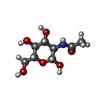
ChemComp-NAG:
2-acetamido-2-deoxy-beta-D-glucopyranose

ChemComp-HOH:
WATER

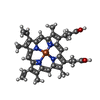
ChemComp-HEM:
PROTOPORPHYRIN IX CONTAINING FE

ChemComp-CL:
Unknown entry

ChemComp-CA:
Unknown entry

Source
  • homo sapiens (human)
  • xenopus laevis (African clawed frog)
  • synthetic construct (others)
KeywordsIMMUNE SYSTEM / Peroxidase / innate immunity / histone / acidic patch / NUCLEAR PROTEIN / NETs

+
About Yorodumi Papers

-
News

-
Feb 9, 2022. New format data for meta-information of EMDB entries

New format data for meta-information of EMDB entries

  • Version 3 of the EMDB header file is now the official format.
  • The previous official version 1.9 will be removed from the archive.

Related info.:EMDB header

External links:wwPDB to switch to version 3 of the EMDB data model

-
Aug 12, 2020. Covid-19 info

Covid-19 info

URL: https://pdbj.org/emnavi/covid19.php

New page: Covid-19 featured information page in EM Navigator.

Related info.:Covid-19 info / Mar 5, 2020. Novel coronavirus structure data

+
Mar 5, 2020. Novel coronavirus structure data

Novel coronavirus structure data

Related info.:Yorodumi Speices / Aug 12, 2020. Covid-19 info

External links:COVID-19 featured content - PDBj / Molecule of the Month (242):Coronavirus Proteases

+
Jan 31, 2019. EMDB accession codes are about to change! (news from PDBe EMDB page)

EMDB accession codes are about to change! (news from PDBe EMDB page)

  • The allocation of 4 digits for EMDB accession codes will soon come to an end. Whilst these codes will remain in use, new EMDB accession codes will include an additional digit and will expand incrementally as the available range of codes is exhausted. The current 4-digit format prefixed with “EMD-” (i.e. EMD-XXXX) will advance to a 5-digit format (i.e. EMD-XXXXX), and so on. It is currently estimated that the 4-digit codes will be depleted around Spring 2019, at which point the 5-digit format will come into force.
  • The EM Navigator/Yorodumi systems omit the EMD- prefix.

Related info.:Q: What is EMD? / ID/Accession-code notation in Yorodumi/EM Navigator

External links:EMDB Accession Codes are Changing Soon! / Contact to PDBj

+
Jul 12, 2017. Major update of PDB

Major update of PDB

  • wwPDB released updated PDB data conforming to the new PDBx/mmCIF dictionary.
  • This is a major update changing the version number from 4 to 5, and with Remediation, in which all the entries are updated.
  • In this update, many items about electron microscopy experimental information are reorganized (e.g. em_software).
  • Now, EM Navigator and Yorodumi are based on the updated data.

External links:wwPDB Remediation / Enriched Model Files Conforming to OneDep Data Standards Now Available in the PDB FTP Archive

-
Yorodumi Papers

Database of articles cited by EMDB/PDB/SASBDB data

  • Database of articles cited by EMDB, PDB, and SASBDB entries
  • Using PubMed data

Related info.:EMDB / PDB / SASBDB / Yorodumi / EMN Papers / Changes in new EM Navigator and Yorodumi

Read more