 Movie
Movie Controller
 Structure viewers
 About Yorodumi Papers


+Search query
-Structure paper
| Title | Growth of complete ammonia oxidizers on guanidine. |
|---|---|
| Journal, issue, pages | Nature, Vol. 633, Issue 8030, Page 646-653, Year 2024 |
| Publish date | Aug 14, 2024 |
 Authors Authors | Marton Palatinszky / Craig W Herbold / Christopher J Sedlacek / Dominic Pühringer / Katharina Kitzinger / Andrew T Giguere / Kenneth Wasmund / Per H Nielsen / Morten K D Dueholm / Nico Jehmlich / Richard Gruseck / Anton Legin / Julius Kostan / Nesrete Krasnici / Claudia Schreiner / Johanna Palmetzhofer / Thilo Hofmann / Michael Zumstein / Kristina Djinović-Carugo / Holger Daims / Michael Wagner /       |
| PubMed Abstract | Guanidine is a chemically stable nitrogen compound that is excreted in human urine and is widely used in manufacturing of plastics, as a flame retardant and as a component of propellants, and is well ...Guanidine is a chemically stable nitrogen compound that is excreted in human urine and is widely used in manufacturing of plastics, as a flame retardant and as a component of propellants, and is well known as a protein denaturant in biochemistry. Guanidine occurs widely in nature and is used by several microorganisms as a nitrogen source, but microorganisms growing on guanidine as the only substrate have not yet been identified. Here we show that the complete ammonia oxidizer (comammox) Nitrospira inopinata and probably most other comammox microorganisms can grow on guanidine as the sole source of energy, reductant and nitrogen. Proteomics, enzyme kinetics and the crystal structure of a N. inopinata guanidinase homologue demonstrated that it is a bona fide guanidinase. Incubation experiments with comammox-containing agricultural soil and wastewater treatment plant microbiomes suggested that guanidine serves as substrate for nitrification in the environment. The identification of guanidine as a growth substrate for comammox shows an unexpected niche of these globally important nitrifiers and offers opportunities for their isolation. |
 External links External links | Nature / PubMed:39143220 / PubMed Central |
| Methods | EM (single particle) / X-ray diffraction |
| Resolution | 1.58 - 3.1 Å |
| Structure data |  EMDB-56607: CryoEM structure of guanidinase from Nitrospira inopinata 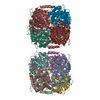 PDB-9fek: |
| Chemicals |  ChemComp-SO4:  ChemComp-MN:  ChemComp-NI:  ChemComp-HOH: |
| Source |
|
 Keywords Keywords | METAL BINDING PROTEIN / comammox / guanidine / guanidinase / complete ammonia oxidizer |
 candidatus nitrospira inopinata (bacteria)