[English] 日本語
Yorodumi Papers
- Database of articles cited by EMDB/PDB/SASBDB data -

+
Search query

Keywords
Structure methods
Author
Journal
IF

-
Structure paper

TitleCommensal gut bacteria employ de-chelatase HmuS to harvest iron from heme.
Journal, issue, pagesEMBO J, Vol. 44, Issue 21, Page 6226-6252, Year 2025
Publish dateSep 12, 2025
AuthorsArnab Kumar Nath / Ronivaldo Rodrigues da Silva / Colin C Gauvin / Emmanuel Akpoto / Mensur Dlakić / C Martin Lawrence / Jennifer L DuBois /
PubMed AbstractIron is essential for almost all organisms, which have evolved different strategies for ensuring a sufficient supply from their environment and using it in different forms, including heme. The hmu ...Iron is essential for almost all organisms, which have evolved different strategies for ensuring a sufficient supply from their environment and using it in different forms, including heme. The hmu operon, primarily found in Bacteroidota and ubiquitous in gastrointestinal tract metagenomes of healthy humans, encodes proteins involved in heme acquisition. Here, we provide direct physiological, biochemical, and structural evidence for the anaerobic removal of iron from heme by HmuS, a membrane-bound, NADH-dependent de-chelatase that deconstructs heme to protoporphyrin IX (PPIX) and Fe(II). Heme can serve as the sole iron source for the model gastrointestinal bacterium Bacteroidetes thetaiotaomicron, when active HmuS is present. Heterologously expressed HmuS was isolated with bound heme molecules under saturating conditions. Its cryo-EM structure at 2.6 Å resolution revealed binding of heme and a pair of cations at distant sites. These sites are conserved across the HmuS family and chelatase superfamily, respectively. The proposed structure-based mechanism for iron removal by HmuS is chemically analogous to the chelatases in both unrelated heme biosynthetic pathways and homologous enzymes in the biosynthetic pathways for chlorophyll and vitamin B12, although the reaction proceeds in the opposite direction. Taken together, our study identifies a widespread mechanism via which anaerobic bacteria can extract nutritional iron from heme.
External linksEMBO J / PubMed:40940422 / PubMed Central
MethodsEM (single particle)
Resolution2.55 - 2.6 Å
Structure data

EMDB-46483, PDB-9d26:
A widespread heme dechelatase in healthy and pathogenic human microbiomes.
Method: EM (single particle) / Resolution: 2.6 Å

EMDB-71280, PDB-9p4s:
HmuS heme dechelatase: disordered domain 1, heme free.
Method: EM (single particle) / Resolution: 2.55 Å

Chemicals

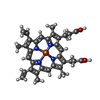
ChemComp-HEM:
PROTOPORPHYRIN IX CONTAINING FE

ChemComp-NA:
Unknown entry

ChemComp-HOH:
WATER

Source
  • bacteroides thetaiotaomicron (bacteria)

  • bacteroides (bacteria)
KeywordsMETAL TRANSPORT / Iron / Microbiome / Heme

+
About Yorodumi Papers

-
News

-
Feb 9, 2022. New format data for meta-information of EMDB entries

New format data for meta-information of EMDB entries

  • Version 3 of the EMDB header file is now the official format.
  • The previous official version 1.9 will be removed from the archive.

Related info.:EMDB header

External links:wwPDB to switch to version 3 of the EMDB data model

-
Aug 12, 2020. Covid-19 info

Covid-19 info

URL: https://pdbj.org/emnavi/covid19.php

New page: Covid-19 featured information page in EM Navigator.

Related info.:Covid-19 info / Mar 5, 2020. Novel coronavirus structure data

+
Mar 5, 2020. Novel coronavirus structure data

Novel coronavirus structure data

Related info.:Yorodumi Speices / Aug 12, 2020. Covid-19 info

External links:COVID-19 featured content - PDBj / Molecule of the Month (242):Coronavirus Proteases

+
Jan 31, 2019. EMDB accession codes are about to change! (news from PDBe EMDB page)

EMDB accession codes are about to change! (news from PDBe EMDB page)

  • The allocation of 4 digits for EMDB accession codes will soon come to an end. Whilst these codes will remain in use, new EMDB accession codes will include an additional digit and will expand incrementally as the available range of codes is exhausted. The current 4-digit format prefixed with “EMD-” (i.e. EMD-XXXX) will advance to a 5-digit format (i.e. EMD-XXXXX), and so on. It is currently estimated that the 4-digit codes will be depleted around Spring 2019, at which point the 5-digit format will come into force.
  • The EM Navigator/Yorodumi systems omit the EMD- prefix.

Related info.:Q: What is EMD? / ID/Accession-code notation in Yorodumi/EM Navigator

External links:EMDB Accession Codes are Changing Soon! / Contact to PDBj

+
Jul 12, 2017. Major update of PDB

Major update of PDB

  • wwPDB released updated PDB data conforming to the new PDBx/mmCIF dictionary.
  • This is a major update changing the version number from 4 to 5, and with Remediation, in which all the entries are updated.
  • In this update, many items about electron microscopy experimental information are reorganized (e.g. em_software).
  • Now, EM Navigator and Yorodumi are based on the updated data.

External links:wwPDB Remediation / Enriched Model Files Conforming to OneDep Data Standards Now Available in the PDB FTP Archive

-
Yorodumi Papers

Database of articles cited by EMDB/PDB/SASBDB data

  • Database of articles cited by EMDB, PDB, and SASBDB entries
  • Using PubMed data

Related info.:EMDB / PDB / SASBDB / Yorodumi / EMN Papers / Changes in new EM Navigator and Yorodumi

Read more