[English] 日本語
Yorodumi Papers
- Database of articles cited by EMDB/PDB/SASBDB data -

+
Search query

Keywords
Structure methods
Author
Journal
IF

-
Structure paper

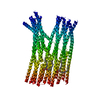
TitleMolecular basis of TMED9 oligomerization and entrapment of misfolded protein cargo in the early secretory pathway.
Journal, issue, pagesSci Adv, Vol. 10, Issue 38, Page eadp2221, Year 2024
Publish dateSep 20, 2024
AuthorsLe Xiao / Xiong Pi / Alissa C Goss / Tarick El-Baba / Julian F Ehrmann / Elizabeth Grinkevich / Silvana Bazua-Valenti / Valeria Padovano / Seth L Alper / Dominique Carey / Namrata D Udeshi / Steven A Carr / Juan Lorenzo Pablo / Carol V Robinson / Anna Greka / Hao Wu /
PubMed AbstractIntracellular accumulation of misfolded proteins causes serious human proteinopathies. The transmembrane emp24 domain 9 (TMED9) cargo receptor promotes a general mechanism of cytotoxicity by ...Intracellular accumulation of misfolded proteins causes serious human proteinopathies. The transmembrane emp24 domain 9 (TMED9) cargo receptor promotes a general mechanism of cytotoxicity by entrapping misfolded protein cargos in the early secretory pathway. However, the molecular basis for this TMED9-mediated cargo retention remains elusive. Here, we report cryo-electron microscopy structures of TMED9, which reveal its unexpected self-oligomerization into octamers, dodecamers, and, by extension, even higher-order oligomers. The TMED9 oligomerization is driven by an intrinsic symmetry mismatch between the trimeric coiled coil domain and the tetrameric transmembrane domain. Using frameshifted Mucin 1 as an example of aggregated disease-related protein cargo, we implicate a mode of direct interaction with the TMED9 luminal Golgi-dynamics domain. The structures suggest and we confirm that TMED9 oligomerization favors the recruitment of coat protein I (COPI), but not COPII coatomers, facilitating retrograde transport and explaining the observed cargo entrapment. Our work thus reveals a molecular basis for TMED9-mediated misfolded protein retention in the early secretory pathway.
External linksSci Adv / PubMed:39303030 / PubMed Central
MethodsEM (single particle)
Resolution3.7 - 5.5 Å
Structure data

EMDB-45634, PDB-9cjk:
Human TMED9 octamer structure
Method: EM (single particle) / Resolution: 3.7 Å

EMDB-45635, PDB-9cjl:
Molecular basis of TMED9 dodecamer
Method: EM (single particle) / Resolution: 5.5 Å

Chemicals


ChemComp, No image

ChemComp-9ED:
Unknown entry

Source
  • homo sapiens (human)
KeywordsPROTEIN TRANSPORT / tmed9 / misfolded protein / secretory pathway / Cryo-EM

+
About Yorodumi Papers

-
News

-
Feb 9, 2022. New format data for meta-information of EMDB entries

New format data for meta-information of EMDB entries

  • Version 3 of the EMDB header file is now the official format.
  • The previous official version 1.9 will be removed from the archive.

Related info.:EMDB header

External links:wwPDB to switch to version 3 of the EMDB data model

-
Aug 12, 2020. Covid-19 info

Covid-19 info

URL: https://pdbj.org/emnavi/covid19.php

New page: Covid-19 featured information page in EM Navigator.

Related info.:Covid-19 info / Mar 5, 2020. Novel coronavirus structure data

+
Mar 5, 2020. Novel coronavirus structure data

Novel coronavirus structure data

Related info.:Yorodumi Speices / Aug 12, 2020. Covid-19 info

External links:COVID-19 featured content - PDBj / Molecule of the Month (242):Coronavirus Proteases

+
Jan 31, 2019. EMDB accession codes are about to change! (news from PDBe EMDB page)

EMDB accession codes are about to change! (news from PDBe EMDB page)

  • The allocation of 4 digits for EMDB accession codes will soon come to an end. Whilst these codes will remain in use, new EMDB accession codes will include an additional digit and will expand incrementally as the available range of codes is exhausted. The current 4-digit format prefixed with “EMD-” (i.e. EMD-XXXX) will advance to a 5-digit format (i.e. EMD-XXXXX), and so on. It is currently estimated that the 4-digit codes will be depleted around Spring 2019, at which point the 5-digit format will come into force.
  • The EM Navigator/Yorodumi systems omit the EMD- prefix.

Related info.:Q: What is EMD? / ID/Accession-code notation in Yorodumi/EM Navigator

External links:EMDB Accession Codes are Changing Soon! / Contact to PDBj

+
Jul 12, 2017. Major update of PDB

Major update of PDB

  • wwPDB released updated PDB data conforming to the new PDBx/mmCIF dictionary.
  • This is a major update changing the version number from 4 to 5, and with Remediation, in which all the entries are updated.
  • In this update, many items about electron microscopy experimental information are reorganized (e.g. em_software).
  • Now, EM Navigator and Yorodumi are based on the updated data.

External links:wwPDB Remediation / Enriched Model Files Conforming to OneDep Data Standards Now Available in the PDB FTP Archive

-
Yorodumi Papers

Database of articles cited by EMDB/PDB/SASBDB data

  • Database of articles cited by EMDB, PDB, and SASBDB entries
  • Using PubMed data

Related info.:EMDB / PDB / SASBDB / Yorodumi / EMN Papers / Changes in new EM Navigator and Yorodumi

Read more