[English] 日本語
Yorodumi Papers
- Database of articles cited by EMDB/PDB/SASBDB data -

+
Search query

Keywords
Structure methods
Author
Journal
IF

-
Structure paper

TitleTransport and inhibition mechanism for VMAT2-mediated synaptic vesicle loading of monoamines.
Journal, issue, pagesCell Res, Vol. 34, Issue 1, Page 47-57, Year 2024
Publish dateJan 2, 2024
AuthorsYuwei Wang / Pei Zhang / Yulin Chao / Zhini Zhu / Chuanhui Yang / Zixuan Zhou / Yaohui Li / Yonghui Long / Yuehua Liu / Dianfan Li / Sheng Wang / Qianhui Qu /
PubMed AbstractMonoamine neurotransmitters such as serotonin and dopamine are loaded by vesicular monoamine transporter 2 (VMAT2) into synaptic vesicles for storage and subsequent release in neurons. Impaired VMAT2 ...Monoamine neurotransmitters such as serotonin and dopamine are loaded by vesicular monoamine transporter 2 (VMAT2) into synaptic vesicles for storage and subsequent release in neurons. Impaired VMAT2 function underlies various neuropsychiatric diseases. VMAT2 inhibitors reserpine and tetrabenazine are used to treat hypertension, movement disorders associated with Huntington's Disease and Tardive Dyskinesia. Despite its physiological and pharmacological significance, the structural basis underlying VMAT2 substrate recognition and its inhibition by various inhibitors remains unknown. Here we present cryo-EM structures of human apo VMAT2 in addition to states bound to serotonin, tetrabenazine, and reserpine. These structures collectively capture three states, namely the lumen-facing, occluded, and cytosol-facing conformations. Notably, tetrabenazine induces a substantial rearrangement of TM2 and TM7, extending beyond the typical rocker-switch movement. These functionally dynamic snapshots, complemented by biochemical analysis, unveil the essential components responsible for ligand recognition, elucidate the proton-driven exchange cycle, and provide a framework to design improved pharmaceutics targeting VMAT2.
External linksCell Res / PubMed:38163846 / PubMed Central
MethodsEM (single particle)
Resolution3.37 - 3.74 Å
Structure data

EMDB-37621, PDB-8wlj:
Cryo-EM structure of human apo VMAT2 with nanobody in an outward-facing conformation
Method: EM (single particle) / Resolution: 3.6 Å

EMDB-37622, PDB-8wlk:
Cryo-EM structure of human VMAT2 in presence of Tetrabenazine, determined in an outward-facing conformation
Method: EM (single particle) / Resolution: 3.37 Å

EMDB-37623, PDB-8wll:
Cryo-EM structure of human VMAT2 Y422C, in the presence of reserpine, determined in an inward-facing conformation
Method: EM (single particle) / Resolution: 3.74 Å

EMDB-37624, PDB-8wlm:
Cryo-EM structure of human VMAT2 in presence of 5-HT, determined in an outward-facing conformation
Method: EM (single particle) / Resolution: 3.57 Å

Chemicals

ChemComp-EBZ:
(3S,5R,11bS)-9,10-dimethoxy-3-(2-methylpropyl)-1,3,4,6,7,11b-hexahydro-2H-pyrido[2,1-a]isoquinolin-2-one

ChemComp-YHR:
reserpine

ChemComp-SRO:
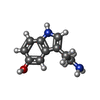
SEROTONIN / neurotransmitter*YM

Source
  • homo sapiens (human)
  • vicugna pacos (alpaca)
KeywordsTRANSPORT PROTEIN/IMMUNE SYSTEM / Human VMAT2 / outward-facing conformation / TRANSPORT PROTEIN / TRANSPORT PROTEIN-IMMUNE SYSTEM complex / Tetrabenazine / Human VMAT2 Y422C / reserpine / Inward-facing conformation / 5-HT

+
About Yorodumi Papers

-
News

-
Feb 9, 2022. New format data for meta-information of EMDB entries

New format data for meta-information of EMDB entries

  • Version 3 of the EMDB header file is now the official format.
  • The previous official version 1.9 will be removed from the archive.

Related info.:EMDB header

External links:wwPDB to switch to version 3 of the EMDB data model

-
Aug 12, 2020. Covid-19 info

Covid-19 info

URL: https://pdbj.org/emnavi/covid19.php

New page: Covid-19 featured information page in EM Navigator.

Related info.:Covid-19 info / Mar 5, 2020. Novel coronavirus structure data

+
Mar 5, 2020. Novel coronavirus structure data

Novel coronavirus structure data

Related info.:Yorodumi Speices / Aug 12, 2020. Covid-19 info

External links:COVID-19 featured content - PDBj / Molecule of the Month (242):Coronavirus Proteases

+
Jan 31, 2019. EMDB accession codes are about to change! (news from PDBe EMDB page)

EMDB accession codes are about to change! (news from PDBe EMDB page)

  • The allocation of 4 digits for EMDB accession codes will soon come to an end. Whilst these codes will remain in use, new EMDB accession codes will include an additional digit and will expand incrementally as the available range of codes is exhausted. The current 4-digit format prefixed with “EMD-” (i.e. EMD-XXXX) will advance to a 5-digit format (i.e. EMD-XXXXX), and so on. It is currently estimated that the 4-digit codes will be depleted around Spring 2019, at which point the 5-digit format will come into force.
  • The EM Navigator/Yorodumi systems omit the EMD- prefix.

Related info.:Q: What is EMD? / ID/Accession-code notation in Yorodumi/EM Navigator

External links:EMDB Accession Codes are Changing Soon! / Contact to PDBj

+
Jul 12, 2017. Major update of PDB

Major update of PDB

  • wwPDB released updated PDB data conforming to the new PDBx/mmCIF dictionary.
  • This is a major update changing the version number from 4 to 5, and with Remediation, in which all the entries are updated.
  • In this update, many items about electron microscopy experimental information are reorganized (e.g. em_software).
  • Now, EM Navigator and Yorodumi are based on the updated data.

External links:wwPDB Remediation / Enriched Model Files Conforming to OneDep Data Standards Now Available in the PDB FTP Archive

-
Yorodumi Papers

Database of articles cited by EMDB/PDB/SASBDB data

  • Database of articles cited by EMDB, PDB, and SASBDB entries
  • Using PubMed data

Related info.:EMDB / PDB / SASBDB / Yorodumi / EMN Papers / Changes in new EM Navigator and Yorodumi

Read more