 Movie
Movie Controller
 Structure viewers
 About Yorodumi Papers


+Search query
-Structure paper
| Title | Reconstruction of the ancient cyanobacterial proto-circadian clock system KaiABC. |
|---|---|
| Journal, issue, pages | EMBO J, Vol. 44, Issue 10, Page 3025-3046, Year 2025 |
| Publish date | Apr 10, 2025 |
 Authors Authors | Silin Li / Zengxuan Zhou / Yufeng Wan / Xudong Jia / Peiliang Wang / Yu Wang / Taisen Zuo / He Cheng / Xiaoting Fang / Shuqi Dong / Jun He / Yilin Yang / Yichen Xu / Shaoxuan Fu / Xujing Wang / Ximing Qin / Qiguang Xie / Xiaodong Xu / Yuwei Zhao / Dan Liang / Peng Zhang / Qinfen Zhang / Jinhu Guo /   |
| PubMed Abstract | Earlier in its history, the Earth used to spin faster than it does today. How ancient organisms adapted to the short day/night cycles during that time remains unclear. In this study we reconstruct ...Earlier in its history, the Earth used to spin faster than it does today. How ancient organisms adapted to the short day/night cycles during that time remains unclear. In this study we reconstruct and analyse the ancient circadian clock system KaiABC (anKaiABC) of cyanobacteria that existed ~0.95 billion years ago, when the daily light/dark cycle was ~18 h-long. Compared to their contemporary counterparts, anKaiABC proteins had different structures and interactions. The kinase, phosphatase, and adenosine triphosphatase (ATPase) activities of anKaiC were lower, while the anKaiA and anKaiB proteins were less effective at regulating the KaiC/anKaiC phosphorylation status. We provide evidence indicating that the anKaiABC system does not endogenously oscillate, but it can be entrained by an 18 h-long light/dark cycle. A Synechococcus strain expressing ankaiABC genes exhibits better adaptation to 9-h light/9-h dark cycles (LD9:9) that mimic the ancient 18-h day/night cycles, whereas the kaiABC-expressing strain preferentially adapts to the LD12:12 contemporary conditions. These findings suggest that, despite its lack of self-sustaining circadian oscillation, the proto-circadian system may have mediated adaptation of ancient cyanobacteria to the 18 h-long light/dark cycles present 0.95 billion years ago. |
 External links External links | EMBO J / PubMed:40210722 / PubMed Central |
| Methods | EM (single particle) |
| Resolution | 2.51 Å |
| Structure data | EMDB-36461, PDB-8jon: |
| Chemicals | 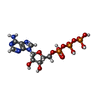 ChemComp-ATP:  ChemComp-MG: 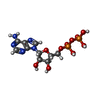 ChemComp-ADP: |
| Source |
|
 Keywords Keywords | BIOSYNTHETIC PROTEIN / circadian clock protein / Synthetic protein / KaiC |


 synechococcus elongatus (strain atcc 33912 / pcc 7942 / fachb-805) (bacteria)