- EMDB-36461: Structure of a synthetic circadian clock protein KaiC mutant of c... -
+
Open data
ID or keywords:
Loading...
-
Basic information
Entry
Database: EMDB / ID: EMD-36461
Title
Structure of a synthetic circadian clock protein KaiC mutant of cyanobacteria Synechococcus elongatus PCC 7942
Map data
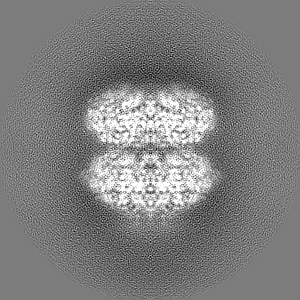
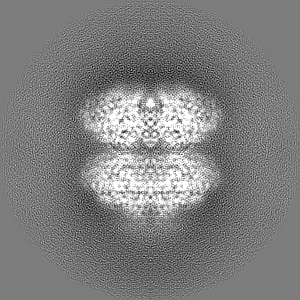
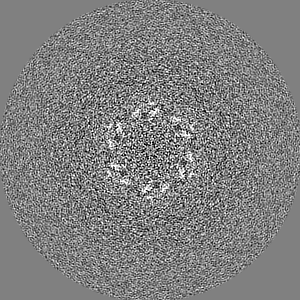
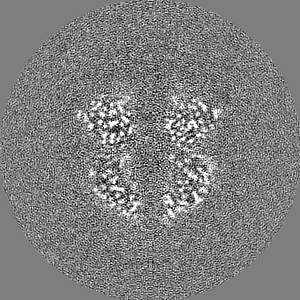
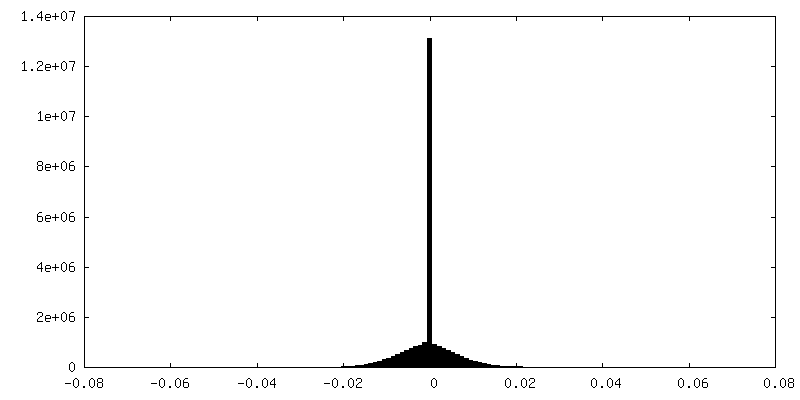
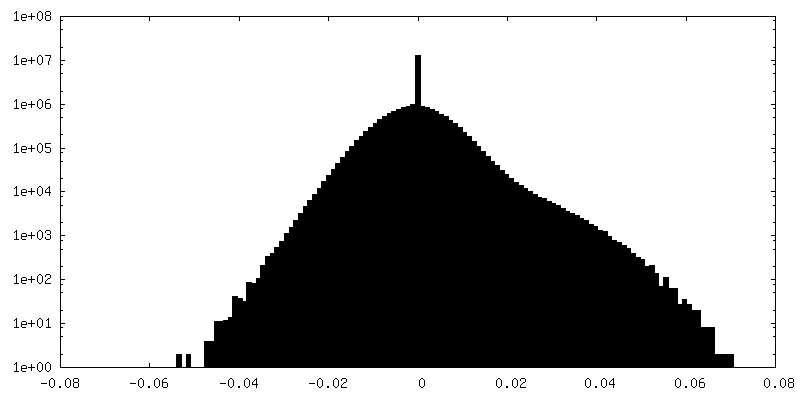
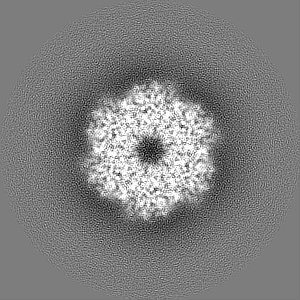
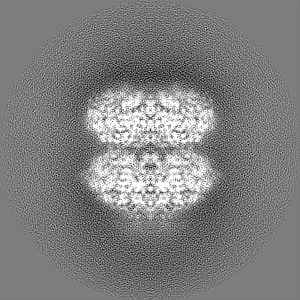
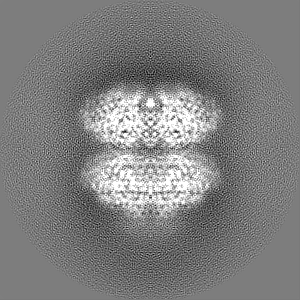
Cryo-EM map of anKaiC
Sample
Complex: Synthetic KaiC protein.
Protein or peptide: Circadian clock oscillator protein KaiC
Ligand: ADENOSINE-5'-TRIPHOSPHATE
Ligand: MAGNESIUM ION
Ligand: ADENOSINE-5'-DIPHOSPHATE
Keywords
circadian clock protein / Synthetic protein / KaiC / BIOSYNTHETIC PROTEIN
Function / homology
Function and homology information
regulation of phosphorelay signal transduction system / negative regulation of circadian rhythm / entrainment of circadian clock / protein serine/threonine/tyrosine kinase activity / circadian rhythm / Hydrolases; Acting on acid anhydrides; Acting on acid anhydrides to facilitate cellular and subcellular movement / non-specific serine/threonine protein kinase / protein serine kinase activity / protein serine/threonine kinase activity / regulation of DNA-templated transcription ...regulation of phosphorelay signal transduction system / negative regulation of circadian rhythm / entrainment of circadian clock / protein serine/threonine/tyrosine kinase activity / circadian rhythm / Hydrolases; Acting on acid anhydrides; Acting on acid anhydrides to facilitate cellular and subcellular movement / non-specific serine/threonine protein kinase / protein serine kinase activity / protein serine/threonine kinase activity / regulation of DNA-templated transcription / magnesium ion binding / ATP hydrolysis activity / DNA binding / DNA-templated transcription / ATP binding / identical protein binding Similarity search - Function
National Natural Science Foundation of China (NSFC)
China
Citation
Journal: EMBO J / Year: 2025 Title: Reconstruction of the ancient cyanobacterial proto-circadian clock system KaiABC. Authors: Silin Li / Zengxuan Zhou / Yufeng Wan / Xudong Jia / Peiliang Wang / Yu Wang / Taisen Zuo / He Cheng / Xiaoting Fang / Shuqi Dong / Jun He / Yilin Yang / Yichen Xu / Shaoxuan Fu / Xujing ...Authors: Silin Li / Zengxuan Zhou / Yufeng Wan / Xudong Jia / Peiliang Wang / Yu Wang / Taisen Zuo / He Cheng / Xiaoting Fang / Shuqi Dong / Jun He / Yilin Yang / Yichen Xu / Shaoxuan Fu / Xujing Wang / Ximing Qin / Qiguang Xie / Xiaodong Xu / Yuwei Zhao / Dan Liang / Peng Zhang / Qinfen Zhang / Jinhu Guo / Abstract: Earlier in its history, the Earth used to spin faster than it does today. How ancient organisms adapted to the short day/night cycles during that time remains unclear. In this study we reconstruct ...Earlier in its history, the Earth used to spin faster than it does today. How ancient organisms adapted to the short day/night cycles during that time remains unclear. In this study we reconstruct and analyse the ancient circadian clock system KaiABC (anKaiABC) of cyanobacteria that existed ~0.95 billion years ago, when the daily light/dark cycle was ~18 h-long. Compared to their contemporary counterparts, anKaiABC proteins had different structures and interactions. The kinase, phosphatase, and adenosine triphosphatase (ATPase) activities of anKaiC were lower, while the anKaiA and anKaiB proteins were less effective at regulating the KaiC/anKaiC phosphorylation status. We provide evidence indicating that the anKaiABC system does not endogenously oscillate, but it can be entrained by an 18 h-long light/dark cycle. A Synechococcus strain expressing ankaiABC genes exhibits better adaptation to 9-h light/9-h dark cycles (LD9:9) that mimic the ancient 18-h day/night cycles, whereas the kaiABC-expressing strain preferentially adapts to the LD12:12 contemporary conditions. These findings suggest that, despite its lack of self-sustaining circadian oscillation, the proto-circadian system may have mediated adaptation of ancient cyanobacteria to the 18 h-long light/dark cycles present 0.95 billion years ago.
In the structure databanks used in Yorodumi, some data are registered as the other names, "COVID-19 virus" and "2019-nCoV". Here are the details of the virus and the list of structure data.
Jan 31, 2019. EMDB accession codes are about to change! (news from PDBe EMDB page)
EMDB accession codes are about to change! (news from PDBe EMDB page)
The allocation of 4 digits for EMDB accession codes will soon come to an end. Whilst these codes will remain in use, new EMDB accession codes will include an additional digit and will expand incrementally as the available range of codes is exhausted. The current 4-digit format prefixed with “EMD-” (i.e. EMD-XXXX) will advance to a 5-digit format (i.e. EMD-XXXXX), and so on. It is currently estimated that the 4-digit codes will be depleted around Spring 2019, at which point the 5-digit format will come into force.
The EM Navigator/Yorodumi systems omit the EMD- prefix.
Related info.:Q: What is EMD? / ID/Accession-code notation in Yorodumi/EM Navigator
Yorodumi is a browser for structure data from EMDB, PDB, SASBDB, etc.
This page is also the successor to EM Navigator detail page, and also detail information page/front-end page for Omokage search.
The word "yorodu" (or yorozu) is an old Japanese word meaning "ten thousand". "mi" (miru) is to see.
Related info.:EMDB / PDB / SASBDB / Comparison of 3 databanks / Yorodumi Search / Aug 31, 2016. New EM Navigator & Yorodumi / Yorodumi Papers / Jmol/JSmol / Function and homology information / Changes in new EM Navigator and Yorodumi
 Movie
Movie Controller

 Yorodumi
 Open data
 Basic information
 Map data
 Sample
 Keywords
 Function and homology information
 Synechococcus elongatus (strain ATCC 33912 / PCC 7942 / FACHB-805) (bacteria)
 Authors
 China, 1 items
  Citation
 Structure visualization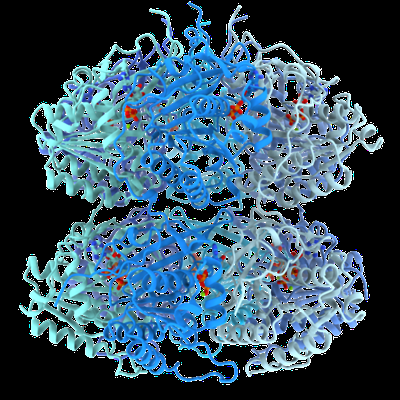
 Downloads & links
 emd_36461.png
 https://data.pdbj.org/pub/emdb/structures/EMD-36461
 X (Sec.)
 Y (Row.)
 Z (Col.)



 Sample components
 Escherichia coli BL21 (bacteria)
 Processing
 Electron microscopy
 FIELD EMISSION GUN