[English] 日本語
Yorodumi Papers
- Database of articles cited by EMDB/PDB/SASBDB data -

+
Search query

Keywords
Structure methods
Author
Journal
IF

-
Structure paper

TitleNew Analogs of the Compstatin Family of Clinical Complement Inhibitors with Low Picomolar Target Affinity.
Journal, issue, pagesJ Med Chem, Vol. 69, Issue 9, Page 11592-11609, Year 2026
Publish dateMay 14, 2026
AuthorsStephanie A Vogt / Alexander J Lander / Karl Herbine / Ekaterina Umnyakova / Jannes Felsch / Roman Aschwanden / Sarah E Hughes / Oliver Schwardt / Markus A Lill / Martin Smieško / John D Lambris / Christina Lamers / Daniel Ricklin /
PubMed AbstractCompstatin-class macrocyclic peptides have emerged as therapeutic complement modulators, with a PEGylated compstatin derivative being approved and sequence-optimized analogs with enhanced PK/PD ...Compstatin-class macrocyclic peptides have emerged as therapeutic complement modulators, with a PEGylated compstatin derivative being approved and sequence-optimized analogs with enhanced PK/PD properties showing clinical promise. By extending structure-activity relationship studies of compstatin, we identified a modification (V3I) that enhances the target affinity up to 30-fold. Analog Cp01-V3I represents the most potent proteinogenic compstatin ( = 20 nM), opening paths toward recombinant applications. Introducing the V3I modification into late-generation compstatin analogs yielded a low-picomolar-affinity derivative ( = 0.08 nM), termed Cp60, featuring potent complement inhibition in vitro. Cryogenic electron microscopy of the C3bB-Cp60 complex at 2.88 Å resolution confirmed the structural basis for enhanced target affinity and provided mechanistic insights. Lastly, we demonstrate that Cp60s ultralong target residence time enables diagnostic applications for detecting complement opsonins on biosurfaces. Collectively, this work highlights the importance of rigorous optimization of de novo peptide inhibitors to improve PK/PD properties and enable novel applications.
External linksJ Med Chem / PubMed:42063338 / PubMed Central
MethodsEM (single particle)
Resolution2.88 - 3.0 Å
Structure data

EMDB-75834, PDB-11mg:
Cryo-EM Structure of Human C3 Pro-Convertase bound to the Compstatin Analog Cp60, TED Conformation 1
Method: EM (single particle) / Resolution: 2.88 Å

EMDB-75835, PDB-11mh:
Cryo-EM Structure of Human C3 Pro-Convertase bound to the Compstatin Analog Cp60, TED Conformation 2
Method: EM (single particle) / Resolution: 3.0 Å

Chemicals

ChemComp-NI:
NICKEL (II) ION

ChemComp-NAG:
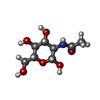
2-acetamido-2-deoxy-beta-D-glucopyranose

Source
  • homo sapiens (human)
  • synthetic construct (others)
KeywordsIMMUNE SYSTEM / Complement System / C3 / Alternate Pathway / C3 Pro-Convertase / C3b / Factor B / Compstatin

+
About Yorodumi Papers

-
News

-
Feb 9, 2022. New format data for meta-information of EMDB entries

New format data for meta-information of EMDB entries

  • Version 3 of the EMDB header file is now the official format.
  • The previous official version 1.9 will be removed from the archive.

Related info.:EMDB header

External links:wwPDB to switch to version 3 of the EMDB data model

-
Aug 12, 2020. Covid-19 info

Covid-19 info

URL: https://pdbj.org/emnavi/covid19.php

New page: Covid-19 featured information page in EM Navigator.

Related info.:Covid-19 info / Mar 5, 2020. Novel coronavirus structure data

+
Mar 5, 2020. Novel coronavirus structure data

Novel coronavirus structure data

Related info.:Yorodumi Speices / Aug 12, 2020. Covid-19 info

External links:COVID-19 featured content - PDBj / Molecule of the Month (242):Coronavirus Proteases

+
Jan 31, 2019. EMDB accession codes are about to change! (news from PDBe EMDB page)

EMDB accession codes are about to change! (news from PDBe EMDB page)

  • The allocation of 4 digits for EMDB accession codes will soon come to an end. Whilst these codes will remain in use, new EMDB accession codes will include an additional digit and will expand incrementally as the available range of codes is exhausted. The current 4-digit format prefixed with “EMD-” (i.e. EMD-XXXX) will advance to a 5-digit format (i.e. EMD-XXXXX), and so on. It is currently estimated that the 4-digit codes will be depleted around Spring 2019, at which point the 5-digit format will come into force.
  • The EM Navigator/Yorodumi systems omit the EMD- prefix.

Related info.:Q: What is EMD? / ID/Accession-code notation in Yorodumi/EM Navigator

External links:EMDB Accession Codes are Changing Soon! / Contact to PDBj

+
Jul 12, 2017. Major update of PDB

Major update of PDB

  • wwPDB released updated PDB data conforming to the new PDBx/mmCIF dictionary.
  • This is a major update changing the version number from 4 to 5, and with Remediation, in which all the entries are updated.
  • In this update, many items about electron microscopy experimental information are reorganized (e.g. em_software).
  • Now, EM Navigator and Yorodumi are based on the updated data.

External links:wwPDB Remediation / Enriched Model Files Conforming to OneDep Data Standards Now Available in the PDB FTP Archive

-
Yorodumi Papers

Database of articles cited by EMDB/PDB/SASBDB data

  • Database of articles cited by EMDB, PDB, and SASBDB entries
  • Using PubMed data

Related info.:EMDB / PDB / SASBDB / Yorodumi / EMN Papers / Changes in new EM Navigator and Yorodumi

Read more