 Movie
Movie Controller

[English] 日本語
 Yorodumi
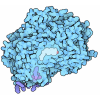
- PDB-11mg: Cryo-EM Structure of Human C3 Pro-Convertase bound to the Compsta... -
+ Open data

- Basic information
| Entry | Database: PDB / ID: 11mg | |||||||||||||||||||||||||||
|---|---|---|---|---|---|---|---|---|---|---|---|---|---|---|---|---|---|---|---|---|---|---|---|---|---|---|---|---|
| Title | Cryo-EM Structure of Human C3 Pro-Convertase bound to the Compstatin Analog Cp60, TED Conformation 1 | |||||||||||||||||||||||||||
 Components Components |
| |||||||||||||||||||||||||||
 Keywords Keywords | IMMUNE SYSTEM / Complement System / C3 / Alternate Pathway / C3 Pro-Convertase / C3b / Factor B / Compstatin | |||||||||||||||||||||||||||
| Function / homology |  Function and homology information Function and homology informationalternative-complement-pathway C3/C5 convertase / complement binding / C5L2 anaphylatoxin chemotactic receptor binding / regulation of triglyceride biosynthetic process / positive regulation of activation of membrane attack complex / vertebrate eye-specific patterning / positive regulation of apoptotic cell clearance / Alternative complement activation / complement-mediated synapse pruning / complement activation, alternative pathway ...alternative-complement-pathway C3/C5 convertase / complement binding / C5L2 anaphylatoxin chemotactic receptor binding / regulation of triglyceride biosynthetic process / positive regulation of activation of membrane attack complex / vertebrate eye-specific patterning / positive regulation of apoptotic cell clearance / Alternative complement activation / complement-mediated synapse pruning / complement activation, alternative pathway / positive regulation of lipid storage / Activation of C3 and C5 / positive regulation of phagocytosis, engulfment / complement activation, GZMK pathway / positive regulation of G protein-coupled receptor signaling pathway / symbiont cell surface / positive regulation of D-glucose transmembrane transport / complement activation / complement receptor mediated signaling pathway / neuron remodeling / endopeptidase inhibitor activity / amyloid-beta clearance / B cell activation / positive regulation of vascular endothelial growth factor production / response to bacterium / Purinergic signaling in leishmaniasis infection / Regulation of Complement cascade / Peptide ligand-binding receptors / Post-translational protein phosphorylation / positive regulation of receptor-mediated endocytosis / positive regulation of protein phosphorylation / Regulation of Insulin-like Growth Factor (IGF) transport and uptake by Insulin-like Growth Factor Binding Proteins (IGFBPs) / Immunoregulatory interactions between a Lymphoid and a non-Lymphoid cell / positive regulation of angiogenesis / azurophil granule lumen / secretory granule lumen / blood microparticle / G alpha (i) signalling events / inflammatory response / immune response / G protein-coupled receptor signaling pathway / receptor ligand activity / endoplasmic reticulum lumen / serine-type endopeptidase activity / signaling receptor binding / Neutrophil degranulation / signal transduction / cell surface / protein-containing complex / proteolysis / extracellular exosome / extracellular region / plasma membrane Similarity search - Function | |||||||||||||||||||||||||||
| Biological species |  Homo sapiens (human) Homo sapiens (human)synthetic construct (others) | |||||||||||||||||||||||||||
| Method | ELECTRON MICROSCOPY / single particle reconstruction / cryo EM / Resolution: 2.88 Å | |||||||||||||||||||||||||||
 Authors Authors | Herbine, K. / Lambris, J. | |||||||||||||||||||||||||||
| Funding support |  United States, 1items United States, 1items
| |||||||||||||||||||||||||||
 Citation Citation | Journal: J Med Chem / Year: 2026 Title: New Analogs of the Compstatin Family of Clinical Complement Inhibitors with Low Picomolar Target Affinity. Authors: Stephanie A Vogt / Alexander J Lander / Karl Herbine / Ekaterina Umnyakova / Jannes Felsch / Roman Aschwanden / Sarah E Hughes / Oliver Schwardt / Markus A Lill / Martin Smieško / John D ...Authors: Stephanie A Vogt / Alexander J Lander / Karl Herbine / Ekaterina Umnyakova / Jannes Felsch / Roman Aschwanden / Sarah E Hughes / Oliver Schwardt / Markus A Lill / Martin Smieško / John D Lambris / Christina Lamers / Daniel Ricklin /   Abstract: Compstatin-class macrocyclic peptides have emerged as therapeutic complement modulators, with a PEGylated compstatin derivative being approved and sequence-optimized analogs with enhanced PK/PD ...Compstatin-class macrocyclic peptides have emerged as therapeutic complement modulators, with a PEGylated compstatin derivative being approved and sequence-optimized analogs with enhanced PK/PD properties showing clinical promise. By extending structure-activity relationship studies of compstatin, we identified a modification (V3I) that enhances the target affinity up to 30-fold. Analog Cp01-V3I represents the most potent proteinogenic compstatin ( = 20 nM), opening paths toward recombinant applications. Introducing the V3I modification into late-generation compstatin analogs yielded a low-picomolar-affinity derivative ( = 0.08 nM), termed Cp60, featuring potent complement inhibition in vitro. Cryogenic electron microscopy of the C3bB-Cp60 complex at 2.88 Å resolution confirmed the structural basis for enhanced target affinity and provided mechanistic insights. Lastly, we demonstrate that Cp60s ultralong target residence time enables diagnostic applications for detecting complement opsonins on biosurfaces. Collectively, this work highlights the importance of rigorous optimization of de novo peptide inhibitors to improve PK/PD properties and enable novel applications. #1: Journal: To Be PublishedTitle: New analogs of the compstatin family of clinical complement inhibi-tors with low picomolar target affinity Authors: Herbine, K. / Lambris, J. | |||||||||||||||||||||||||||
| History |
|
- Structure visualization
| Structure viewer | Molecule: MolmilJmol/JSmol |
|---|
- Downloads & links
-Download
| PDBx/mmCIF format | 11mg.cif.gz | 463.5 KB | Display | PDBx/mmCIF format |
|---|---|---|---|---|
| PDB format | pdb11mg.ent.gz | 364.4 KB | Display | PDB format |
| PDBx/mmJSON format | 11mg.json.gz | Tree view | PDBx/mmJSON format | |
| Others |  Other downloads Other downloads |
-Validation report
| Arichive directory | https://data.pdbj.org/pub/pdb/validation_reports/1m/11mgftp://data.pdbj.org/pub/pdb/validation_reports/1m/11mg | HTTPS FTP |
|---|
-Related structure data
| Related structure data |  75834MC  11mhC M: map data used to model this data C: citing same article ( |
|---|---|
| Similar structure data |

-Links
 PDBj
PDBj

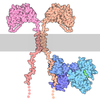
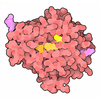
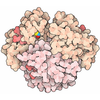
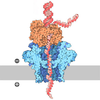
- Assembly
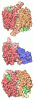
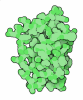
| Deposited unit | 
|
|---|---|
| 1 |
|
-Components
-Protein , 3 types, 3 molecules ABD
| #1: Protein | Mass: 71393.320 Da / Num. of mol.: 1 / Source method: isolated from a natural source / Source: (natural) Homo sapiens (human) / References: UniProt: P01024 |
|---|---|
| #2: Protein | Mass: 104073.164 Da / Num. of mol.: 1 / Source method: isolated from a natural source / Source: (natural) Homo sapiens (human) / References: UniProt: P01024 |
| #4: Protein | Mass: 83109.750 Da / Num. of mol.: 1 / Source method: isolated from a natural source / Source: (natural) Homo sapiens (human)References: UniProt: P00751, alternative-complement-pathway C3/C5 convertase |
-Protein/peptide / Non-polymers , 2 types, 3 molecules C
| #3: Protein/peptide | Mass: 2066.493 Da / Num. of mol.: 1 / Source method: obtained synthetically / Source: (synth.) synthetic construct (others) |
|---|---|
| #6: Chemical | 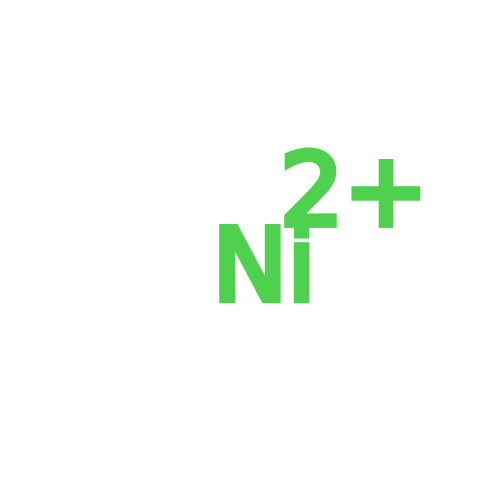 Mass: 58.693 Da / Num. of mol.: 2 / Source method: obtained synthetically / Formula: Ni / Feature type: SUBJECT OF INVESTIGATION Mass: 58.693 Da / Num. of mol.: 2 / Source method: obtained synthetically / Formula: Ni / Feature type: SUBJECT OF INVESTIGATION |
-Sugars , 2 types, 4 molecules 
| #5: Polysaccharide | Source method: isolated from a genetically manipulated source #7: Sugar | 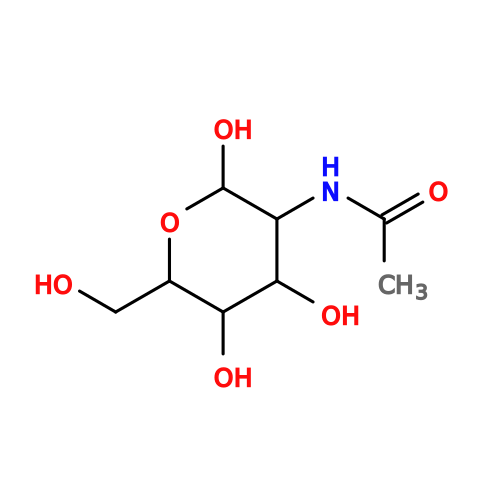 Type: D-saccharide, beta linking / Mass: 221.208 Da / Num. of mol.: 2 Type: D-saccharide, beta linking / Mass: 221.208 Da / Num. of mol.: 2Source method: isolated from a genetically manipulated source Formula: C8H15NO6 / Feature type: SUBJECT OF INVESTIGATION |
|---|
-Details
| Has ligand of interest | Y |
|---|---|
| Has protein modification | Y |
-Experimental details
-Experiment
| Experiment | Method: ELECTRON MICROSCOPY |
|---|---|
| EM experiment | Aggregation state: PARTICLE / 3D reconstruction method: single particle reconstruction |
- Sample preparation
| Component | Name: Cryo-EM Structure of Human C3 Pro-Convertase bound to the Compstatin Analog Cp60, TED Conformation 1 Type: COMPLEX / Entity ID: #1, #3, #2, #4 / Source: NATURAL |
|---|---|
| Molecular weight | Value: 0.256 MDa / Experimental value: NO |
| Source (natural) | Organism: Homo sapiens (human) |
| Buffer solution | pH: 7.5 Details: 20 mM Tris-HCl pH 7.5, 140 mM NaCl, and 10 mM NiCl2 |
| Specimen | Conc.: 0.67 mg/ml / Embedding applied: NO / Shadowing applied: NO / Staining applied: NO / Vitrification applied: YES Details: 3 uM C3b and FB were mixed with Cp60 at 1:1:2 molar ratio in buffer containing 20 mM Tris-HCl pH 7.5, 140 mM NaCl, and 10 mM NiCl2, and incubated on ice for 1 hour prior to vitrification. |
| Specimen support | Details: Negatively glow-discharged with 15 mA for 60 seconds using a PELCO easiGlow Grid material: COPPER / Grid mesh size: 300 divisions/in. / Grid type: Quantifoil R1.2/1.3 |
| Vitrification | Instrument: FEI VITROBOT MARK IV / Cryogen name: ETHANE / Humidity: 100 % / Chamber temperature: 277.15 K |
- Electron microscopy imaging
| Microscopy | Model: TFS GLACIOS |
|---|---|
| Electron gun | Electron source:  FIELD EMISSION GUN / Accelerating voltage: 200 kV / Illumination mode: FLOOD BEAM FIELD EMISSION GUN / Accelerating voltage: 200 kV / Illumination mode: FLOOD BEAM |
| Electron lens | Mode: BRIGHT FIELD / Nominal magnification: 130000 X / Nominal defocus max: 2100 nm / Nominal defocus min: 300 nm / Cs: 2.7 mm / C2 aperture diameter: 100 µm / Alignment procedure: COMA FREE |
| Specimen holder | Cryogen: NITROGEN / Specimen holder model: FEI TITAN KRIOS AUTOGRID HOLDER |
| Image recording | Average exposure time: 6 sec. / Electron dose: 43.36 e/Å2 / Film or detector model: TFS FALCON 4i (4k x 4k) / Num. of real images: 6993 |
| EM imaging optics | Energyfilter name: TFS Selectris / Energyfilter slit width: 20 eV |
| Image scans | Width: 4096 / Height: 4096 |
- Processing
| EM software |
| ||||||||||||||||||||||||||||||||||||||||
|---|---|---|---|---|---|---|---|---|---|---|---|---|---|---|---|---|---|---|---|---|---|---|---|---|---|---|---|---|---|---|---|---|---|---|---|---|---|---|---|---|---|
| CTF correction | Details: Patch CTF estimation / Type: PHASE FLIPPING AND AMPLITUDE CORRECTION | ||||||||||||||||||||||||||||||||||||||||
| Particle selection | Num. of particles selected: 1475831 Details: Automated particle picking (Blob and Template picker, CryoSPARC) with manual inspection and micrograph junk detector | ||||||||||||||||||||||||||||||||||||||||
| Symmetry | Point symmetry: C1 (asymmetric) | ||||||||||||||||||||||||||||||||||||||||
| 3D reconstruction | Resolution: 2.88 Å / Resolution method: FSC 0.143 CUT-OFF / Num. of particles: 143730 / Num. of class averages: 1 / Symmetry type: POINT | ||||||||||||||||||||||||||||||||||||||||
| Atomic model building | Protocol: FLEXIBLE FIT / Space: REAL / Target criteria: Cross-correlation coefficient Details: Initial docking of starting model performed in ChimeraX. Flexible/Refinement performed with Phenix Real-Space Refinement. Coot used for manual fitting and inspection. | ||||||||||||||||||||||||||||||||||||||||
| Atomic model building | PDB-ID: 2XWJ Accession code: 2XWJ / Source name: PDB / Type: experimental model | ||||||||||||||||||||||||||||||||||||||||
| Refinement | Highest resolution: 2.88 Å Stereochemistry target values: REAL-SPACE (WEIGHTED MAP SUM AT ATOM CENTERS) | ||||||||||||||||||||||||||||||||||||||||
| Refine LS restraints |
|

