[English] 日本語
Yorodumi Papers
- Database of articles cited by EMDB/PDB/SASBDB data -

+
Search query

Keywords
Structure methods
Author
Journal
IF

-
Structure paper

TitleClustering and a conformational switch drive activation of the mammalian receptor tyrosine kinase ROS1.
Journal, issue, pagesNat Commun, Year 2026
Publish dateFeb 17, 2026
AuthorsHengyi Li / Jianan Zhang / Tongqing Li / Yueyue Wang / Claudio R Alarcón / Daryl E Klein /
PubMed AbstractReceptor tyrosine kinases (RTKs) are key regulators of cellular signaling and are often co-opted in cancer. ROS1 is an orphan RTK aberrantly expressed in multiple tumors, yet no approved biologic ...Receptor tyrosine kinases (RTKs) are key regulators of cellular signaling and are often co-opted in cancer. ROS1 is an orphan RTK aberrantly expressed in multiple tumors, yet no approved biologic therapies target it, and its activation mechanism remains unknown. Here, we present Cryo-EM structures of mammalian ROS1 in ligand-free and NELL2-bound states, revealing how trimeric NELL2 induces both receptor clustering and a conformational switch that relieves receptor autoinhibition - both mechanisms are required for ROS1 activation. These structures, along with biochemical characterization, reflect a striking evolutionary divergence in regulatory logic compared to the invertebrate ortholog Sevenless (dROS1), highlighting how conserved RTKs can adopt fundamentally different activation strategies. Guided by these structural insights, we develop monoclonal antibodies that either block ligand binding or trap ROS1 in an inactive conformation. These agents potently suppress ROS1 signaling, representing distinct mechanistic classes of biologics that directly target ROS1 activity. Our findings elucidate a distinct mode of RTK regulation and establish a therapeutic framework for cancers driven by ROS1.
External linksNat Commun / PubMed:41698918
MethodsEM (single particle)
Resolution2.99 - 4.57 Å
Structure data

EMDB-47324, PDB-9dz4:
Cryo-EM Structure of Receptor Tyrosine Kinase ROS1 in Complex with Fab-CT4
Method: EM (single particle) / Resolution: 2.99 Å

EMDB-71895, PDB-9pvp:
Cryo-EM structure of receptor tyrosine kinase ROS1 extracellular domain
Method: EM (single particle) / Resolution: 4.57 Å

EMDB-71938, PDB-9pwq:
Cryo-EM structure of receptor tyrosine kinase ROS1 extracellular domain in complex with NELL2
Method: EM (single particle) / Resolution: 4.45 Å

EMDB-75142, PDB-10ft:
Cryo-EM structure of receptor tyrosine kinase ROS1 in complex with NELL2
Method: EM (single particle) / Resolution: 3.21 Å

EMDB-75151, PDB-10gh:
Cryo-EM structure of Receptor Tyrosine Kinase ROS1 in complex with Fab-RX5
Method: EM (single particle) / Resolution: 3.06 Å

Chemicals

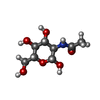
ChemComp-NAG:
2-acetamido-2-deoxy-beta-D-glucopyranose

Source
  • homo sapiens (human)
  • mus musculus (house mouse)
KeywordsTRANSFERASE / Receptor tyrosine kinase ROS1 / ROS1-NELL2 complex / TRANSFERASE-SIGNALING PROTEIN complex / TRANSFERASE/IMMUNE SYSTEM / Receptor tyrosine kinase / ROS1 extracellular bent-over conformation / Inhibitory Fab-RX5 / TRANSFERASE-IMMUNE SYSTEM complex / Inhibitory Fab-CT4 / TRANSFERASE/SIGNALING PROTEIN

+
About Yorodumi Papers

-
News

-
Feb 9, 2022. New format data for meta-information of EMDB entries

New format data for meta-information of EMDB entries

  • Version 3 of the EMDB header file is now the official format.
  • The previous official version 1.9 will be removed from the archive.

Related info.:EMDB header

External links:wwPDB to switch to version 3 of the EMDB data model

-
Aug 12, 2020. Covid-19 info

Covid-19 info

URL: https://pdbj.org/emnavi/covid19.php

New page: Covid-19 featured information page in EM Navigator.

Related info.:Covid-19 info / Mar 5, 2020. Novel coronavirus structure data

+
Mar 5, 2020. Novel coronavirus structure data

Novel coronavirus structure data

Related info.:Yorodumi Speices / Aug 12, 2020. Covid-19 info

External links:COVID-19 featured content - PDBj / Molecule of the Month (242):Coronavirus Proteases

+
Jan 31, 2019. EMDB accession codes are about to change! (news from PDBe EMDB page)

EMDB accession codes are about to change! (news from PDBe EMDB page)

  • The allocation of 4 digits for EMDB accession codes will soon come to an end. Whilst these codes will remain in use, new EMDB accession codes will include an additional digit and will expand incrementally as the available range of codes is exhausted. The current 4-digit format prefixed with “EMD-” (i.e. EMD-XXXX) will advance to a 5-digit format (i.e. EMD-XXXXX), and so on. It is currently estimated that the 4-digit codes will be depleted around Spring 2019, at which point the 5-digit format will come into force.
  • The EM Navigator/Yorodumi systems omit the EMD- prefix.

Related info.:Q: What is EMD? / ID/Accession-code notation in Yorodumi/EM Navigator

External links:EMDB Accession Codes are Changing Soon! / Contact to PDBj

+
Jul 12, 2017. Major update of PDB

Major update of PDB

  • wwPDB released updated PDB data conforming to the new PDBx/mmCIF dictionary.
  • This is a major update changing the version number from 4 to 5, and with Remediation, in which all the entries are updated.
  • In this update, many items about electron microscopy experimental information are reorganized (e.g. em_software).
  • Now, EM Navigator and Yorodumi are based on the updated data.

External links:wwPDB Remediation / Enriched Model Files Conforming to OneDep Data Standards Now Available in the PDB FTP Archive

-
Yorodumi Papers

Database of articles cited by EMDB/PDB/SASBDB data

  • Database of articles cited by EMDB, PDB, and SASBDB entries
  • Using PubMed data

Related info.:EMDB / PDB / SASBDB / Yorodumi / EMN Papers / Changes in new EM Navigator and Yorodumi

Read more