[English] 日本語
Yorodumi Papers
- Database of articles cited by EMDB/PDB/SASBDB data -

+
Search query

Keywords
Structure methods
Author
Journal
IF

-
Structure paper

TitleThe tumour suppressor RBM5 activates the helicase DHX15 to regulate splicing.
Journal, issue, pagesbioRxiv, Year 2026
Publish dateMar 27, 2026
AuthorsShiheng Liu / Tiantian Su / Jeffrey Huang / Chia-Ho Lin / Douglas L Black / Andrey Damianov / Z Hong Zhou
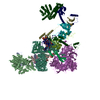
PubMed AbstractPre-mRNA splicing determines the expressed proteome and is frequently dysregulated in cancer. The tumour-suppressor RBM5 controls an exon network regulating apoptosis, yet its molecular mechanism is ...Pre-mRNA splicing determines the expressed proteome and is frequently dysregulated in cancer. The tumour-suppressor RBM5 controls an exon network regulating apoptosis, yet its molecular mechanism is elusive. Using in vivo spliceosome capture and cryogenic electron microscopy, we determined structures of precatalytic spliceosomes arrested by RBM5 immediately after U2 snRNP branchpoint recognition. Despite intron diversity, the U2-pre-mRNA duplex, branchpoint adenine, and downstream polypyrimidine tract are well-resolved. RBM5 binds the outer SF3B1 HEAT surface and performs dual functions: First, its helix-loop-helix motif and upstream zinc-finger domain sterically block tri-snRNP and Prp8 docking and prevent progression to pre-B and B complexes; Second, its G-patch activates DHX15 and places this DExH-box helicase on the pre-mRNA as it exits SF3B1, poised for branch helix unwinding. DHX15 binding to SF3B1 is facilitated by U2SURP/SR140, which engages SF3B1 near RBM5's helix-loop-helix. Functional assays confirm that disruption of the RBM5 interfaces with either DHX15 or SF3B1 inhibit exon repression. Mutations at these regulatory interfaces are common in cancer genomes and predicted to disrupt its regulation of apoptotic isoforms. Thus, RBM5 acts as a dual-action spliceosome gatekeeper that couples helicase activation with physical stalling to enforce tumour-suppressive alternative splicing programmes.
External linksbioRxiv / PubMed:41929118 / PubMed Central
MethodsEM (single particle)
Resolution3.26 - 3.94 Å
Structure data

EMDB-74082, PDB-9ze0:
Cryo-EM structure of the endogenous U2/branchpoint spliceosomal complex (Proximal DHX15 state)
Method: EM (single particle) / Resolution: 3.43 Å

EMDB-74089, PDB-9ze2:
Cryo-EM structure of the endogenous U2/branchpoint spliceosomal complex (core)
Method: EM (single particle) / Resolution: 3.26 Å

EMDB-74090, PDB-9ze3:
Cryo-EM structure of the endogenous U2/branchpoint spliceosomal complex (Distal DHX15 state)
Method: EM (single particle) / Resolution: 3.93 Å

EMDB-74099, PDB-9zec:
Cryo-EM structure of the endogenous U2/branchpoint spliceosomal complex (SF3A state 1)
Method: EM (single particle) / Resolution: 3.61 Å

EMDB-74100, PDB-9zed:
Cryo-EM structure of the endogenous U2/branchpoint spliceosomal complex (SF3A state 2)
Method: EM (single particle) / Resolution: 3.94 Å

Chemicals

ChemComp-ZN:
Unknown entry

Source
  • homo sapiens (human)
KeywordsSPLICING / spliceosome / tumor suppressor / helicase / DHX15 / RBM5 / SR140 / prespliceosomal A complex

+
About Yorodumi Papers

-
News

-
Feb 9, 2022. New format data for meta-information of EMDB entries

New format data for meta-information of EMDB entries

  • Version 3 of the EMDB header file is now the official format.
  • The previous official version 1.9 will be removed from the archive.

Related info.:EMDB header

External links:wwPDB to switch to version 3 of the EMDB data model

-
Aug 12, 2020. Covid-19 info

Covid-19 info

URL: https://pdbj.org/emnavi/covid19.php

New page: Covid-19 featured information page in EM Navigator.

Related info.:Covid-19 info / Mar 5, 2020. Novel coronavirus structure data

+
Mar 5, 2020. Novel coronavirus structure data

Novel coronavirus structure data

Related info.:Yorodumi Speices / Aug 12, 2020. Covid-19 info

External links:COVID-19 featured content - PDBj / Molecule of the Month (242):Coronavirus Proteases

+
Jan 31, 2019. EMDB accession codes are about to change! (news from PDBe EMDB page)

EMDB accession codes are about to change! (news from PDBe EMDB page)

  • The allocation of 4 digits for EMDB accession codes will soon come to an end. Whilst these codes will remain in use, new EMDB accession codes will include an additional digit and will expand incrementally as the available range of codes is exhausted. The current 4-digit format prefixed with “EMD-” (i.e. EMD-XXXX) will advance to a 5-digit format (i.e. EMD-XXXXX), and so on. It is currently estimated that the 4-digit codes will be depleted around Spring 2019, at which point the 5-digit format will come into force.
  • The EM Navigator/Yorodumi systems omit the EMD- prefix.

Related info.:Q: What is EMD? / ID/Accession-code notation in Yorodumi/EM Navigator

External links:EMDB Accession Codes are Changing Soon! / Contact to PDBj

+
Jul 12, 2017. Major update of PDB

Major update of PDB

  • wwPDB released updated PDB data conforming to the new PDBx/mmCIF dictionary.
  • This is a major update changing the version number from 4 to 5, and with Remediation, in which all the entries are updated.
  • In this update, many items about electron microscopy experimental information are reorganized (e.g. em_software).
  • Now, EM Navigator and Yorodumi are based on the updated data.

External links:wwPDB Remediation / Enriched Model Files Conforming to OneDep Data Standards Now Available in the PDB FTP Archive

-
Yorodumi Papers

Database of articles cited by EMDB/PDB/SASBDB data

  • Database of articles cited by EMDB, PDB, and SASBDB entries
  • Using PubMed data

Related info.:EMDB / PDB / SASBDB / Yorodumi / EMN Papers / Changes in new EM Navigator and Yorodumi

Read more