 Movie
Movie Controller
 Structure viewers
 About Yorodumi Papers


+Search query
-Structure paper
| Title | Structure of human green cone opsin yields insights into mechanisms underlying the rapid decay of its active, signaling state. |
|---|---|
| Journal, issue, pages | Proc Natl Acad Sci U S A, Vol. 122, Issue 49, Page e2516318122, Year 2025 |
| Publish date | Dec 9, 2025 |
 Authors Authors | Weekie Yao / Jonathan F Fay / David L Farrens /  |
| PubMed Abstract | Cone opsins enable daylight vision and color discrimination. Like their dim-light cousin rhodopsin (Rho) found in rod cells, they use a covalently attached retinal ligand to sense light and initiate ...Cone opsins enable daylight vision and color discrimination. Like their dim-light cousin rhodopsin (Rho) found in rod cells, they use a covalently attached retinal ligand to sense light and initiate visual phototransduction by activating G proteins. Unfortunately, we know less about their structural properties, in part because their activated state is unstable-cone opsins release their retinal agonist within seconds after light activation, ~100× faster than Rho. To determine what causes this rapid release and how it affects G protein activation, we solved the structure of active-state, wild-type human green cone opsin (GCO) stabilized with a mini-G protein and then compared its structural and biophysical properties to Rho. Our results reveal unique features in the active-state GCO structure. These include i) a larger water channel connected to a larger retinal binding cavity, ii) a larger "hole" near the retinal Schiff base that could facilitate both retinal escape and water access; and iii) a potential anionic residue, E102, that lies within ~3.6 Å of the Schiff base. Our biophysical assays show that neutralizing E102 (mutant GCO) slows retinal release (~8×) from the receptor and increases G protein activation. Surprisingly, our kinetic studies suggest that entropic factors are the main cause for the faster retinal release from activated GCO. These unique attributes in GCO likely facilitate its function in bright daylight. These results support the proposal that rapid retinal release from an active-state cone opsin helps prevent signal saturation and enables rapid resetting of the receptor. |
 External links External links | Proc Natl Acad Sci U S A / PubMed:41329744 / PubMed Central |
| Methods | EM (single particle) |
| Resolution | 2.9 Å |
| Structure data | EMDB-72798, PDB-9yda: |
| Chemicals | 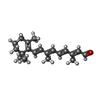 ChemComp-RET: |
| Source |
|
 Keywords Keywords | SIGNALING PROTEIN / G protein-coupled receptor / cone opsin |


 homo sapiens (human)
 mus musculus (house mouse)