 Movie
Movie Controller

[English] 日本語
 Yorodumi
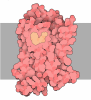
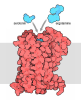
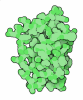
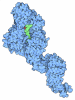
- PDB-9yda: Cryo-EM structure of active human green cone opsin in complex wit... -
+ Open data

- Basic information
| Entry | Database: PDB / ID: 9yda | ||||||||||||||||||||||||
|---|---|---|---|---|---|---|---|---|---|---|---|---|---|---|---|---|---|---|---|---|---|---|---|---|---|
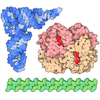
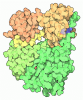
| Title | Cryo-EM structure of active human green cone opsin in complex with chimeric G protein (miniGist) | ||||||||||||||||||||||||
 Components Components |
| ||||||||||||||||||||||||
 Keywords Keywords | SIGNALING PROTEIN / G protein-coupled receptor / cone opsin | ||||||||||||||||||||||||
| Function / homology |  Function and homology information Function and homology informationDefective visual phototransduction due to OPN1MW loss of function / cone photoreceptor disc membrane / The retinoid cycle in cones (daylight vision) / Opsins / absorption of visible light / G protein-coupled photoreceptor activity / cellular response to light stimulus / photoreceptor activity / positive regulation of cytokinesis / phototransduction ...Defective visual phototransduction due to OPN1MW loss of function / cone photoreceptor disc membrane / The retinoid cycle in cones (daylight vision) / Opsins / absorption of visible light / G protein-coupled photoreceptor activity / cellular response to light stimulus / photoreceptor activity / positive regulation of cytokinesis / phototransduction / photoreceptor outer segment / visual perception / adenylate cyclase-inhibiting G protein-coupled receptor signaling pathway / Olfactory Signaling Pathway / Activation of the phototransduction cascade / G protein-coupled acetylcholine receptor signaling pathway / G beta:gamma signalling through PLC beta / Presynaptic function of Kainate receptors / Thromboxane signalling through TP receptor / Activation of G protein gated Potassium channels / Inhibition of voltage gated Ca2+ channels via Gbeta/gamma subunits / G-protein activation / Glucagon signaling in metabolic regulation / G beta:gamma signalling through CDC42 / Prostacyclin signalling through prostacyclin receptor / Synthesis, secretion, and inactivation of Glucagon-like Peptide-1 (GLP-1) / photoreceptor disc membrane / G beta:gamma signalling through BTK / ADP signalling through P2Y purinoceptor 12 / Sensory perception of sweet, bitter, and umami (glutamate) taste / Glucagon-type ligand receptors / Adrenaline,noradrenaline inhibits insulin secretion / Vasopressin regulates renal water homeostasis via Aquaporins / G alpha (z) signalling events / Glucagon-like Peptide-1 (GLP1) regulates insulin secretion / ADP signalling through P2Y purinoceptor 1 / cellular response to catecholamine stimulus / G beta:gamma signalling through PI3Kgamma / ADORA2B mediated anti-inflammatory cytokines production / adenylate cyclase-activating dopamine receptor signaling pathway / cellular response to prostaglandin E stimulus / Cooperation of PDCL (PhLP1) and TRiC/CCT in G-protein beta folding / GPER1 signaling / heterotrimeric G-protein complex / G alpha (12/13) signalling events / Inactivation, recovery and regulation of the phototransduction cascade / G-protein beta-subunit binding / extracellular vesicle / Thrombin signalling through proteinase activated receptors (PARs) / signaling receptor complex adaptor activity / GTPase binding / Ca2+ pathway / High laminar flow shear stress activates signaling by PIEZO1 and PECAM1:CDH5:KDR in endothelial cells / G alpha (i) signalling events / G alpha (s) signalling events / G alpha (q) signalling events / Ras protein signal transduction / Extra-nuclear estrogen signaling / G protein-coupled receptor signaling pathway / lysosomal membrane / GTPase activity / synapse / protein-containing complex binding / signal transduction / extracellular exosome / membrane / identical protein binding / plasma membrane / cytosol Similarity search - Function | ||||||||||||||||||||||||
| Biological species |  Homo sapiens (human) Homo sapiens (human)  Mus musculus (house mouse) Mus musculus (house mouse) | ||||||||||||||||||||||||
| Method | ELECTRON MICROSCOPY / single particle reconstruction / cryo EM / Resolution: 2.9 Å | ||||||||||||||||||||||||
 Authors Authors | Yao, W. / Fay, J.F. / Farrens, D.L. | ||||||||||||||||||||||||
| Funding support |  United States, 1items United States, 1items
| ||||||||||||||||||||||||
 Citation Citation | Journal: Proc Natl Acad Sci U S A / Year: 2025 Title: Structure of human green cone opsin yields insights into mechanisms underlying the rapid decay of its active, signaling state. Authors: Weekie Yao / Jonathan F Fay / David L Farrens / Abstract: Cone opsins enable daylight vision and color discrimination. Like their dim-light cousin rhodopsin (Rho) found in rod cells, they use a covalently attached retinal ligand to sense light and initiate ...Cone opsins enable daylight vision and color discrimination. Like their dim-light cousin rhodopsin (Rho) found in rod cells, they use a covalently attached retinal ligand to sense light and initiate visual phototransduction by activating G proteins. Unfortunately, we know less about their structural properties, in part because their activated state is unstable-cone opsins release their retinal agonist within seconds after light activation, ~100× faster than Rho. To determine what causes this rapid release and how it affects G protein activation, we solved the structure of active-state, wild-type human green cone opsin (GCO) stabilized with a mini-G protein and then compared its structural and biophysical properties to Rho. Our results reveal unique features in the active-state GCO structure. These include i) a larger water channel connected to a larger retinal binding cavity, ii) a larger "hole" near the retinal Schiff base that could facilitate both retinal escape and water access; and iii) a potential anionic residue, E102, that lies within ~3.6 Å of the Schiff base. Our biophysical assays show that neutralizing E102 (mutant GCO) slows retinal release (~8×) from the receptor and increases G protein activation. Surprisingly, our kinetic studies suggest that entropic factors are the main cause for the faster retinal release from activated GCO. These unique attributes in GCO likely facilitate its function in bright daylight. These results support the proposal that rapid retinal release from an active-state cone opsin helps prevent signal saturation and enables rapid resetting of the receptor. | ||||||||||||||||||||||||
| History |
|
- Structure visualization
| Structure viewer | Molecule: MolmilJmol/JSmol |
|---|
- Downloads & links
-Download
| PDBx/mmCIF format | 9yda.cif.gz | 244.3 KB | Display | PDBx/mmCIF format |
|---|---|---|---|---|
| PDB format | pdb9yda.ent.gz | 187.2 KB | Display | PDB format |
| PDBx/mmJSON format | 9yda.json.gz | Tree view | PDBx/mmJSON format | |
| Others |  Other downloads Other downloads |
-Validation report
| Arichive directory | https://data.pdbj.org/pub/pdb/validation_reports/yd/9ydaftp://data.pdbj.org/pub/pdb/validation_reports/yd/9yda | HTTPS FTP |
|---|
-Related structure data
| Related structure data |  72798MC M: map data used to model this data C: citing same article ( |
|---|---|
| Similar structure data |
-Links
 PDBj
PDBj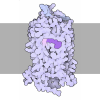

- Assembly
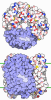
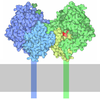
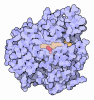
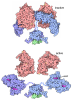
| Deposited unit | 
|
|---|---|
| 1 |
|
-Components
-Protein , 2 types, 2 molecules RA
| #1: Protein | Mass: 40700.293 Da / Num. of mol.: 1 Source method: isolated from a genetically manipulated source Details: wild-type human green cone opsin with Rho1D4 tail / Source: (gene. exp.) Homo sapiens (human) / Gene: OPN1MW, GCP / Plasmid: pMT4 / Cell (production host): fibroblast / Cell line (production host): COS-1 / Production host: Chlorocebus aethiops (grivet monkey) / Tissue (production host): kidney / References: UniProt: P04001 |
|---|---|
| #5: Protein | Mass: 57380.715 Da / Num. of mol.: 1 Source method: isolated from a genetically manipulated source Source: (gene. exp.) Homo sapiens (human) / Plasmid: pcDNA3 / Cell (production host): fibroblast / Cell line (production host): COS-1 / Production host: Chlorocebus aethiops (grivet monkey) / Tissue (production host): kidneyReferences: Hydrolases; Acting on acid anhydrides; Acting on GTP to facilitate cellular and subcellular movement |
-Guanine nucleotide-binding protein ... , 2 types, 2 molecules BG
| #2: Protein | Mass: 38878.375 Da / Num. of mol.: 1 Source method: isolated from a genetically manipulated source Details: G beta 1 subunit with Rho1D4 tail / Source: (gene. exp.) Homo sapiens (human) / Gene: GNB1 / Plasmid: pcDNA3 / Cell (production host): fibroblast / Cell line (production host): COS-1 / Production host: Chlorocebus aethiops (grivet monkey) / Tissue (production host): kidney / References: UniProt: P62873 |
|---|---|
| #3: Protein | Mass: 7861.143 Da / Num. of mol.: 1 Source method: isolated from a genetically manipulated source Source: (gene. exp.) Homo sapiens (human) / Gene: GNG2 / Plasmid: pcDNA3 / Cell (production host): fibroblast / Cell line (production host): COS-1 / Production host: Chlorocebus aethiops (grivet monkey) / Tissue (production host): kidney / References: UniProt: P59768 |
-Antibody / Non-polymers , 2 types, 2 molecules H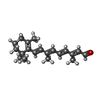
| #4: Antibody | Mass: 27784.896 Da / Num. of mol.: 1 Source method: isolated from a genetically manipulated source Source: (gene. exp.) Mus musculus (house mouse) / Cell line (production host): Sf9 / Production host:   Spodoptera frugiperda (fall armyworm) Spodoptera frugiperda (fall armyworm) |
|---|---|
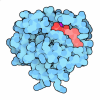
| #6: Chemical | ChemComp-RET / 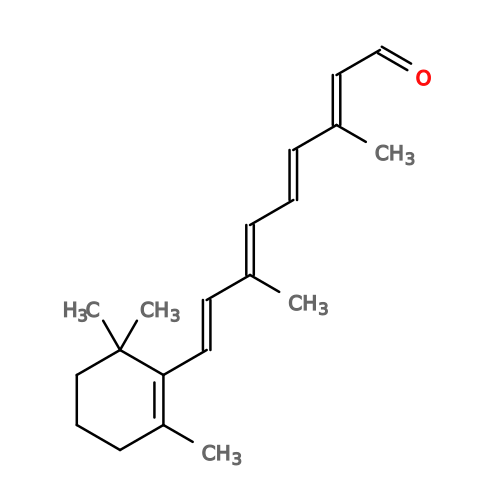 Mass: 284.436 Da / Num. of mol.: 1 / Source method: obtained synthetically / Formula: C20H28O / Feature type: SUBJECT OF INVESTIGATION Mass: 284.436 Da / Num. of mol.: 1 / Source method: obtained synthetically / Formula: C20H28O / Feature type: SUBJECT OF INVESTIGATION |
-Details
| Has ligand of interest | Y |
|---|---|
| Has protein modification | Y |
-Experimental details
-Experiment
| Experiment | Method: ELECTRON MICROSCOPY |
|---|---|
| EM experiment | Aggregation state: PARTICLE / 3D reconstruction method: single particle reconstruction |
- Sample preparation
| Component | Name: Cryo-EM structure of active human green cone opsin in complex with chimeric G protein (miniGist) Type: COMPLEX / Entity ID: #1-#5 / Source: RECOMBINANT |
|---|---|
| Molecular weight | Experimental value: NO |
| Source (natural) | Organism: Homo sapiens (human) |
| Source (recombinant) | Organism: Chlorocebus aethiops (grivet monkey) / Cell: COS-1 / Plasmid: pcDNA3 |
| Buffer solution | pH: 7 |
| Buffer component | Conc.: 20 mM / Name: HEPES / Formula: C8H18N2O4S |
| Specimen | Conc.: 3 mg/ml / Embedding applied: NO / Shadowing applied: NO / Staining applied: NO / Vitrification applied: YES |
| Specimen support | Grid material: GOLD / Grid mesh size: 300 divisions/in. / Grid type: Quantifoil R1.2/1.3 |
| Vitrification | Instrument: FEI VITROBOT MARK IV / Cryogen name: ETHANE-PROPANE / Humidity: 100 % / Chamber temperature: 277 K |
- Electron microscopy imaging
| Microscopy | Model: TFS GLACIOS |
|---|---|
| Electron gun | Electron source:  FIELD EMISSION GUN / Accelerating voltage: 200 kV / Illumination mode: FLOOD BEAM FIELD EMISSION GUN / Accelerating voltage: 200 kV / Illumination mode: FLOOD BEAM |
| Electron lens | Mode: BRIGHT FIELD / Nominal defocus max: 2100 nm / Nominal defocus min: 200 nm |
| Image recording | Electron dose: 37.2 e/Å2 / Film or detector model: FEI FALCON IV (4k x 4k) / Num. of real images: 4190 |
- Processing
| EM software |
| |||||||||||||||||||||
|---|---|---|---|---|---|---|---|---|---|---|---|---|---|---|---|---|---|---|---|---|---|---|
| CTF correction | Type: PHASE FLIPPING AND AMPLITUDE CORRECTION | |||||||||||||||||||||
| 3D reconstruction | Resolution: 2.9 Å / Resolution method: FSC 0.143 CUT-OFF / Num. of particles: 639873 / Symmetry type: POINT | |||||||||||||||||||||
| Atomic model building | Source name: AlphaFold / Type: in silico model |
