 Movie
Movie Controller
 Structure viewers
 About Yorodumi Papers


+Search query
-Structure paper
| Title | Affinity Maturation and Light-Chain-Mediated Paratope Diversification Anticipate Viral Evolution. |
|---|---|
| Journal, issue, pages | bioRxiv, Year 2025 |
| Publish date | Aug 28, 2025 |
 Authors Authors | John Dingus / Duck-Kyun Yoo / Sachin Kumar / Yajuan Wang / Md Golam Kibria / Shahab Saghei / Zahra Allahyari / Jessica W Chen / Natalie M Caputo / Jason Hwang / Bing Chen / Duane R Wesemann /  |
| PubMed Abstract | A key goal of vaccinology is to train the immune system to combat current pathogens while simultaneously preparing it for future evolved variants. Understanding factors contributing to anticipatory ...A key goal of vaccinology is to train the immune system to combat current pathogens while simultaneously preparing it for future evolved variants. Understanding factors contributing to anticipatory breadth, wherein affinity maturation against an ancestral strain yields neutralization capacity against evolved variants, is therefore of great importance. Here, we investigated the mechanism of anticipatory breadth development in a public antibody family targeting the functionally restricted ACE2 binding site on SARS-CoV-2. IGHV3-53/66 antibodies isolated from memory B cells of infection-naïve individuals vaccinated with the ancestral Wuhan-strain mRNA vaccine frequently neutralized evolved Omicron variants and contained several hallmark mutations previously shown to enhance neutralization breadth. Comparative analyses with antibodies from Omicron breakthrough infections revealed that breadth-associated patterns of somatic hypermutation emerged independently of variant exposure. However, Omicron infection had a marked impact on light chain pairing frequencies, suggestive of variant-imposed selection of favorable light chains. Analysis of available IGHV3-53/66 antibody structures complexed with SARS-CoV-2 receptor binding domain (RBD) clarified these findings; convergent somatic mutations on the heavy chain largely refined contacts with invariant RBD residues, while light chain pairings shifted epitopes to avoid steric challenges posed by Omicron mutations. These findings support a model of anticipatory breadth with three key elements: (1) targeting of a functionally restricted epitope, (2) affinity maturation to establish an affinity buffer, and (3) variable chain pairing to generate paratope diversity. These elements each serve to compensate for a distinct consequence of viral mutagenesis, offering a mechanistic framework for anticipating viral evolution. |
 External links External links | bioRxiv / PubMed:40909599 / PubMed Central |
| Methods | EM (single particle) |
| Resolution | 2.82 Å |
| Structure data |  EMDB-71900: The local refinement map of Structure of V30V4 in complex with SARS-CoV-2 spike |
| Source |
|

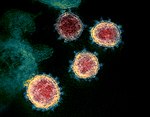 Severe acute respiratory syndrome coronavirus 2
 Homo sapiens (human)
 Mus musculus (house mouse)