[English] 日本語
Yorodumi Papers
- Database of articles cited by EMDB/PDB/SASBDB data -

+
Search query

Keywords
Structure methods
Author
Journal
IF

-
Structure paper

TitleStructure-guided design of a synthetic bile acid that inhibits Clostridioides difficile TcdB toxin.
Journal, issue, pagesNat Microbiol, Vol. 10, Issue 12, Page 3215-3228, Year 2025
Publish dateNov 18, 2025
AuthorsSean Miletic / Simoun Icho / Zhijie Li / John Tam / Elizabeth C Rose / Cypress E Perkins / Ali Nakhi / Xinglin Yang / Howard C Hang / John L Rubinstein / Peter I Dosa / Casey M Theriot / Roman A Melnyk /
PubMed AbstractIntestinal bile acids are a family of host and microbiota metabolites that can directly inhibit toxin B (TcdB), the primary virulence factor of Clostridioides difficile that causes infectious ...Intestinal bile acids are a family of host and microbiota metabolites that can directly inhibit toxin B (TcdB), the primary virulence factor of Clostridioides difficile that causes infectious diarrhoea and colitis. However, the mechanism underlying the inhibition is unclear. Here we used cryogenic electron microscopy and determined the structure of TcdB bound to inhibitory bile acids cholic acid (methyl ester) and taurochenodeoxycholic acid at 2.9 Å and 3.3 Å resolution, respectively. These structures revealed that bile acids lock the C-terminal CROP domain of TcdB in a conformation that allosterically masks the two receptor-binding sites and prevents target cell recognition. Guided by the structure, we synthesized gut-restricted bile acid derivatives, designed to evade the bile acid reuptake transporters within the gut. One of the derivatives, sBA-2, was retained within the gut upon oral dosing and protected mice from toxin-induced C. difficile disease pathology. Our study uncovers the structural basis of inhibition of TcdB by bile acids and its analogues, paving the way for the development of orally deliverable therapeutics against C. difficile.
External linksNat Microbiol / PubMed:41254394
MethodsEM (single particle)
Resolution2.87 - 3.59 Å
Structure data

EMDB-70486, PDB-9ohc:
CryoEM structure of Toxin B (TcdB) from clostridioides difficile complexed with taurochenodeoxycholic acid (TCDCA)
Method: EM (single particle) / Resolution: 3.28 Å

EMDB-70487, PDB-9ohd:
CryoEM structure of Toxin B (TcdB) from clostridioides difficile complexed with methyl cholate
Method: EM (single particle) / Resolution: 2.87 Å

EMDB-70488, PDB-9ohe:
CryoEM structure of apo Toxin B (TcdB) from Clostridioides difficile in the closed CROP state
Method: EM (single particle) / Resolution: 3.59 Å

EMDB-70489, PDB-9ohf:
CryoEM structure of apo Toxin B (TcdB) from Clostridioides difficile in the open CROP state
Method: EM (single particle) / Resolution: 3.19 Å

Chemicals

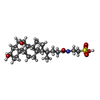
ChemComp-TUD:
TAUROCHENODEOXYCHOLIC ACID

PDB-1cba:
Unknown entry

Source
  • clostridioides difficile (bacteria)
KeywordsTOXIN / clostridioides difficile / Toxin B / TcdB / Bile acid / TCDCA / methyl cholate

+
About Yorodumi Papers

-
News

-
Feb 9, 2022. New format data for meta-information of EMDB entries

New format data for meta-information of EMDB entries

  • Version 3 of the EMDB header file is now the official format.
  • The previous official version 1.9 will be removed from the archive.

Related info.:EMDB header

External links:wwPDB to switch to version 3 of the EMDB data model

-
Aug 12, 2020. Covid-19 info

Covid-19 info

URL: https://pdbj.org/emnavi/covid19.php

New page: Covid-19 featured information page in EM Navigator.

Related info.:Covid-19 info / Mar 5, 2020. Novel coronavirus structure data

+
Mar 5, 2020. Novel coronavirus structure data

Novel coronavirus structure data

Related info.:Yorodumi Speices / Aug 12, 2020. Covid-19 info

External links:COVID-19 featured content - PDBj / Molecule of the Month (242):Coronavirus Proteases

+
Jan 31, 2019. EMDB accession codes are about to change! (news from PDBe EMDB page)

EMDB accession codes are about to change! (news from PDBe EMDB page)

  • The allocation of 4 digits for EMDB accession codes will soon come to an end. Whilst these codes will remain in use, new EMDB accession codes will include an additional digit and will expand incrementally as the available range of codes is exhausted. The current 4-digit format prefixed with “EMD-” (i.e. EMD-XXXX) will advance to a 5-digit format (i.e. EMD-XXXXX), and so on. It is currently estimated that the 4-digit codes will be depleted around Spring 2019, at which point the 5-digit format will come into force.
  • The EM Navigator/Yorodumi systems omit the EMD- prefix.

Related info.:Q: What is EMD? / ID/Accession-code notation in Yorodumi/EM Navigator

External links:EMDB Accession Codes are Changing Soon! / Contact to PDBj

+
Jul 12, 2017. Major update of PDB

Major update of PDB

  • wwPDB released updated PDB data conforming to the new PDBx/mmCIF dictionary.
  • This is a major update changing the version number from 4 to 5, and with Remediation, in which all the entries are updated.
  • In this update, many items about electron microscopy experimental information are reorganized (e.g. em_software).
  • Now, EM Navigator and Yorodumi are based on the updated data.

External links:wwPDB Remediation / Enriched Model Files Conforming to OneDep Data Standards Now Available in the PDB FTP Archive

-
Yorodumi Papers

Database of articles cited by EMDB/PDB/SASBDB data

  • Database of articles cited by EMDB, PDB, and SASBDB entries
  • Using PubMed data

Related info.:EMDB / PDB / SASBDB / Yorodumi / EMN Papers / Changes in new EM Navigator and Yorodumi

Read more