 Movie
Movie Controller

[English] 日本語
 Yorodumi
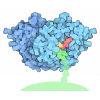
- PDB-9ohd: CryoEM structure of Toxin B (TcdB) from clostridioides difficile ... -
+ Open data

- Basic information
| Entry | Database: PDB / ID: 9ohd | |||||||||||||||||||||
|---|---|---|---|---|---|---|---|---|---|---|---|---|---|---|---|---|---|---|---|---|---|---|
| Title | CryoEM structure of Toxin B (TcdB) from clostridioides difficile complexed with methyl cholate | |||||||||||||||||||||
 Components Components | Toxin B | |||||||||||||||||||||
 Keywords Keywords | TOXIN / clostridioides difficile / Toxin B / TcdB / Bile acid / methyl cholate | |||||||||||||||||||||
| Function / homology |  Function and homology information Function and homology informationsymbiont-mediated perturbation of host actin cytoskeleton via filamentous actin depolymerization / glucosyltransferase activity / Transferases; Glycosyltransferases; Hexosyltransferases / host cell cytosol / cysteine-type peptidase activity / host cell endosome membrane / toxin activity / Hydrolases; Acting on peptide bonds (peptidases); Cysteine endopeptidases / lipid binding / host cell plasma membrane ...symbiont-mediated perturbation of host actin cytoskeleton via filamentous actin depolymerization / glucosyltransferase activity / Transferases; Glycosyltransferases; Hexosyltransferases / host cell cytosol / cysteine-type peptidase activity / host cell endosome membrane / toxin activity / Hydrolases; Acting on peptide bonds (peptidases); Cysteine endopeptidases / lipid binding / host cell plasma membrane / proteolysis / metal ion binding / extracellular region Similarity search - Function | |||||||||||||||||||||
| Biological species |  Clostridioides difficile (bacteria) Clostridioides difficile (bacteria) | |||||||||||||||||||||
| Method | ELECTRON MICROSCOPY / single particle reconstruction / cryo EM / Resolution: 2.87 Å | |||||||||||||||||||||
 Authors Authors | Miletic, S. / Li, Z. / Melnyk, R.A. | |||||||||||||||||||||
| Funding support |  Canada, 1items Canada, 1items
| |||||||||||||||||||||
 Citation Citation | Journal: Nat Microbiol / Year: 2025 Title: Structure-guided design of a synthetic bile acid that inhibits Clostridioides difficile TcdB toxin. Authors: Sean Miletic / Simoun Icho / Zhijie Li / John Tam / Elizabeth C Rose / Cypress E Perkins / Ali Nakhi / Xinglin Yang / Howard C Hang / John L Rubinstein / Peter I Dosa / Casey M Theriot / Roman A Melnyk /  Abstract: Intestinal bile acids are a family of host and microbiota metabolites that can directly inhibit toxin B (TcdB), the primary virulence factor of Clostridioides difficile that causes infectious ...Intestinal bile acids are a family of host and microbiota metabolites that can directly inhibit toxin B (TcdB), the primary virulence factor of Clostridioides difficile that causes infectious diarrhoea and colitis. However, the mechanism underlying the inhibition is unclear. Here we used cryogenic electron microscopy and determined the structure of TcdB bound to inhibitory bile acids cholic acid (methyl ester) and taurochenodeoxycholic acid at 2.9 Å and 3.3 Å resolution, respectively. These structures revealed that bile acids lock the C-terminal CROP domain of TcdB in a conformation that allosterically masks the two receptor-binding sites and prevents target cell recognition. Guided by the structure, we synthesized gut-restricted bile acid derivatives, designed to evade the bile acid reuptake transporters within the gut. One of the derivatives, sBA-2, was retained within the gut upon oral dosing and protected mice from toxin-induced C. difficile disease pathology. Our study uncovers the structural basis of inhibition of TcdB by bile acids and its analogues, paving the way for the development of orally deliverable therapeutics against C. difficile. | |||||||||||||||||||||
| History |
|
- Structure visualization
| Structure viewer | Molecule: MolmilJmol/JSmol |
|---|
- Downloads & links
-Download
| PDBx/mmCIF format | 9ohd.cif.gz | 1.1 MB | Display | PDBx/mmCIF format |
|---|---|---|---|---|
| PDB format | pdb9ohd.ent.gz | Display | PDB format | |
| PDBx/mmJSON format | 9ohd.json.gz | Tree view | PDBx/mmJSON format | |
| Others |  Other downloads Other downloads |
-Validation report
| Arichive directory | https://data.pdbj.org/pub/pdb/validation_reports/oh/9ohdftp://data.pdbj.org/pub/pdb/validation_reports/oh/9ohd | HTTPS FTP |
|---|
-Related structure data
| Related structure data |  70487MC  9ohcC  9oheC  9ohfC M: map data used to model this data C: citing same article ( |
|---|---|
| Similar structure data |


-Links
 PDBj
PDBj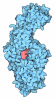
- Assembly
| Deposited unit | 
|
|---|---|
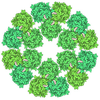
| 1 |
|
-Components
| #1: Protein | Mass: 270767.281 Da / Num. of mol.: 1 Source method: isolated from a genetically manipulated source Source: (gene. exp.) Clostridioides difficile (bacteria) / Strain: VPI 10463 / Gene: tcdB, toxB / Plasmid: pHIS1522Details (production host): Expression plasmid for P. megaterium. Xylose-inducible expression. Tetracycline resistance. Production host: Priestia megaterium (bacteria) / Strain (production host): WH320References: UniProt: P18177, Hydrolases; Acting on peptide bonds (peptidases); Cysteine endopeptidases | ||||
|---|---|---|---|---|---|
| #2: Chemical | Mass: 422.598 Da / Num. of mol.: 3 / Source method: obtained synthetically / Formula: C25H42O5 / Feature type: SUBJECT OF INVESTIGATION Has ligand of interest | Y | Has protein modification | N | |
-Experimental details
-Experiment
| Experiment | Method: ELECTRON MICROSCOPY |
|---|---|
| EM experiment | Aggregation state: PARTICLE / 3D reconstruction method: single particle reconstruction |
- Sample preparation
| Component | Name: Clostridioides difficile Toxin B (TcdB) complexed with the synthetic bile acid methyl cholate Type: COMPLEX / Details: 200 micromolar methyl cholate / Entity ID: #1 / Source: RECOMBINANT | |||||||||||||||
|---|---|---|---|---|---|---|---|---|---|---|---|---|---|---|---|---|
| Molecular weight | Value: 0.276 MDa / Experimental value: NO | |||||||||||||||
| Source (natural) | Organism: Clostridioides difficile (bacteria) / Strain: VPI 10463 | |||||||||||||||
| Source (recombinant) | Organism: Priestia megaterium (bacteria) / Strain: WH320 | |||||||||||||||
| Buffer solution | pH: 8 Details: 200 micromolar of methyl cholate was added before freezing. | |||||||||||||||
| Buffer component |
| |||||||||||||||
| Specimen | Conc.: 2 mg/ml / Embedding applied: NO / Shadowing applied: NO / Staining applied: NO / Vitrification applied: YES Details: Purified TcdB was mixed with 200 micromolar of methyl cholate (4% DMSO final concentration) and incubated on ice until plunge freezing. | |||||||||||||||
| Specimen support | Grid material: COPPER / Grid mesh size: 400 divisions/in. / Grid type: Homemade | |||||||||||||||
| Vitrification | Instrument: LEICA EM GP / Cryogen name: ETHANE / Humidity: 80 % / Chamber temperature: 277 K / Details: 30s preblot incubation on grid. 2-3s blot time. |
- Electron microscopy imaging
| Experimental equipment |  Model: Titan Krios / Image courtesy: FEI Company |
|---|---|
| Microscopy | Model: TFS KRIOS |
| Electron gun | Electron source:  FIELD EMISSION GUN / Accelerating voltage: 300 kV / Illumination mode: FLOOD BEAM FIELD EMISSION GUN / Accelerating voltage: 300 kV / Illumination mode: FLOOD BEAM |
| Electron lens | Mode: BRIGHT FIELD / Nominal magnification: 75000 X / Nominal defocus max: 2000 nm / Nominal defocus min: 1000 nm |
| Specimen holder | Cryogen: NITROGEN / Specimen holder model: FEI TITAN KRIOS AUTOGRID HOLDER |
| Image recording | Electron dose: 40 e/Å2 / Film or detector model: FEI FALCON IV (4k x 4k) |
- Processing
| EM software |
| ||||||||||||||||||||||||||||||||||||
|---|---|---|---|---|---|---|---|---|---|---|---|---|---|---|---|---|---|---|---|---|---|---|---|---|---|---|---|---|---|---|---|---|---|---|---|---|---|
| CTF correction | Type: PHASE FLIPPING AND AMPLITUDE CORRECTION | ||||||||||||||||||||||||||||||||||||
| Symmetry | Point symmetry: C1 (asymmetric) | ||||||||||||||||||||||||||||||||||||
| 3D reconstruction | Resolution: 2.87 Å / Resolution method: FSC 0.143 CUT-OFF / Num. of particles: 339310 / Symmetry type: POINT | ||||||||||||||||||||||||||||||||||||
| Atomic model building | Protocol: OTHER / Space: REAL Details: Predicted models were docked into the map using ChimeraX. The model was then manually built with ISOLDE and Coot and refined with phenix.real_space_refine. | ||||||||||||||||||||||||||||||||||||
| Atomic model building | Accession code: P18177 / Source name: AlphaFold / Type: in silico model | ||||||||||||||||||||||||||||||||||||
| Refinement | Cross valid method: NONE Stereochemistry target values: GeoStd + Monomer Library + CDL v1.2 | ||||||||||||||||||||||||||||||||||||
| Displacement parameters | Biso mean: 161.18 Å2 | ||||||||||||||||||||||||||||||||||||
| Refine LS restraints |
|
