 Movie
Movie Controller
 Structure viewers
 About Yorodumi Papers


+Search query
-Structure paper
| Title | Conduction pathway for potassium through the E. coli pump KdpFABC. |
|---|---|
| Journal, issue, pages | bioRxiv, Year 2025 |
| Publish date | May 6, 2025 |
 Authors Authors | Adel Hussein / Xihui Zhang / Bjørn Panyella Pedersen / David L Stokes /   |
| PubMed Abstract | Under osmotic stress, bacteria express a heterotetrameric protein complex, KdpFABC, which functions as an ATP-dependent K pump to maintain intracellular potassium levels. The subunit KdpA belongs to ...Under osmotic stress, bacteria express a heterotetrameric protein complex, KdpFABC, which functions as an ATP-dependent K pump to maintain intracellular potassium levels. The subunit KdpA belongs to the Superfamily of K Transporters and adopts a pseudo-tetrameric architecture with a membrane embedded selectivity filter as seen in K channels. KdpB belongs to the superfamily of P-type ATPases with a conserved binding site for ions within the membrane domain and three cytoplasmic domains that orchestrate ATP hydrolysis via an aspartyl phosphate intermediate. Previous work has hypothesized that K moves parallel to the membrane plane through a 40-Å long tunnel that connects the selectivity filter of KdpA with a canonical binding site in KdpB. In the current work, we have reconstituted KdpFABC into lipid nanodiscs and used cryo-EM to image the wild-type pump under turnover conditions. We present a 2.1 Å structure of the E1~P·ADP conformation, which reveals new features of the conduction pathway. This map shows strong densities within the selectivity filter and at the canonical binding site, consistent with K bound at each of these sites in this conformation. Many water molecules occupy a vestibule and the proximal end of the tunnel, which becomes markedly hydrophobic and dewetted at the subunit interface. We go on to use ATPase and ion transport assays to assess effects of numerous mutations along this proposed conduction pathway. The results confirm that K ions pass through the tunnel and support the existence of a low affinity site in KdpB for releasing these ions to the cytoplasm. Taken together, these data shed new light on the unique partnership between a transmembrane channel and an ATP-driven pump in maintaining the large electrochemical K gradient essential for bacterial survival. |
 External links External links | bioRxiv / PubMed:40654642 / PubMed Central |
| Methods | EM (single particle) |
| Resolution | 2.1 Å |
| Structure data | EMDB-70308, PDB-9oc4: |
| Chemicals |  ChemComp-K: 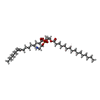 ChemComp-9Y0: 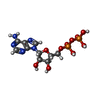 ChemComp-ADP:  ChemComp-MG:  ChemComp-HOH: |
| Source |
|
 Keywords Keywords | TRANSPORT PROTEIN / P-type ATPase potassium channel transporter pump |


 escherichia coli k-12 (bacteria)