[English] 日本語
Yorodumi Papers
- Database of articles cited by EMDB/PDB/SASBDB data -

+
Search query

Keywords
Structure methods
Author
Journal
IF

-
Structure paper

TitleFilament-mediated repurposing of toxic dITP for immunity in the Kongming system.
Journal, issue, pagesMol Cell, Vol. 86, Issue 6, Page 1148-11163.e5, Year 2026
Publish dateMar 19, 2026
AuthorsHao Feng / Kai Shao / Zhifeng Zeng / Eddie Yong Jun Tan / Zeyu Hu / Ruiliang Zhao / Jikai Rao / Jian Shi / Zhuojian Chen / Rafael Pinilla Redondo / Bin Wu / Wenyuan Han / Min Luo /
PubMed AbstractAbortive infection systems protect bacteria by triggering self-destruction in response to phage attack. Most known systems rely on stable cyclic nucleotides that accumulate to stoichiometric levels ...Abortive infection systems protect bacteria by triggering self-destruction in response to phage attack. Most known systems rely on stable cyclic nucleotides that accumulate to stoichiometric levels to activate effectors; the Kongming (Kom) system employs the toxic metabolite deoxyinosine triphosphate (dITP) as its signaling molecule. Here, we show that the Escherichia coli KomB-KomC (KomBC) complex forms a preassembled filament that remains inactive until dITP binding induces cooperative allosteric activation. KomB, a homolog of the nucleotide-hydrolyzing enzyme HAM1, has lost catalytic activity but evolved a high-affinity, hydrolysis-resistant binding pocket for dITP. Interestingly, substoichiometric dITP binding is sufficient to activate adjacent KomC NADase domains, which propagate activation cooperatively along the filament. This filament-based architecture enables ultrasensitive, long-range allosteric signaling in response to a low-abundance and short-lived metabolite. Our findings reveal an ultrasensitive immune strategy that transforms a toxic byproduct into a robust antiviral trigger, expanding the known repertoire of bacterial defense strategies.
External linksMol Cell / PubMed:41638214
MethodsEM (helical sym.)
Resolution3.0 - 3.66 Å
Structure data

EMDB-60413, PDB-8zsf:
CryoEM Helical Structure of KomC
Method: EM (helical sym.) / Resolution: 3.24 Å

EMDB-60414, PDB-8zsg:
CryoEM Helical Structure of resting KomBC complex
Method: EM (helical sym.) / Resolution: 3.66 Å

EMDB-60415, PDB-8zsh:
Cryo-EM Helical Structure of dITP-activated KomBC complex
Method: EM (helical sym.) / Resolution: 3.0 Å

EMDB-67286, PDB-9xvc:
Cryo-EM Helical Structure of the dITP-KomBC(H146N) Complex with NAD Fragments
Method: EM (helical sym.) / Resolution: 3.2 Å

Chemicals

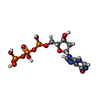
ChemComp-Y43:
2'-deoxyinosine 5'-triphosphate

ChemComp-MG:
Unknown entry

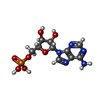
ChemComp-AMP:
ADENOSINE MONOPHOSPHATE / AMP*YM

Source
  • escherichia coli (E. coli)
KeywordsIMMUNE SYSTEM / NADase / Filament / CryoEM / Bacterial immunity / CryoEM. / KomBC / NAD hydrolysis protein

+
About Yorodumi Papers

-
News

-
Feb 9, 2022. New format data for meta-information of EMDB entries

New format data for meta-information of EMDB entries

  • Version 3 of the EMDB header file is now the official format.
  • The previous official version 1.9 will be removed from the archive.

Related info.:EMDB header

External links:wwPDB to switch to version 3 of the EMDB data model

-
Aug 12, 2020. Covid-19 info

Covid-19 info

URL: https://pdbj.org/emnavi/covid19.php

New page: Covid-19 featured information page in EM Navigator.

Related info.:Covid-19 info / Mar 5, 2020. Novel coronavirus structure data

+
Mar 5, 2020. Novel coronavirus structure data

Novel coronavirus structure data

Related info.:Yorodumi Speices / Aug 12, 2020. Covid-19 info

External links:COVID-19 featured content - PDBj / Molecule of the Month (242):Coronavirus Proteases

+
Jan 31, 2019. EMDB accession codes are about to change! (news from PDBe EMDB page)

EMDB accession codes are about to change! (news from PDBe EMDB page)

  • The allocation of 4 digits for EMDB accession codes will soon come to an end. Whilst these codes will remain in use, new EMDB accession codes will include an additional digit and will expand incrementally as the available range of codes is exhausted. The current 4-digit format prefixed with “EMD-” (i.e. EMD-XXXX) will advance to a 5-digit format (i.e. EMD-XXXXX), and so on. It is currently estimated that the 4-digit codes will be depleted around Spring 2019, at which point the 5-digit format will come into force.
  • The EM Navigator/Yorodumi systems omit the EMD- prefix.

Related info.:Q: What is EMD? / ID/Accession-code notation in Yorodumi/EM Navigator

External links:EMDB Accession Codes are Changing Soon! / Contact to PDBj

+
Jul 12, 2017. Major update of PDB

Major update of PDB

  • wwPDB released updated PDB data conforming to the new PDBx/mmCIF dictionary.
  • This is a major update changing the version number from 4 to 5, and with Remediation, in which all the entries are updated.
  • In this update, many items about electron microscopy experimental information are reorganized (e.g. em_software).
  • Now, EM Navigator and Yorodumi are based on the updated data.

External links:wwPDB Remediation / Enriched Model Files Conforming to OneDep Data Standards Now Available in the PDB FTP Archive

-
Yorodumi Papers

Database of articles cited by EMDB/PDB/SASBDB data

  • Database of articles cited by EMDB, PDB, and SASBDB entries
  • Using PubMed data

Related info.:EMDB / PDB / SASBDB / Yorodumi / EMN Papers / Changes in new EM Navigator and Yorodumi

Read more