[English] 日本語
Yorodumi Papers
- Database of articles cited by EMDB/PDB/SASBDB data -

+
Search query

Keywords
Structure methods
Author
Journal
IF

-
Structure paper

TitleTransport and inhibition mechanisms of human glycine transporter 2.
Journal, issue, pagesNat Commun, Vol. 17, Issue 1, Year 2026
Publish dateApr 16, 2026
AuthorsWenming Ji / Yuanzhi Yu / Zirui Liu / Junwen Su / Qianyu Wang / Mulin Lai / Jing-Xiang Wu /
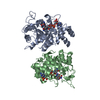
PubMed AbstractNeuronal human glycine transporter 2 (hGlyT2) plays a critical role in maintaining glycinergic neurotransmission via the reuptake of glycine into presynaptic neurons by using the driving force of ...Neuronal human glycine transporter 2 (hGlyT2) plays a critical role in maintaining glycinergic neurotransmission via the reuptake of glycine into presynaptic neurons by using the driving force of sodium and chloride ion gradients. hGlyT2 represents an important drug target for analgesic purpose. However, its structure and the molecular mechanisms remain elusive. Here, we report structures of hGlyT2 in three functional states, including the apo state, the substrate glycine-bound state, and the inhibitor-bound states. The apo state of hGlyT2 adopts an inward conformation. The substrate glycine binds at the central pocket of hGlyT2 in its occluded conformation. Both inhibitors, ORG25543 and opiranserin, bind to an allosteric site, which is vertical to the extracellular tunnel, buried under the extracellular loop 4 (EL4) and near to the transmembrane helix 1b (TM1b). These inhibitors act as wedges to prevent the inward movement of TM1b and closure of the extracellular gate. Further structural analysis reveals both global and local conformational changes associated with the ions and glycine binding and release. These structures define the mechanisms governing transport and allosteric inhibition in hGlyT2, providing a blueprint for further development of non-opioid analgesics targeting hGlyT2.
External linksNat Commun / PubMed:41991951 / PubMed Central
MethodsEM (single particle)
Resolution2.73 - 3.2 Å
Structure data

EMDB-65747, PDB-9w8j:
Transport and inhibition mechanisms of human glycine transporter 2
Method: EM (single particle) / Resolution: 2.73 Å

EMDB-65748, PDB-9w8q:
Transport and inhibition mechanisms of human glycine transporter 2
Method: EM (single particle) / Resolution: 3.2 Å

EMDB-65847, PDB-9wbr:
The structure of glycine transport 2 in apo state
Method: EM (single particle) / Resolution: 3.13 Å

EMDB-65856, PDB-9wc6:
The structure of glycine transport 2 in complex with glycine
Method: EM (single particle) / Resolution: 3.1 Å

Chemicals

PDB-1ef3:
FIDARESTAT BOUND TO HUMAN ALDOSE REDUCTASE

ChemComp-NA:
Unknown entry

ChemComp-CL:
Unknown entry

PDB-1ef1:
CRYSTAL STRUCTURE OF THE MOESIN FERM DOMAIN/TAIL DOMAIN COMPLEX

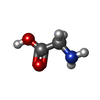
ChemComp-GLY:
GLYCINE

Source
  • homo sapiens (human)
KeywordsTRANSPORT PROTEIN / GlyT2 / membrane transport protein / Opiranserin / Glycine transport 2

+
About Yorodumi Papers

-
News

-
Feb 9, 2022. New format data for meta-information of EMDB entries

New format data for meta-information of EMDB entries

  • Version 3 of the EMDB header file is now the official format.
  • The previous official version 1.9 will be removed from the archive.

Related info.:EMDB header

External links:wwPDB to switch to version 3 of the EMDB data model

-
Aug 12, 2020. Covid-19 info

Covid-19 info

URL: https://pdbj.org/emnavi/covid19.php

New page: Covid-19 featured information page in EM Navigator.

Related info.:Covid-19 info / Mar 5, 2020. Novel coronavirus structure data

+
Mar 5, 2020. Novel coronavirus structure data

Novel coronavirus structure data

Related info.:Yorodumi Speices / Aug 12, 2020. Covid-19 info

External links:COVID-19 featured content - PDBj / Molecule of the Month (242):Coronavirus Proteases

+
Jan 31, 2019. EMDB accession codes are about to change! (news from PDBe EMDB page)

EMDB accession codes are about to change! (news from PDBe EMDB page)

  • The allocation of 4 digits for EMDB accession codes will soon come to an end. Whilst these codes will remain in use, new EMDB accession codes will include an additional digit and will expand incrementally as the available range of codes is exhausted. The current 4-digit format prefixed with “EMD-” (i.e. EMD-XXXX) will advance to a 5-digit format (i.e. EMD-XXXXX), and so on. It is currently estimated that the 4-digit codes will be depleted around Spring 2019, at which point the 5-digit format will come into force.
  • The EM Navigator/Yorodumi systems omit the EMD- prefix.

Related info.:Q: What is EMD? / ID/Accession-code notation in Yorodumi/EM Navigator

External links:EMDB Accession Codes are Changing Soon! / Contact to PDBj

+
Jul 12, 2017. Major update of PDB

Major update of PDB

  • wwPDB released updated PDB data conforming to the new PDBx/mmCIF dictionary.
  • This is a major update changing the version number from 4 to 5, and with Remediation, in which all the entries are updated.
  • In this update, many items about electron microscopy experimental information are reorganized (e.g. em_software).
  • Now, EM Navigator and Yorodumi are based on the updated data.

External links:wwPDB Remediation / Enriched Model Files Conforming to OneDep Data Standards Now Available in the PDB FTP Archive

-
Yorodumi Papers

Database of articles cited by EMDB/PDB/SASBDB data

  • Database of articles cited by EMDB, PDB, and SASBDB entries
  • Using PubMed data

Related info.:EMDB / PDB / SASBDB / Yorodumi / EMN Papers / Changes in new EM Navigator and Yorodumi

Read more