 Movie
Movie Controller


+ Open data

- Basic information
| Entry | Database: PDB / ID: 9wc6 | |||||||||||||||||||||||||||
|---|---|---|---|---|---|---|---|---|---|---|---|---|---|---|---|---|---|---|---|---|---|---|---|---|---|---|---|---|
| Title | The structure of glycine transport 2 in complex with glycine | |||||||||||||||||||||||||||
 Components Components | Sodium- and chloride-dependent glycine transporter 2 | |||||||||||||||||||||||||||
 Keywords Keywords | TRANSPORT PROTEIN / Glycine transport 2 | |||||||||||||||||||||||||||
| Function / homology |  Function and homology information Function and homology informationDefective SLC6A5 causes hyperekplexia 3 (HKPX3) / synaptic transmission, glycinergic / glycine import across plasma membrane / glycine:sodium symporter activity / dense core granule / SLC-mediated transport of neurotransmitters / neurotransmitter transport / sodium ion transmembrane transport / chemical synaptic transmission / endosome ...Defective SLC6A5 causes hyperekplexia 3 (HKPX3) / synaptic transmission, glycinergic / glycine import across plasma membrane / glycine:sodium symporter activity / dense core granule / SLC-mediated transport of neurotransmitters / neurotransmitter transport / sodium ion transmembrane transport / chemical synaptic transmission / endosome / synapse / metal ion binding / membrane / plasma membrane Similarity search - Function | |||||||||||||||||||||||||||
| Biological species |  Homo sapiens (human) Homo sapiens (human) | |||||||||||||||||||||||||||
| Method | ELECTRON MICROSCOPY / single particle reconstruction / cryo EM / Resolution: 3.1 Å | |||||||||||||||||||||||||||
 Authors Authors | Wu, J.X. / jI, W.M. / Yu, Y.Z. | |||||||||||||||||||||||||||
| Funding support |  China, 1items China, 1items
| |||||||||||||||||||||||||||
 Citation Citation | Journal: Nat Commun / Year: 2026 Title: Transport and inhibition mechanisms of human glycine transporter 2. Authors: Wenming Ji / Yuanzhi Yu / Zirui Liu / Junwen Su / Qianyu Wang / Mulin Lai / Jing-Xiang Wu / Abstract: Neuronal human glycine transporter 2 (hGlyT2) plays a critical role in maintaining glycinergic neurotransmission via the reuptake of glycine into presynaptic neurons by using the driving force of ...Neuronal human glycine transporter 2 (hGlyT2) plays a critical role in maintaining glycinergic neurotransmission via the reuptake of glycine into presynaptic neurons by using the driving force of sodium and chloride ion gradients. hGlyT2 represents an important drug target for analgesic purpose. However, its structure and the molecular mechanisms remain elusive. Here, we report structures of hGlyT2 in three functional states, including the apo state, the substrate glycine-bound state, and the inhibitor-bound states. The apo state of hGlyT2 adopts an inward conformation. The substrate glycine binds at the central pocket of hGlyT2 in its occluded conformation. Both inhibitors, ORG25543 and opiranserin, bind to an allosteric site, which is vertical to the extracellular tunnel, buried under the extracellular loop 4 (EL4) and near to the transmembrane helix 1b (TM1b). These inhibitors act as wedges to prevent the inward movement of TM1b and closure of the extracellular gate. Further structural analysis reveals both global and local conformational changes associated with the ions and glycine binding and release. These structures define the mechanisms governing transport and allosteric inhibition in hGlyT2, providing a blueprint for further development of non-opioid analgesics targeting hGlyT2. | |||||||||||||||||||||||||||
| History |
|
- Structure visualization
| Structure viewer | Molecule: MolmilJmol/JSmol |
|---|
- Downloads & links
-Download
| PDBx/mmCIF format | 9wc6.cif.gz | 123.6 KB | Display | PDBx/mmCIF format |
|---|---|---|---|---|
| PDB format | pdb9wc6.ent.gz | 91.9 KB | Display | PDB format |
| PDBx/mmJSON format | 9wc6.json.gz | Tree view | PDBx/mmJSON format | |
| Others |  Other downloads Other downloads |
-Validation report
| Arichive directory | https://data.pdbj.org/pub/pdb/validation_reports/wc/9wc6ftp://data.pdbj.org/pub/pdb/validation_reports/wc/9wc6 | HTTPS FTP |
|---|
-Related structure data
| Related structure data |  65856MC  9w8jC  9w8qC  9wbrC M: map data used to model this data C: citing same article ( |
|---|---|
| Similar structure data |


-Links
 PDBj
PDBj
- Assembly
| Deposited unit | 
|
|---|---|
| 1 |
|
-Components
| #1: Protein | Mass: 87496.453 Da / Num. of mol.: 1 Source method: isolated from a genetically manipulated source Source: (gene. exp.) Homo sapiens (human) / Gene: SLC6A5, GLYT2, NET1 / Cell line (production host): HEK293 / Production host: Homo sapiens (human) / References: UniProt: Q9Y345 | ||||||
|---|---|---|---|---|---|---|---|
| #2: Chemical | ChemComp-CL /   Mass: 35.453 Da / Num. of mol.: 1 / Source method: obtained synthetically / Formula: Cl Mass: 35.453 Da / Num. of mol.: 1 / Source method: obtained synthetically / Formula: Cl | ||||||
| #3: Chemical |   Mass: 22.990 Da / Num. of mol.: 2 / Source method: obtained synthetically / Formula: Na Mass: 22.990 Da / Num. of mol.: 2 / Source method: obtained synthetically / Formula: Na#4: Chemical | ChemComp-GLY / | 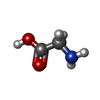 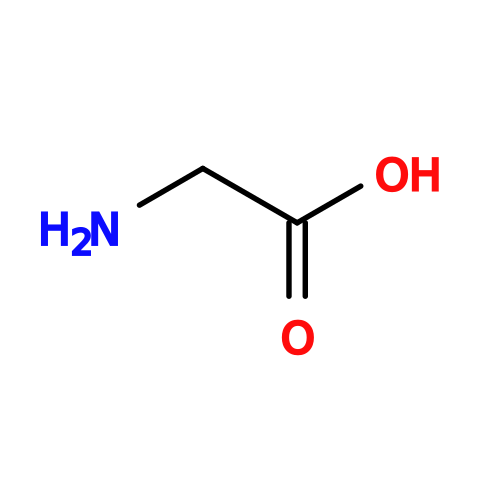 Type: peptide linking / Mass: 75.067 Da / Num. of mol.: 1 / Source method: obtained synthetically / Formula: C2H5NO2 / Feature type: SUBJECT OF INVESTIGATION Type: peptide linking / Mass: 75.067 Da / Num. of mol.: 1 / Source method: obtained synthetically / Formula: C2H5NO2 / Feature type: SUBJECT OF INVESTIGATIONHas ligand of interest | Y | Has protein modification | N | |
-Experimental details
-Experiment
| Experiment | Method: ELECTRON MICROSCOPY |
|---|---|
| EM experiment | Aggregation state: PARTICLE / 3D reconstruction method: single particle reconstruction |
- Sample preparation
| Component | Name: The complex of GlyT2 with glycine / Type: COMPLEX / Entity ID: #1 / Source: RECOMBINANT |
|---|---|
| Source (natural) | Organism: Homo sapiens (human) |
| Source (recombinant) | Organism: Homo sapiens (human) |
| Buffer solution | pH: 7.5 |
| Specimen | Embedding applied: NO / Shadowing applied: NO / Staining applied: NO / Vitrification applied: YES |
| Vitrification | Cryogen name: ETHANE |
- Electron microscopy imaging
| Experimental equipment |  Model: Titan Krios / Image courtesy: FEI Company |
|---|---|
| Microscopy | Model: TFS KRIOS |
| Electron gun | Electron source:  FIELD EMISSION GUN / Accelerating voltage: 300 kV / Illumination mode: FLOOD BEAM FIELD EMISSION GUN / Accelerating voltage: 300 kV / Illumination mode: FLOOD BEAM |
| Electron lens | Mode: BRIGHT FIELD / Nominal defocus max: 1800 nm / Nominal defocus min: 1500 nm |
| Image recording | Electron dose: 50 e/Å2 / Film or detector model: GATAN K3 BIOQUANTUM (6k x 4k) |
- Processing
| EM software |
| ||||||||||||
|---|---|---|---|---|---|---|---|---|---|---|---|---|---|
| CTF correction | Type: NONE | ||||||||||||
| 3D reconstruction | Resolution: 3.1 Å / Resolution method: FSC 0.143 CUT-OFF / Num. of particles: 56965 / Symmetry type: POINT | ||||||||||||
| Atomic model building | Source name: AlphaFold / Type: in silico model |
