[English] 日本語
Yorodumi Papers
- Database of articles cited by EMDB/PDB/SASBDB data -

+
Search query

Keywords
Structure methods
Author
Journal
IF

-
Structure paper

TitleSubstrate recognition and transport mechanism of the human proton-coupled amino-acid transporter 1 (SLC36A1).
Journal, issue, pagesNat Commun, Year 2026
Publish dateJul 7, 2026
AuthorsJian Yin / Sensen Zhang / Chang Liu / Min Xie / Yuanzhu Gao / Maofei Chen / Yixue Wang / Meiying Chen / Hongxuan Fan / Zi Yang / Huan Li / Li Liang / Boda Zhou / Xudong Chen / Maojun Yang /
PubMed AbstractThe proton-coupled amino-acid transporter SLC36A1 (hPAT1) is an atypical H⁺-driven carrier and mediates the intestinal absorption of a wide array of zwitterionic amino-acid analogs, including many ...The proton-coupled amino-acid transporter SLC36A1 (hPAT1) is an atypical H⁺-driven carrier and mediates the intestinal absorption of a wide array of zwitterionic amino-acid analogs, including many compounds with central nervous-system (CNS) activity, as well as the activation of the mTORC1 pathway and the export of amino acids from lysosomes, thereby maintaining cellular amino-acid homeostasis. Here, we present the cryo-EM structures of a member of the SLC36 family, hPAT1, in its apo state and in complex with three chemically distinct substrates, including the α-amino acid D-serine, the β-amino acid nipecotic acid, and the heterocyclic drug D-cycloserine, at resolutions of 3.4-3.5 Å. Despite their chemical diversity, all ligands adopt a spatially convergent binding mode, elucidating the structural basis for PAT1's broad substrate promiscuity. In addition, we identify E270 as a potential proton-binding site. Together, these findings provide structural insights into the molecular mechanism of proton-coupled amino acid transport. Notably, the cryo-EM structure of PAT1 bound to D-cycloserine illustrates a viable oral CNS drug delivery strategy: exploiting polar scaffolds to achieve transporter-mediated intestinal absorption and blood-brain barrier penetration without relying on high lipophilicity.
External linksNat Commun / PubMed:42414312
MethodsEM (single particle)
Resolution3.37 - 3.73 Å
Structure data

EMDB-64756, PDB-9v3t:
Apo SLC36A1
Method: EM (single particle) / Resolution: 3.73 Å

EMDB-64757, PDB-9v3v:
SLC36A1 bound to D-cycloserine
Method: EM (single particle) / Resolution: 3.37 Å

EMDB-64759, PDB-9v3x:
SLC36A1 bound to D-serine
Method: EM (single particle) / Resolution: 3.4 Å

EMDB-64762, PDB-9v3z:
SLC36A1 bound to D-NPA
Method: EM (single particle) / Resolution: 3.4 Å

Chemicals

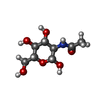
ChemComp-NAG:
2-acetamido-2-deoxy-beta-D-glucopyranose

ChemComp-4AX:
(R)-4-AMINO-ISOXAZOLIDIN-3-ONE / medication, antibiotic*YM

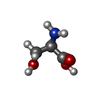
ChemComp-DSN:
D-SERINE

PDB-1bdb:
CIS-BIPHENYL-2,3-DIHYDRODIOL-2,3-DEHYDROGENASE FROM PSEUDOMONAS SP. LB400

Source
  • homo sapiens (human)
KeywordsTRANSPORT PROTEIN / lysosomal membrane protein apo / lysosomal membrane protein D-ser / lysosomal membrane protein ser / lysosomal membrane protein NPA

+
About Yorodumi Papers

-
News

-
Feb 9, 2022. New format data for meta-information of EMDB entries

New format data for meta-information of EMDB entries

  • Version 3 of the EMDB header file is now the official format.
  • The previous official version 1.9 will be removed from the archive.

Related info.:EMDB header

External links:wwPDB to switch to version 3 of the EMDB data model

-
Aug 12, 2020. Covid-19 info

Covid-19 info

URL: https://pdbj.org/emnavi/covid19.php

New page: Covid-19 featured information page in EM Navigator.

Related info.:Covid-19 info / Mar 5, 2020. Novel coronavirus structure data

+
Mar 5, 2020. Novel coronavirus structure data

Novel coronavirus structure data

Related info.:Yorodumi Speices / Aug 12, 2020. Covid-19 info

External links:COVID-19 featured content - PDBj / Molecule of the Month (242):Coronavirus Proteases

+
Jan 31, 2019. EMDB accession codes are about to change! (news from PDBe EMDB page)

EMDB accession codes are about to change! (news from PDBe EMDB page)

  • The allocation of 4 digits for EMDB accession codes will soon come to an end. Whilst these codes will remain in use, new EMDB accession codes will include an additional digit and will expand incrementally as the available range of codes is exhausted. The current 4-digit format prefixed with “EMD-” (i.e. EMD-XXXX) will advance to a 5-digit format (i.e. EMD-XXXXX), and so on. It is currently estimated that the 4-digit codes will be depleted around Spring 2019, at which point the 5-digit format will come into force.
  • The EM Navigator/Yorodumi systems omit the EMD- prefix.

Related info.:Q: What is EMD? / ID/Accession-code notation in Yorodumi/EM Navigator

External links:EMDB Accession Codes are Changing Soon! / Contact to PDBj

+
Jul 12, 2017. Major update of PDB

Major update of PDB

  • wwPDB released updated PDB data conforming to the new PDBx/mmCIF dictionary.
  • This is a major update changing the version number from 4 to 5, and with Remediation, in which all the entries are updated.
  • In this update, many items about electron microscopy experimental information are reorganized (e.g. em_software).
  • Now, EM Navigator and Yorodumi are based on the updated data.

External links:wwPDB Remediation / Enriched Model Files Conforming to OneDep Data Standards Now Available in the PDB FTP Archive

-
Yorodumi Papers

Database of articles cited by EMDB/PDB/SASBDB data

  • Database of articles cited by EMDB, PDB, and SASBDB entries
  • Using PubMed data

Related info.:EMDB / PDB / SASBDB / Yorodumi / EMN Papers / Changes in new EM Navigator and Yorodumi

Read more