 Movie
Movie Controller


+ Open data

- Basic information
| Entry | Database: PDB / ID: 9v3t | |||||||||||||||||||||
|---|---|---|---|---|---|---|---|---|---|---|---|---|---|---|---|---|---|---|---|---|---|---|
| Title | Apo SLC36A1 | |||||||||||||||||||||
 Components Components | Proton-coupled amino acid transporter 1 | |||||||||||||||||||||
 Keywords Keywords | TRANSPORT PROTEIN / lysosomal membrane protein apo | |||||||||||||||||||||
| Function / homology |  Function and homology information Function and homology informationamino acid:proton symporter activity / ABC-type taurine transporter transporter activity / gamma-aminobutyric acid:proton symporter activity / Proton-coupled neutral amino acid transporters / proline:proton symporter activity / L-alanine transport / proline transmembrane transport / L-proline transmembrane transporter activity / glycine transmembrane transporter activity / glycine transport ...amino acid:proton symporter activity / ABC-type taurine transporter transporter activity / gamma-aminobutyric acid:proton symporter activity / Proton-coupled neutral amino acid transporters / proline:proton symporter activity / L-alanine transport / proline transmembrane transport / L-proline transmembrane transporter activity / glycine transmembrane transporter activity / glycine transport / L-alanine transmembrane transporter activity / alanine transmembrane transporter activity / alanine transport / taurine transmembrane transport / Amino acid transport across the plasma membrane / amino acid transmembrane transporter activity / amino acid transport / amino acid import across plasma membrane / proton transmembrane transport / apical plasma membrane / lysosomal membrane / endoplasmic reticulum / plasma membrane Similarity search - Function | |||||||||||||||||||||
| Biological species |  Homo sapiens (human) Homo sapiens (human) | |||||||||||||||||||||
| Method | ELECTRON MICROSCOPY / single particle reconstruction / cryo EM / Resolution: 3.73 Å | |||||||||||||||||||||
 Authors Authors | Zhang, S.S. | |||||||||||||||||||||
| Funding support |  China, 1items China, 1items
| |||||||||||||||||||||
 Citation Citation | Journal: Nat Commun / Year: 2026 Title: Substrate recognition and transport mechanism of the human proton-coupled amino-acid transporter 1 (SLC36A1). Authors: Jian Yin / Sensen Zhang / Chang Liu / Min Xie / Yuanzhu Gao / Maofei Chen / Yixue Wang / Meiying Chen / Hongxuan Fan / Zi Yang / Huan Li / Li Liang / Boda Zhou / Xudong Chen / Maojun Yang / Abstract: The proton-coupled amino-acid transporter SLC36A1 (hPAT1) is an atypical H⁺-driven carrier and mediates the intestinal absorption of a wide array of zwitterionic amino-acid analogs, including many ...The proton-coupled amino-acid transporter SLC36A1 (hPAT1) is an atypical H⁺-driven carrier and mediates the intestinal absorption of a wide array of zwitterionic amino-acid analogs, including many compounds with central nervous-system (CNS) activity, as well as the activation of the mTORC1 pathway and the export of amino acids from lysosomes, thereby maintaining cellular amino-acid homeostasis. Here, we present the cryo-EM structures of a member of the SLC36 family, hPAT1, in its apo state and in complex with three chemically distinct substrates, including the α-amino acid D-serine, the β-amino acid nipecotic acid, and the heterocyclic drug D-cycloserine, at resolutions of 3.4-3.5 Å. Despite their chemical diversity, all ligands adopt a spatially convergent binding mode, elucidating the structural basis for PAT1's broad substrate promiscuity. In addition, we identify E270 as a potential proton-binding site. Together, these findings provide structural insights into the molecular mechanism of proton-coupled amino acid transport. Notably, the cryo-EM structure of PAT1 bound to D-cycloserine illustrates a viable oral CNS drug delivery strategy: exploiting polar scaffolds to achieve transporter-mediated intestinal absorption and blood-brain barrier penetration without relying on high lipophilicity. | |||||||||||||||||||||
| History |
|
- Structure visualization
| Structure viewer | Molecule: MolmilJmol/JSmol |
|---|
- Downloads & links
-Download
| PDBx/mmCIF format | 9v3t.cif.gz | 85.2 KB | Display | PDBx/mmCIF format |
|---|---|---|---|---|
| PDB format | pdb9v3t.ent.gz | 62.9 KB | Display | PDB format |
| PDBx/mmJSON format | 9v3t.json.gz | Tree view | PDBx/mmJSON format | |
| Others |  Other downloads Other downloads |
-Validation report
| Arichive directory | https://data.pdbj.org/pub/pdb/validation_reports/v3/9v3tftp://data.pdbj.org/pub/pdb/validation_reports/v3/9v3t | HTTPS FTP |
|---|
-Related structure data
| Related structure data |  64756MC  9v3vC  9v3xC  9v3zC M: map data used to model this data C: citing same article ( |
|---|---|
| Similar structure data |


-Links
 PDBj
PDBj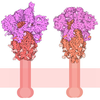
- Assembly
| Deposited unit | 
|
|---|---|
| 1 |
|
-Components
| #1: Protein | Mass: 53112.230 Da / Num. of mol.: 1 Source method: isolated from a genetically manipulated source Source: (gene. exp.) Homo sapiens (human) / Gene: SLC36A1, PAT1 / Cell line (production host): HEK293 / Production host: Homo sapiens (human) / References: UniProt: Q7Z2H8 |
|---|---|
| #2: Sugar | ChemComp-NAG /  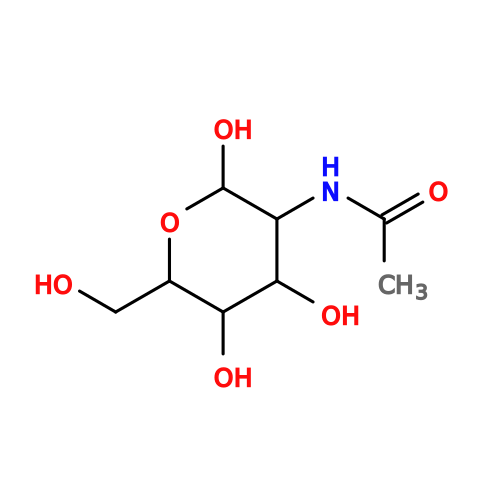 Type: D-saccharide, beta linking / Mass: 221.208 Da / Num. of mol.: 1 / Source method: obtained synthetically / Formula: C8H15NO6 Type: D-saccharide, beta linking / Mass: 221.208 Da / Num. of mol.: 1 / Source method: obtained synthetically / Formula: C8H15NO6 |
| Has ligand of interest | N |
| Has protein modification | Y |
-Experimental details
-Experiment
| Experiment | Method: ELECTRON MICROSCOPY |
|---|---|
| EM experiment | Aggregation state: PARTICLE / 3D reconstruction method: single particle reconstruction |
- Sample preparation
| Component | Name: lysosomal membrane protein / Type: COMPLEX / Entity ID: #1 / Source: RECOMBINANT |
|---|---|
| Source (natural) | Organism: Homo sapiens (human) |
| Source (recombinant) | Organism: Homo sapiens (human) |
| Buffer solution | pH: 7.2 |
| Specimen | Embedding applied: NO / Shadowing applied: NO / Staining applied: NO / Vitrification applied: YES |
| Vitrification | Cryogen name: ETHANE |
- Electron microscopy imaging
| Experimental equipment |  Model: Titan Krios / Image courtesy: FEI Company |
|---|---|
| Microscopy | Model: TFS KRIOS |
| Electron gun | Electron source:  FIELD EMISSION GUN / Accelerating voltage: 300 kV / Illumination mode: FLOOD BEAM FIELD EMISSION GUN / Accelerating voltage: 300 kV / Illumination mode: FLOOD BEAM |
| Electron lens | Mode: BRIGHT FIELD / Nominal defocus max: 2500 nm / Nominal defocus min: 1200 nm |
| Image recording | Electron dose: 50 e/Å2 / Film or detector model: GATAN K3 BIOQUANTUM (6k x 4k) |
- Processing
| CTF correction | Type: PHASE FLIPPING AND AMPLITUDE CORRECTION |
|---|---|
| 3D reconstruction | Resolution: 3.73 Å / Resolution method: FSC 0.143 CUT-OFF / Num. of particles: 225000 / Symmetry type: POINT |
