 Movie
Movie Controller
 Structure viewers
 About Yorodumi Papers


+Search query
-Structure paper
| Title | Structural and mechanistic insights into caseinolytic protease inhibition for antimicrobial development against Pseudomonas plecoglossicida. |
|---|---|
| Journal, issue, pages | PLoS Pathog, Vol. 22, Issue 2, Page e1013909, Year 2026 |
| Publish date | Feb 12, 2026 |
 Authors Authors | Jingjie Chen / Ping Zhang / Hongxin Guan / Bing Gong / Xiaoding Li / Zekai Li / Fan Li / Biao Zhou / Xuemin Chen / Xinhua Chen / Songying Ouyang / Yong-An Zhang /  |
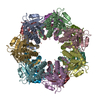
| PubMed Abstract | The caseinolytic protease (ClpP) is an emerging antibacterial target. Pseudomonas plecoglossicida (Pp), a pathogen causing visceral white spot disease in Larimichthys crocea, encodes two ClpP ...The caseinolytic protease (ClpP) is an emerging antibacterial target. Pseudomonas plecoglossicida (Pp), a pathogen causing visceral white spot disease in Larimichthys crocea, encodes two ClpP paralogs, PpClpP1 and PpClpP2. This study characterizes their distinct structural and functional properties. Phylogenetic and biochemical analysis revealed that PpClpP2 functions as a canonical serine protease with high peptidase activity, while PpClpP1 is evolutionarily divergent, exhibiting low inherent activity due to an unconventional Ser-His-Pro catalytic triad and a truncated N-terminal domain. Cryo-EM structure determination of PpClpP1 confirmed a homotetradecameric assembly with a dilated axial pore and a non-canonical catalytic geometry. In contrast, AlphaFold-predicted PpClpP2 displayed a compact structure with a canonical Ser-His-Asp triad. The subunits formed a stable heterotetradecamer (PpClpP1P2) with enhanced proteolytic activity compared to individual homotetradecameric. Pull-down assays demonstrated that PpClpP2, but not PpClpP1, specifically interacts with the unfoldase PpClpX, and the PpClpP1P2 heterotetradecamer further augmented PpClpX-mediated degradation of model substrates. Notably, the proteasome inhibitor bortezomib (BTZ) selectively inhibited PpClpP1 by binding to a unique pocket near the active site without engaging the catalytic serine, thereby suppressing bacterial growth in a PpClpP1-dependent manner. This study elucidates the structural basis of functional divergence between PpClpP paralogs, highlights their synergistic interplay in proteolysis, and identifies PpClpP1 as a druggable target for antibacterial development. |
 External links External links | PLoS Pathog / PubMed:41678539 / PubMed Central |
| Methods | EM (single particle) |
| Resolution | 3.07 Å |
| Structure data | EMDB-64601, PDB-9uxt: |
| Source |
|
 Keywords Keywords | HYDROLASE / Pseudomonas plecoglossicida; caseinolytic proteases; tetradecameric; Cryo-EM structure |

 Pseudomonas plecoglossicida (bacteria)