[English] 日本語
Yorodumi
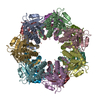
- EMDB-64601: The Structural Basis of ClpP1 in Pseudomonas plecoglossicida -

+
Open data


ID or keywords:

Loading...

-
Basic information

Entry
Database: EMDB / ID: EMD-64601
TitleThe Structural Basis of ClpP1 in Pseudomonas plecoglossicida
Map data
Sample
  • Complex: ClpP tetradecamer
    • Protein or peptide: Clp protease
KeywordsPseudomonas plecoglossicida / caseinolytic proteases / tetradecameric / Cryo-EM structure / HYDROLASE
Function / homologyClp protease proteolytic subunit /Translocation-enhancing protein TepA / Clp protease / ClpP/crotonase-like domain superfamily / peptidase activity / proteolysis / Clp protease
Function and homology information
Biological speciesPseudomonas plecoglossicida (bacteria) / Pseudomonas plecoglossicida NBRC 103162 = DSM 15088 (bacteria)
Methodsingle particle reconstruction / Resolution: 3.07 Å
AuthorsJingjie C
Funding support1 items
OrganizationGrant numberCountry
Not funded
CitationJournal: PLoS Pathog / Year: 2026
Title: Structural and mechanistic insights into caseinolytic protease inhibition for antimicrobial development against Pseudomonas plecoglossicida.
Authors: Jingjie Chen / Ping Zhang / Hongxin Guan / Bing Gong / Xiaoding Li / Zekai Li / Fan Li / Biao Zhou / Xuemin Chen / Xinhua Chen / Songying Ouyang / Yong-An Zhang /
Abstract: The caseinolytic protease (ClpP) is an emerging antibacterial target. Pseudomonas plecoglossicida (Pp), a pathogen causing visceral white spot disease in Larimichthys crocea, encodes two ClpP ...The caseinolytic protease (ClpP) is an emerging antibacterial target. Pseudomonas plecoglossicida (Pp), a pathogen causing visceral white spot disease in Larimichthys crocea, encodes two ClpP paralogs, PpClpP1 and PpClpP2. This study characterizes their distinct structural and functional properties. Phylogenetic and biochemical analysis revealed that PpClpP2 functions as a canonical serine protease with high peptidase activity, while PpClpP1 is evolutionarily divergent, exhibiting low inherent activity due to an unconventional Ser-His-Pro catalytic triad and a truncated N-terminal domain. Cryo-EM structure determination of PpClpP1 confirmed a homotetradecameric assembly with a dilated axial pore and a non-canonical catalytic geometry. In contrast, AlphaFold-predicted PpClpP2 displayed a compact structure with a canonical Ser-His-Asp triad. The subunits formed a stable heterotetradecamer (PpClpP1P2) with enhanced proteolytic activity compared to individual homotetradecameric. Pull-down assays demonstrated that PpClpP2, but not PpClpP1, specifically interacts with the unfoldase PpClpX, and the PpClpP1P2 heterotetradecamer further augmented PpClpX-mediated degradation of model substrates. Notably, the proteasome inhibitor bortezomib (BTZ) selectively inhibited PpClpP1 by binding to a unique pocket near the active site without engaging the catalytic serine, thereby suppressing bacterial growth in a PpClpP1-dependent manner. This study elucidates the structural basis of functional divergence between PpClpP paralogs, highlights their synergistic interplay in proteolysis, and identifies PpClpP1 as a druggable target for antibacterial development.
History
DepositionMay 15, 2025-
Header (metadata) releaseMar 18, 2026-
Map releaseMar 18, 2026-
UpdateMar 18, 2026-
Current statusMar 18, 2026Processing site: PDBc / Status: Released

-
Structure visualization

Supplemental images

Downloads & links

-
Map

FileDownload / File: emd_64601.map.gz / Format: CCP4 / Size: 125 MB / Type: IMAGE STORED AS FLOATING POINT NUMBER (4 BYTES)
Projections & slices

Image control

Size
Brightness
Contrast
Others
AxesZ (Sec.)Y (Row.)X (Col.)
0.7 Å/pix.
x 320 pix.
= 223.36 Å
0.7 Å/pix.
x 320 pix.
= 223.36 Å
0.7 Å/pix.
x 320 pix.
= 223.36 Å

Surface

Projections

Slices (1/3)

Slices (1/2)

Slices (2/3)

Images are generated by Spider.

Voxel sizeX=Y=Z: 0.698 Å
Density
Contour LevelBy AUTHOR: 0.0121
Minimum - Maximum-0.0017001772 - 1.715682
Average (Standard dev.)0.004247111 (±0.048169043)
SymmetrySpace group: 1
Details

EMDB XML:

Map geometry
Axis orderXYZ
Origin000
Dimensions320320320
Spacing320320320
CellA=B=C: 223.36 Å
α=β=γ: 90.0 °

-
Supplemental data

-
Half map: #2

Fileemd_64601_half_map_1.map
Projections & Slices
AxesZYX

Projections

Slices (1/2)
Density Histograms

-
Half map: #1

Fileemd_64601_half_map_2.map
Projections & Slices
AxesZYX

Projections

Slices (1/2)
Density Histograms

-
Sample components

-
Entire : ClpP tetradecamer

EntireName: ClpP tetradecamer
Components
  • Complex: ClpP tetradecamer
    • Protein or peptide: Clp protease

-
Supramolecule #1: ClpP tetradecamer

SupramoleculeName: ClpP tetradecamer / type: complex / ID: 1 / Parent: 0 / Macromolecule list: all
Source (natural)Organism: Pseudomonas plecoglossicida (bacteria)

-
Macromolecule #1: Clp protease

MacromoleculeName: Clp protease / type: protein_or_peptide / ID: 1 / Number of copies: 14 / Enantiomer: LEVO
Source (natural)Organism: Pseudomonas plecoglossicida NBRC 103162 = DSM 15088 (bacteria)
Molecular weightTheoretical: 20.400279 KDa
Recombinant expressionOrganism: Escherichia coli (E. coli)
SequenceString:
MARHIIHFTG PINSSTCGNL INTCSKALQQ GADILQLNIA TMGGECSYGF TLYNYLRGLP VPLHTHNLGT VESMGNILFL AGEHRTACA RSKFLFHPFH WTLHGSVDHA RMAEYAMSLD YDLRLYAQIV AERTEGSIEV LDTTRYLMAY PRILGPQEAM D SGMIHAID EMPIEAEAPQ WSVHA

UniProtKB: Clp protease

-
Experimental details

-
Structure determination

Processingsingle particle reconstruction
Aggregation state3D array

-
Sample preparation

BufferpH: 7.5

-
Electron microscopy

MicroscopeTFS GLACIOS
Image recordingFilm or detector model: GATAN K2 SUMMIT (4k x 4k) / Average electron dose: 45.0 e/Å2
Electron beamAcceleration voltage: 300 kV / Electron source: FIELD EMISSION GUN
Electron opticsIllumination mode: FLOOD BEAM / Imaging mode: BRIGHT FIELD / Nominal defocus max: 2.0 µm / Nominal defocus min: 0.4 µm

+
Image processing

CTF correctionType: NONE
Startup modelType of model: NONE
Final reconstructionResolution.type: BY AUTHOR / Resolution: 3.07 Å / Resolution method: FSC 0.143 CUT-OFF / Software - Name: RELION (ver. 9.03) / Number images used: 39438
Initial angle assignmentType: OTHER
Final angle assignmentType: COMMON LINE

-
Atomic model buiding 1

Initial modelChain - Source name: Other / Chain - Initial model type: experimental model / Details: predicted
Output model

PDB-9uxt:
The Structural Basis of ClpP1 in Pseudomonas plecoglossicida

+
About Yorodumi

-
News

-
Feb 9, 2022. New format data for meta-information of EMDB entries

New format data for meta-information of EMDB entries

  • Version 3 of the EMDB header file is now the official format.
  • The previous official version 1.9 will be removed from the archive.

Related info.:EMDB header

External links:wwPDB to switch to version 3 of the EMDB data model

-
Aug 12, 2020. Covid-19 info

Covid-19 info

URL: https://pdbj.org/emnavi/covid19.php

New page: Covid-19 featured information page in EM Navigator.

Related info.:Covid-19 info / Mar 5, 2020. Novel coronavirus structure data

+
Mar 5, 2020. Novel coronavirus structure data

Novel coronavirus structure data

Related info.:Yorodumi Speices / Aug 12, 2020. Covid-19 info

External links:COVID-19 featured content - PDBj / Molecule of the Month (242):Coronavirus Proteases

+
Jan 31, 2019. EMDB accession codes are about to change! (news from PDBe EMDB page)

EMDB accession codes are about to change! (news from PDBe EMDB page)

  • The allocation of 4 digits for EMDB accession codes will soon come to an end. Whilst these codes will remain in use, new EMDB accession codes will include an additional digit and will expand incrementally as the available range of codes is exhausted. The current 4-digit format prefixed with “EMD-” (i.e. EMD-XXXX) will advance to a 5-digit format (i.e. EMD-XXXXX), and so on. It is currently estimated that the 4-digit codes will be depleted around Spring 2019, at which point the 5-digit format will come into force.
  • The EM Navigator/Yorodumi systems omit the EMD- prefix.

Related info.:Q: What is EMD? / ID/Accession-code notation in Yorodumi/EM Navigator

External links:EMDB Accession Codes are Changing Soon! / Contact to PDBj

+
Jul 12, 2017. Major update of PDB

Major update of PDB

  • wwPDB released updated PDB data conforming to the new PDBx/mmCIF dictionary.
  • This is a major update changing the version number from 4 to 5, and with Remediation, in which all the entries are updated.
  • In this update, many items about electron microscopy experimental information are reorganized (e.g. em_software).
  • Now, EM Navigator and Yorodumi are based on the updated data.

External links:wwPDB Remediation / Enriched Model Files Conforming to OneDep Data Standards Now Available in the PDB FTP Archive

-
Yorodumi

Thousand views of thousand structures

  • Yorodumi is a browser for structure data from EMDB, PDB, SASBDB, etc.
  • This page is also the successor to EM Navigator detail page, and also detail information page/front-end page for Omokage search.
  • The word "yorodu" (or yorozu) is an old Japanese word meaning "ten thousand". "mi" (miru) is to see.

Related info.:EMDB / PDB / SASBDB / Comparison of 3 databanks / Yorodumi Search / Aug 31, 2016. New EM Navigator & Yorodumi / Yorodumi Papers / Jmol/JSmol / Function and homology information / Changes in new EM Navigator and Yorodumi

Read more