[English] 日本語
Yorodumi Papers
- Database of articles cited by EMDB/PDB/SASBDB data -

+
Search query

Keywords
Structure methods
Author
Journal
IF

-
Structure paper

TitleMolecular basis of very-long-chain fatty acid elongation by the CER6-GL2 enzyme complex in plant wax biosynthesis.
Journal, issue, pagesSci Adv, Vol. 11, Issue 49, Page eadz0135, Year 2025
Publish dateDec 5, 2025
AuthorsYaqi Liu / Yuan Chen / Xue Zhang / Mengxue Li / Ji Wang / Zhao Yang / Miaolian Ma / Zhiwei Zhao / Hongtao Liu / Fang Yu / Peng Zhang /
PubMed AbstractPlant cuticular waxes, crucial hydrophobic barriers, are primarily composed of aliphatics derived from very-long-chain fatty acids (VLCFAs; >C28) synthesized by the endoplasmic reticulum fatty acid ...Plant cuticular waxes, crucial hydrophobic barriers, are primarily composed of aliphatics derived from very-long-chain fatty acids (VLCFAs; >C28) synthesized by the endoplasmic reticulum fatty acid elongase complex. The core catalytic subunit, CER6 (KCS6), requires interaction with the BAHD protein GL2 to elongate acyl chains beyond C28. We determined the cryo-electron microscopy structure of the maize CER6-GL2 (ZmCER6-ZmGL2) heterotetramer bound to coenzyme A (CoA) and malonyl-CoA, revealing a membrane-anchored ZmCER6 homodimer, with each cytosolic catalytic domain having a substrate tunnel. Structural and biochemical analyses suggest that ZmGL2's amino terminus binds ZmCER6 and remodels its substrate tunnel into a continuous hydrophobic channel at their interface, enabling acyl-chain elongation. CER6 uses a distinct Cys-His-Asn catalytic triad, differing from the histidine-dependent catalysis of mammalian elongases. GL2 acts noncatalytically to modulate CER6 activity. Comparative analyses suggest that species-specific substrate preferences arise from divergent CER2/GL2 interactions. This work elucidates the acyl-chain elongation mechanism of plant VLCFA biosynthesis and provides a foundation for engineering stress-resilient crops via wax modulation.
External linksSci Adv / PubMed:41337596 / PubMed Central
MethodsEM (single particle)
Resolution2.88 - 3.26 Å
Structure data

EMDB-64504, PDB-9uu3:
Cryo-EM structure of the maize CER6-GL2 complex bound with CoA
Method: EM (single particle) / Resolution: 3.01 Å

EMDB-64505, PDB-9uu4:
Cryo-EM structure of the maize CER6-GL2 complex (inactive C222A mutant) bound with malonyl-CoA
Method: EM (single particle) / Resolution: 2.96 Å

EMDB-64506, PDB-9uu5:
Cryo-EM structure of the maize CER6-GL2 complex in the presence of 30:0 CoA
Method: EM (single particle) / Resolution: 3.26 Å

EMDB-64507: Cryo-EM structure of the maize CER6-GL2 complex (inactive C222A mutant) in the presence of 28:0 CoA
Method: EM (single particle) / Resolution: 2.88 Å

Chemicals

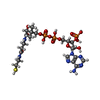
ChemComp-COA:
COENZYME A

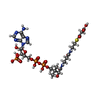
ChemComp-MLC:
MALONYL-COENZYME A

Source
  • zea mays (maize)
KeywordsPLANT PROTEIN / Complex / CoA / inactive C222A mutant / Malonyl-CoA / 30:0 CoA

+
About Yorodumi Papers

-
News

-
Feb 9, 2022. New format data for meta-information of EMDB entries

New format data for meta-information of EMDB entries

  • Version 3 of the EMDB header file is now the official format.
  • The previous official version 1.9 will be removed from the archive.

Related info.:EMDB header

External links:wwPDB to switch to version 3 of the EMDB data model

-
Aug 12, 2020. Covid-19 info

Covid-19 info

URL: https://pdbj.org/emnavi/covid19.php

New page: Covid-19 featured information page in EM Navigator.

Related info.:Covid-19 info / Mar 5, 2020. Novel coronavirus structure data

+
Mar 5, 2020. Novel coronavirus structure data

Novel coronavirus structure data

Related info.:Yorodumi Speices / Aug 12, 2020. Covid-19 info

External links:COVID-19 featured content - PDBj / Molecule of the Month (242):Coronavirus Proteases

+
Jan 31, 2019. EMDB accession codes are about to change! (news from PDBe EMDB page)

EMDB accession codes are about to change! (news from PDBe EMDB page)

  • The allocation of 4 digits for EMDB accession codes will soon come to an end. Whilst these codes will remain in use, new EMDB accession codes will include an additional digit and will expand incrementally as the available range of codes is exhausted. The current 4-digit format prefixed with “EMD-” (i.e. EMD-XXXX) will advance to a 5-digit format (i.e. EMD-XXXXX), and so on. It is currently estimated that the 4-digit codes will be depleted around Spring 2019, at which point the 5-digit format will come into force.
  • The EM Navigator/Yorodumi systems omit the EMD- prefix.

Related info.:Q: What is EMD? / ID/Accession-code notation in Yorodumi/EM Navigator

External links:EMDB Accession Codes are Changing Soon! / Contact to PDBj

+
Jul 12, 2017. Major update of PDB

Major update of PDB

  • wwPDB released updated PDB data conforming to the new PDBx/mmCIF dictionary.
  • This is a major update changing the version number from 4 to 5, and with Remediation, in which all the entries are updated.
  • In this update, many items about electron microscopy experimental information are reorganized (e.g. em_software).
  • Now, EM Navigator and Yorodumi are based on the updated data.

External links:wwPDB Remediation / Enriched Model Files Conforming to OneDep Data Standards Now Available in the PDB FTP Archive

-
Yorodumi Papers

Database of articles cited by EMDB/PDB/SASBDB data

  • Database of articles cited by EMDB, PDB, and SASBDB entries
  • Using PubMed data

Related info.:EMDB / PDB / SASBDB / Yorodumi / EMN Papers / Changes in new EM Navigator and Yorodumi

Read more