[English] 日本語
Yorodumi Papers
- Database of articles cited by EMDB/PDB/SASBDB data -

+
Search query

Keywords
Structure methods
Author
Journal
IF

-
Structure paper

TitleMultiple structures of photosystem I-FCPI supercomplexes from a coccolithophore alga reveal a modular antenna organization.
Journal, issue, pagesBiochim Biophys Acta Bioenerg, Vol. 1867, Issue 3, Page 149588, Year 2026
Publish dateMar 19, 2026
AuthorsRomain La Rocca / Pi-Cheng Tsai / Koji Kato / Yoshiki Nakajima / Fusamichi Akita / Jian-Ren Shen /
PubMed AbstractPhotosystem I (PSI) converts light energy into chemical energy in photosynthesis, and forms supercomplexes with light-harvesting complexes (LHCI) in eukaryotes to enhance energy capture and transfer. ...Photosystem I (PSI) converts light energy into chemical energy in photosynthesis, and forms supercomplexes with light-harvesting complexes (LHCI) in eukaryotes to enhance energy capture and transfer. Various numbers and organizations of both PSI core and LHCI subunits are observed in various organisms. A subgroup of haptophytes named coccolithophores play a major role in marine carbon cycle and CaCO production, and the light-harvesting antennas of them are named FCPs (fucoxanthin-chlorophyll a/c binding protein) because they bind chlorophyll c and fucoxanthin in addition to chlorophyll a. A structure of a large PSI-FCPI supercomplex containing 38 FCPI subunits has been reported from a coccolithophore Emiliania huxleyi recently (L. Shen et al., Science 389, eadv2132, 2025). Here we solved five cryo-electron microscopy (cryo-EM) structures of PSI-FCPI supercomplexes isolated from another coccolithophore Chrysotila roscoffensis with different detergents at resolutions ranging from 2.3 to 1.7 Å. These structures represent discrete PSI-FCPIs containing 1, 4, 6, 8 and 9 FCPI subunits, with FCPIs arranged in a modular fashion. Association of each FCPI module to the PSI core, as well as the arrangement of protein subunits and pigments, are revealed. Contributions of individual antenna modules to excitation energy transfer were calculated and compared with PSI-FCPI supercomplexes from other species of coccolithophores and haptophytes. These results pinpoint the assembly of stable PSI-FCPI supercomplexes in C. roscoffensis and provide insights into how antenna modules contribute to energy transfer in coccolithophores.
External linksBiochim Biophys Acta Bioenerg / PubMed:41864554
MethodsEM (single particle)
Resolution1.74 - 2.33 Å
Structure data

EMDB-64153, PDB-9uh3:
PSI-9 FCPI supercomplex from haptophyte Chrysotila roscoffensis
Method: EM (single particle) / Resolution: 1.74 Å

EMDB-64154, PDB-9uh4:
PSI-4 FCPI supercomplex from haptophyte Chrysotila roscoffensis
Method: EM (single particle) / Resolution: 2.12 Å

EMDB-64362, PDB-9unu:
PSI-1 FCPI supercomplex from haptophyte Chrysotila roscoffensis
Method: EM (single particle) / Resolution: 2.18 Å

EMDB-64378, PDB-9uof:
PSI-6 FCPI supercomplex from haptophyte Chrysotila roscoffensis
Method: EM (single particle) / Resolution: 1.89 Å

EMDB-64383, PDB-9uov:
PSI-8 FCPI supercomplex from haptophyte Chrysotila roscoffensis
Method: EM (single particle) / Resolution: 2.33 Å

Chemicals

ChemComp-CLA:
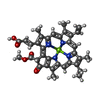
CHLOROPHYLL A

ChemComp-PQN:
PHYLLOQUINONE

ChemComp-LHG:
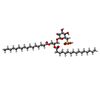
1,2-DIPALMITOYL-PHOSPHATIDYL-GLYCEROLE / phospholipid*YM

ChemComp-BCR:
BETA-CAROTENE

ChemComp-LMU:
DODECYL-ALPHA-D-MALTOSIDE / detergent*YM

ChemComp-CL0:
CHLOROPHYLL A ISOMER

ChemComp-SF4:
IRON/SULFUR CLUSTER

ChemComp-DGD:
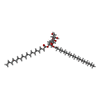
DIGALACTOSYL DIACYL GLYCEROL (DGDG)

ChemComp-SQD:
1,2-DI-O-ACYL-3-O-[6-DEOXY-6-SULFO-ALPHA-D-GLUCOPYRANOSYL]-SN-GLYCEROL

ChemComp-DD6:
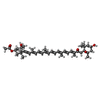
(3S,3'R,5R,6S,7cis)-7',8'-didehydro-5,6-dihydro-5,6-epoxy-beta,beta-carotene-3,3'-diol

ChemComp-LMG:
1,2-DISTEAROYL-MONOGALACTOSYL-DIGLYCERIDE

ChemComp-KC1:
Chlorophyll c1

ChemComp-A86:
(3S,3'S,5R,5'R,6S,6'R,8'R)-3,5'-dihydroxy-8-oxo-6',7'-didehydro-5,5',6,6',7,8-hexahydro-5,6-epoxy-beta,beta-caroten-3'-

ChemComp-HOH:
WATER

Source
  • chrysotila roscoffensis (eukaryote)
KeywordsPHOTOSYNTHESIS / photosystem I / chlorophyll / light-harvesting complex / biogenesis / assembly / LHCI / FCPI / coccolithophore / haptophyte

+
About Yorodumi Papers

-
News

-
Feb 9, 2022. New format data for meta-information of EMDB entries

New format data for meta-information of EMDB entries

  • Version 3 of the EMDB header file is now the official format.
  • The previous official version 1.9 will be removed from the archive.

Related info.:EMDB header

External links:wwPDB to switch to version 3 of the EMDB data model

-
Aug 12, 2020. Covid-19 info

Covid-19 info

URL: https://pdbj.org/emnavi/covid19.php

New page: Covid-19 featured information page in EM Navigator.

Related info.:Covid-19 info / Mar 5, 2020. Novel coronavirus structure data

+
Mar 5, 2020. Novel coronavirus structure data

Novel coronavirus structure data

Related info.:Yorodumi Speices / Aug 12, 2020. Covid-19 info

External links:COVID-19 featured content - PDBj / Molecule of the Month (242):Coronavirus Proteases

+
Jan 31, 2019. EMDB accession codes are about to change! (news from PDBe EMDB page)

EMDB accession codes are about to change! (news from PDBe EMDB page)

  • The allocation of 4 digits for EMDB accession codes will soon come to an end. Whilst these codes will remain in use, new EMDB accession codes will include an additional digit and will expand incrementally as the available range of codes is exhausted. The current 4-digit format prefixed with “EMD-” (i.e. EMD-XXXX) will advance to a 5-digit format (i.e. EMD-XXXXX), and so on. It is currently estimated that the 4-digit codes will be depleted around Spring 2019, at which point the 5-digit format will come into force.
  • The EM Navigator/Yorodumi systems omit the EMD- prefix.

Related info.:Q: What is EMD? / ID/Accession-code notation in Yorodumi/EM Navigator

External links:EMDB Accession Codes are Changing Soon! / Contact to PDBj

+
Jul 12, 2017. Major update of PDB

Major update of PDB

  • wwPDB released updated PDB data conforming to the new PDBx/mmCIF dictionary.
  • This is a major update changing the version number from 4 to 5, and with Remediation, in which all the entries are updated.
  • In this update, many items about electron microscopy experimental information are reorganized (e.g. em_software).
  • Now, EM Navigator and Yorodumi are based on the updated data.

External links:wwPDB Remediation / Enriched Model Files Conforming to OneDep Data Standards Now Available in the PDB FTP Archive

-
Yorodumi Papers

Database of articles cited by EMDB/PDB/SASBDB data

  • Database of articles cited by EMDB, PDB, and SASBDB entries
  • Using PubMed data

Related info.:EMDB / PDB / SASBDB / Yorodumi / EMN Papers / Changes in new EM Navigator and Yorodumi

Read more