 Movie
Movie Controller


+ Open data

- Basic information
| Entry | Database: PDB / ID: 9uov | |||||||||||||||||||||||||||
|---|---|---|---|---|---|---|---|---|---|---|---|---|---|---|---|---|---|---|---|---|---|---|---|---|---|---|---|---|
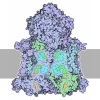
| Title | PSI-8 FCPI supercomplex from haptophyte Chrysotila roscoffensis | |||||||||||||||||||||||||||
 Components Components |
| |||||||||||||||||||||||||||
 Keywords Keywords | PHOTOSYNTHESIS / photosystem I / chlorophyll / light-harvesting complex / biogenesis / assembly / LHCI / FCPI / coccolithophore / haptophyte | |||||||||||||||||||||||||||
| Function / homology |  Function and homology information Function and homology informationChem-A86 / BETA-CAROTENE / CHLOROPHYLL A ISOMER / CHLOROPHYLL A / Chem-DD6 / DIGALACTOSYL DIACYL GLYCEROL (DGDG) / Chlorophyll c1 / 1,2-DIPALMITOYL-PHOSPHATIDYL-GLYCEROLE / 1,2-DISTEAROYL-MONOGALACTOSYL-DIGLYCERIDE / PHYLLOQUINONE ...Chem-A86 / BETA-CAROTENE / CHLOROPHYLL A ISOMER / CHLOROPHYLL A / Chem-DD6 / DIGALACTOSYL DIACYL GLYCEROL (DGDG) / Chlorophyll c1 / 1,2-DIPALMITOYL-PHOSPHATIDYL-GLYCEROLE / 1,2-DISTEAROYL-MONOGALACTOSYL-DIGLYCERIDE / PHYLLOQUINONE / IRON/SULFUR CLUSTER / Chem-SQD Similarity search - Component | |||||||||||||||||||||||||||
| Biological species |  Chrysotila roscoffensis (eukaryote) Chrysotila roscoffensis (eukaryote) | |||||||||||||||||||||||||||
| Method | ELECTRON MICROSCOPY / single particle reconstruction / cryo EM / Resolution: 2.33 Å | |||||||||||||||||||||||||||
 Authors Authors | La Rocca, R. / Tsai, P.-C. / Kato, K. / Nakajima, Y. / Akita, F. / Shen, J.-R. | |||||||||||||||||||||||||||
| Funding support | 1items
| |||||||||||||||||||||||||||
 Citation Citation | Journal: Biochim Biophys Acta Bioenerg / Year: 2026 Title: Multiple structures of photosystem I-FCPI supercomplexes from a coccolithophore alga reveal a modular antenna organization. Authors: Romain La Rocca / Pi-Cheng Tsai / Koji Kato / Yoshiki Nakajima / Fusamichi Akita / Jian-Ren Shen /  Abstract: Photosystem I (PSI) converts light energy into chemical energy in photosynthesis, and forms supercomplexes with light-harvesting complexes (LHCI) in eukaryotes to enhance energy capture and transfer. ...Photosystem I (PSI) converts light energy into chemical energy in photosynthesis, and forms supercomplexes with light-harvesting complexes (LHCI) in eukaryotes to enhance energy capture and transfer. Various numbers and organizations of both PSI core and LHCI subunits are observed in various organisms. A subgroup of haptophytes named coccolithophores play a major role in marine carbon cycle and CaCO production, and the light-harvesting antennas of them are named FCPs (fucoxanthin-chlorophyll a/c binding protein) because they bind chlorophyll c and fucoxanthin in addition to chlorophyll a. A structure of a large PSI-FCPI supercomplex containing 38 FCPI subunits has been reported from a coccolithophore Emiliania huxleyi recently (L. Shen et al., Science 389, eadv2132, 2025). Here we solved five cryo-electron microscopy (cryo-EM) structures of PSI-FCPI supercomplexes isolated from another coccolithophore Chrysotila roscoffensis with different detergents at resolutions ranging from 2.3 to 1.7 Å. These structures represent discrete PSI-FCPIs containing 1, 4, 6, 8 and 9 FCPI subunits, with FCPIs arranged in a modular fashion. Association of each FCPI module to the PSI core, as well as the arrangement of protein subunits and pigments, are revealed. Contributions of individual antenna modules to excitation energy transfer were calculated and compared with PSI-FCPI supercomplexes from other species of coccolithophores and haptophytes. These results pinpoint the assembly of stable PSI-FCPI supercomplexes in C. roscoffensis and provide insights into how antenna modules contribute to energy transfer in coccolithophores. | |||||||||||||||||||||||||||
| History |
|
- Structure visualization
| Structure viewer | Molecule: MolmilJmol/JSmol |
|---|
- Downloads & links
-Download
| PDBx/mmCIF format | 9uov.cif.gz | 907 KB | Display | PDBx/mmCIF format |
|---|---|---|---|---|
| PDB format | pdb9uov.ent.gz | 798.1 KB | Display | PDB format |
| PDBx/mmJSON format | 9uov.json.gz | Tree view | PDBx/mmJSON format | |
| Others |  Other downloads Other downloads |
-Validation report
| Arichive directory | https://data.pdbj.org/pub/pdb/validation_reports/uo/9uovftp://data.pdbj.org/pub/pdb/validation_reports/uo/9uov | HTTPS FTP |
|---|
-Related structure data
| Related structure data |  64383MC  9uh3C  9uh4C  9unuC  9uofC M: map data used to model this data C: citing same article ( |
|---|---|
| Similar structure data |


-Links
 PDBj
PDBj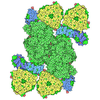
- Assembly
| Deposited unit | 
|
|---|---|
| 1 |
|
-Components
-Photosystem I P700 chlorophyll a apoprotein ... , 2 types, 2 molecules AB
| #1: Protein | Mass: 83368.938 Da / Num. of mol.: 1 / Source method: isolated from a natural source / Source: (natural) Chrysotila roscoffensis (eukaryote) |
|---|---|
| #2: Protein | Mass: 82002.906 Da / Num. of mol.: 1 / Source method: isolated from a natural source / Source: (natural) Chrysotila roscoffensis (eukaryote) |
-Photosystem I reaction center subunit ... , 8 types, 8 molecules DEFIJLMR
| #4: Protein | Mass: 15936.089 Da / Num. of mol.: 1 / Source method: isolated from a natural source / Source: (natural) Chrysotila roscoffensis (eukaryote) |
|---|---|
| #5: Protein | Mass: 7342.328 Da / Num. of mol.: 1 / Source method: isolated from a natural source / Source: (natural) Chrysotila roscoffensis (eukaryote) |
| #6: Protein | Mass: 20163.416 Da / Num. of mol.: 1 / Source method: isolated from a natural source / Source: (natural) Chrysotila roscoffensis (eukaryote) |
| #7: Protein/peptide | Mass: 3900.682 Da / Num. of mol.: 1 / Source method: isolated from a natural source / Source: (natural) Chrysotila roscoffensis (eukaryote) |
| #8: Protein/peptide | Mass: 4340.066 Da / Num. of mol.: 1 / Source method: isolated from a natural source / Source: (natural) Chrysotila roscoffensis (eukaryote) |
| #9: Protein | Mass: 15045.253 Da / Num. of mol.: 1 / Source method: isolated from a natural source / Source: (natural) Chrysotila roscoffensis (eukaryote) |
| #10: Protein/peptide | Mass: 3082.678 Da / Num. of mol.: 1 / Source method: isolated from a natural source / Source: (natural) Chrysotila roscoffensis (eukaryote) |
| #14: Protein | Mass: 9637.013 Da / Num. of mol.: 1 / Source method: isolated from a natural source / Source: (natural) Chrysotila roscoffensis (eukaryote) |
-Fucoxanthin chlorophyll a/c binding protein ... , 8 types, 8 molecules OPQSUGHT
| #11: Protein | Mass: 21458.887 Da / Num. of mol.: 1 / Source method: isolated from a natural source / Source: (natural) Chrysotila roscoffensis (eukaryote) |
|---|---|
| #12: Protein | Mass: 24382.199 Da / Num. of mol.: 1 / Source method: isolated from a natural source / Source: (natural) Chrysotila roscoffensis (eukaryote) |
| #13: Protein | Mass: 21064.480 Da / Num. of mol.: 1 / Source method: isolated from a natural source / Source: (natural) Chrysotila roscoffensis (eukaryote) |
| #15: Protein | Mass: 22708.201 Da / Num. of mol.: 1 / Source method: isolated from a natural source / Source: (natural) Chrysotila roscoffensis (eukaryote) |
| #16: Protein | Mass: 20547.621 Da / Num. of mol.: 1 / Source method: isolated from a natural source / Source: (natural) Chrysotila roscoffensis (eukaryote) |
| #17: Protein | Mass: 22153.486 Da / Num. of mol.: 1 / Source method: isolated from a natural source / Source: (natural) Chrysotila roscoffensis (eukaryote) |
| #18: Protein | Mass: 18375.295 Da / Num. of mol.: 1 / Source method: isolated from a natural source / Source: (natural) Chrysotila roscoffensis (eukaryote) |
| #19: Protein | Mass: 21379.760 Da / Num. of mol.: 1 / Source method: isolated from a natural source / Source: (natural) Chrysotila roscoffensis (eukaryote) |
-Protein / Sugars , 2 types, 2 molecules C
| #27: Sugar | ChemComp-DGD /  Type: saccharide / Mass: 949.299 Da / Num. of mol.: 1 / Source method: obtained synthetically / Formula: C51H96O15 / Feature type: SUBJECT OF INVESTIGATION Type: saccharide / Mass: 949.299 Da / Num. of mol.: 1 / Source method: obtained synthetically / Formula: C51H96O15 / Feature type: SUBJECT OF INVESTIGATION |
|---|---|
| #3: Protein | Mass: 8836.194 Da / Num. of mol.: 1 / Source method: isolated from a natural source / Source: (natural) Chrysotila roscoffensis (eukaryote) |
-Non-polymers , 12 types, 478 molecules 
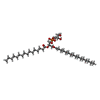
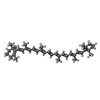
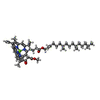
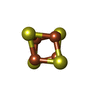

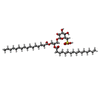
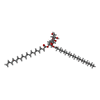
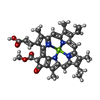
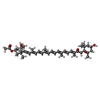

| #20: Chemical | ChemComp-CLA / 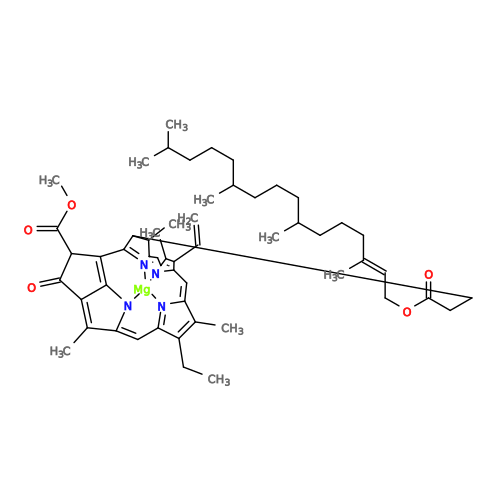 Mass: 893.489 Da / Num. of mol.: 166 / Source method: obtained synthetically / Formula: C55H72MgN4O5 / Feature type: SUBJECT OF INVESTIGATION Mass: 893.489 Da / Num. of mol.: 166 / Source method: obtained synthetically / Formula: C55H72MgN4O5 / Feature type: SUBJECT OF INVESTIGATION#21: Chemical | 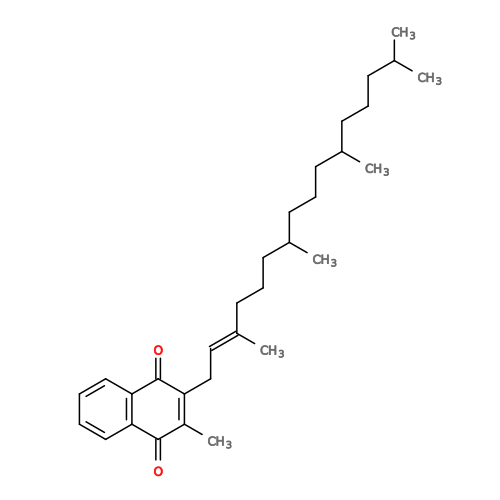 Mass: 450.696 Da / Num. of mol.: 2 / Source method: obtained synthetically / Formula: C31H46O2 / Feature type: SUBJECT OF INVESTIGATION Mass: 450.696 Da / Num. of mol.: 2 / Source method: obtained synthetically / Formula: C31H46O2 / Feature type: SUBJECT OF INVESTIGATION#22: Chemical | ChemComp-LHG / 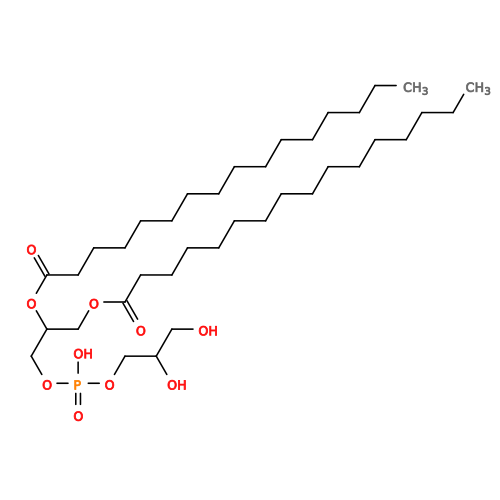 Mass: 722.970 Da / Num. of mol.: 4 / Source method: obtained synthetically / Formula: C38H75O10P / Feature type: SUBJECT OF INVESTIGATION / Comment: phospholipid*YM Mass: 722.970 Da / Num. of mol.: 4 / Source method: obtained synthetically / Formula: C38H75O10P / Feature type: SUBJECT OF INVESTIGATION / Comment: phospholipid*YM#23: Chemical | ChemComp-BCR / 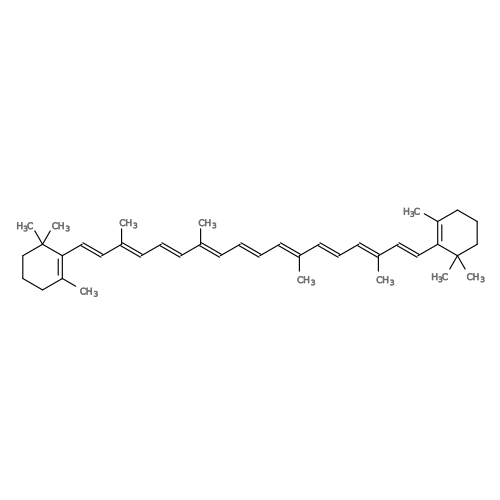 Mass: 536.873 Da / Num. of mol.: 18 / Source method: obtained synthetically / Formula: C40H56 / Feature type: SUBJECT OF INVESTIGATION Mass: 536.873 Da / Num. of mol.: 18 / Source method: obtained synthetically / Formula: C40H56 / Feature type: SUBJECT OF INVESTIGATION#24: Chemical | ChemComp-CL0 / | 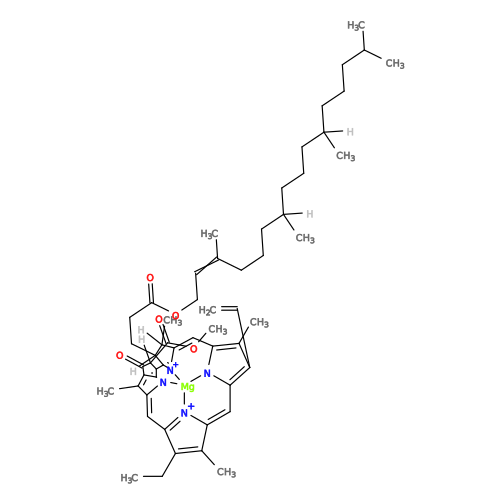 Mass: 893.489 Da / Num. of mol.: 1 / Source method: obtained synthetically / Formula: C55H72MgN4O5 / Feature type: SUBJECT OF INVESTIGATION Mass: 893.489 Da / Num. of mol.: 1 / Source method: obtained synthetically / Formula: C55H72MgN4O5 / Feature type: SUBJECT OF INVESTIGATION#25: Chemical | 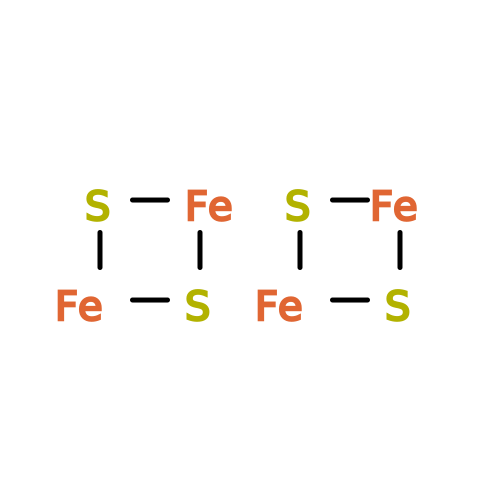 Mass: 351.640 Da / Num. of mol.: 3 / Source method: obtained synthetically / Formula: Fe4S4 / Feature type: SUBJECT OF INVESTIGATION Mass: 351.640 Da / Num. of mol.: 3 / Source method: obtained synthetically / Formula: Fe4S4 / Feature type: SUBJECT OF INVESTIGATION#26: Chemical | ChemComp-DD6 / (  Mass: 582.855 Da / Num. of mol.: 30 / Source method: obtained synthetically / Formula: C40H54O3 / Feature type: SUBJECT OF INVESTIGATION Mass: 582.855 Da / Num. of mol.: 30 / Source method: obtained synthetically / Formula: C40H54O3 / Feature type: SUBJECT OF INVESTIGATION#28: Chemical | 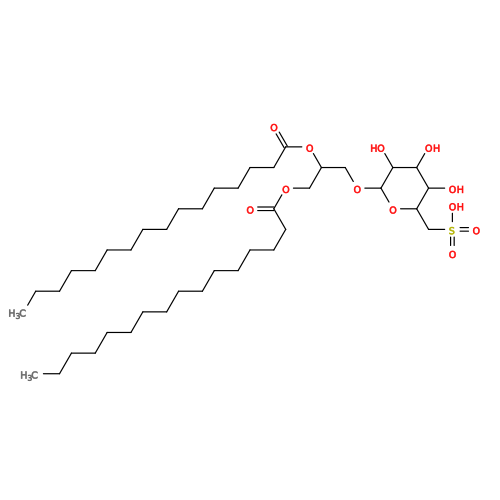 Mass: 795.116 Da / Num. of mol.: 2 / Source method: obtained synthetically / Formula: C41H78O12S / Feature type: SUBJECT OF INVESTIGATION Mass: 795.116 Da / Num. of mol.: 2 / Source method: obtained synthetically / Formula: C41H78O12S / Feature type: SUBJECT OF INVESTIGATION#29: Chemical | ChemComp-LMG / 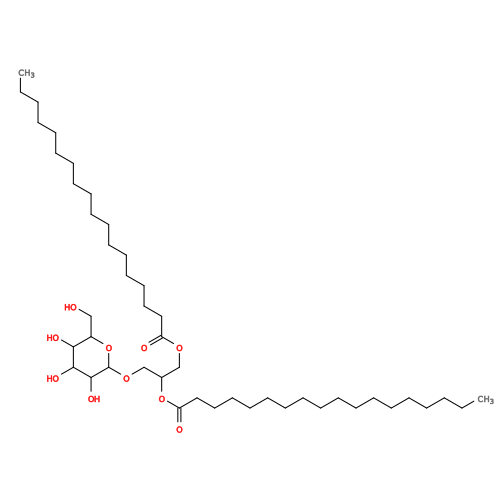 Mass: 787.158 Da / Num. of mol.: 6 / Source method: obtained synthetically / Formula: C45H86O10 / Feature type: SUBJECT OF INVESTIGATION Mass: 787.158 Da / Num. of mol.: 6 / Source method: obtained synthetically / Formula: C45H86O10 / Feature type: SUBJECT OF INVESTIGATION#30: Chemical | ChemComp-KC1 / 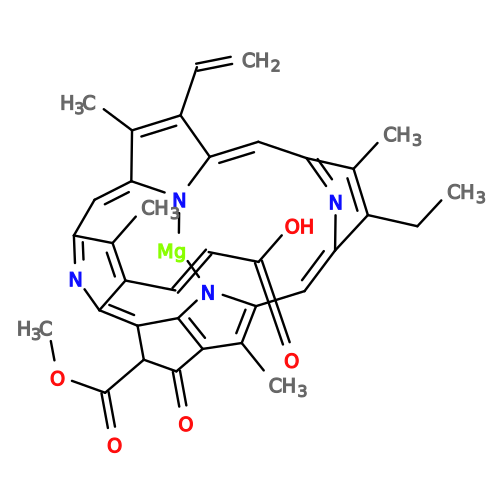 Mass: 610.941 Da / Num. of mol.: 10 / Source method: obtained synthetically / Formula: C35H30MgN4O5 / Feature type: SUBJECT OF INVESTIGATION Mass: 610.941 Da / Num. of mol.: 10 / Source method: obtained synthetically / Formula: C35H30MgN4O5 / Feature type: SUBJECT OF INVESTIGATION#31: Chemical | ChemComp-A86 / ( 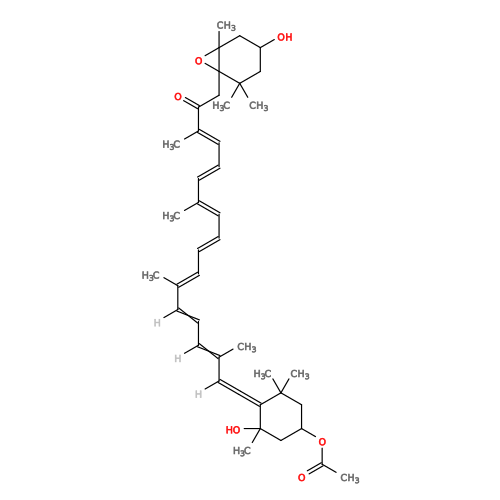 Mass: 658.906 Da / Num. of mol.: 7 / Source method: obtained synthetically / Formula: C42H58O6 / Feature type: SUBJECT OF INVESTIGATION Mass: 658.906 Da / Num. of mol.: 7 / Source method: obtained synthetically / Formula: C42H58O6 / Feature type: SUBJECT OF INVESTIGATION#32: Water | ChemComp-HOH / | Mass: 18.015 Da / Num. of mol.: 229 / Source method: isolated from a natural source / Formula: H2O |
|---|
-Details
| Has ligand of interest | Y |
|---|---|
| Has protein modification | Y |
-Experimental details
-Experiment
| Experiment | Method: ELECTRON MICROSCOPY |
|---|---|
| EM experiment | Aggregation state: PARTICLE / 3D reconstruction method: single particle reconstruction |
- Sample preparation
| Component | Name: Photosystem I (PSI) with 8 fucoxanthin chlorophyll a/c binding protein I (FCPI) supercomplex from haptophyte Chrysotila roscoffensis Type: COMPLEX / Details: PSI-8 FCPI supercomplex. / Entity ID: #8 / Source: NATURAL | |||||||||||||||||||||||||
|---|---|---|---|---|---|---|---|---|---|---|---|---|---|---|---|---|---|---|---|---|---|---|---|---|---|---|
| Molecular weight | Experimental value: NO | |||||||||||||||||||||||||
| Source (natural) | Organism: Chrysotila roscoffensis (eukaryote) | |||||||||||||||||||||||||
| Buffer solution | pH: 6.5 | |||||||||||||||||||||||||
| Buffer component |
| |||||||||||||||||||||||||
| Specimen | Embedding applied: NO / Shadowing applied: NO / Staining applied: NO / Vitrification applied: YES | |||||||||||||||||||||||||
| Specimen support | Grid material: COPPER / Grid mesh size: 300 divisions/in. / Grid type: Quantifoil R1.2/1.3 | |||||||||||||||||||||||||
| Vitrification | Instrument: FEI VITROBOT MARK IV / Cryogen name: ETHANE / Humidity: 100 % / Chamber temperature: 281 K |
- Electron microscopy imaging
| Experimental equipment |  Model: Titan Krios / Image courtesy: FEI Company |
|---|---|
| Microscopy | Model: TFS KRIOS |
| Electron gun | Electron source:  FIELD EMISSION GUN / Accelerating voltage: 300 kV / Illumination mode: FLOOD BEAM FIELD EMISSION GUN / Accelerating voltage: 300 kV / Illumination mode: FLOOD BEAM |
| Electron lens | Mode: BRIGHT FIELD / Nominal magnification: 165000 X / Nominal defocus max: 1800 nm / Nominal defocus min: 800 nm |
| Image recording | Electron dose: 50 e/Å2 / Film or detector model: FEI FALCON IV (4k x 4k) |
- Processing
| EM software | Name: PHENIX / Version: 1.19.2_4158: / Category: model refinement |
|---|---|
| CTF correction | Type: PHASE FLIPPING AND AMPLITUDE CORRECTION |
| Symmetry | Point symmetry: C1 (asymmetric) |
| 3D reconstruction | Resolution: 2.33 Å / Resolution method: FSC 0.143 CUT-OFF / Num. of particles: 17450 / Algorithm: FOURIER SPACE / Num. of class averages: 12 / Symmetry type: POINT |
