[English] 日本語
Yorodumi Papers
- Database of articles cited by EMDB/PDB/SASBDB data -

+
Search query

Keywords
Structure methods
Author
Journal
IF

-
Structure paper

TitleA gate-clamp mechanism for ssDNA translocation by DdmD in Vibrio cholerae plasmid defense.
Journal, issue, pagesNucleic Acids Res, Vol. 53, Issue 3, Year 2025
Publish dateJan 24, 2025
AuthorsRuoyu Li / Yusong Liu / Haishan Gao / Zhonghui Lin /
PubMed AbstractThe DdmDE antiplasmid system, consisting of the helicase-nuclease DdmD and the prokaryotic Argonaute (pAgo) protein DdmE, plays a crucial role in defending Vibrio cholerae against plasmids. Guided by ...The DdmDE antiplasmid system, consisting of the helicase-nuclease DdmD and the prokaryotic Argonaute (pAgo) protein DdmE, plays a crucial role in defending Vibrio cholerae against plasmids. Guided by DNA, DdmE specifically targets plasmids, disassembles the DdmD dimer, and forms a DdmD-DdmE handover complex to facilitate plasmid degradation. However, the precise ATP-dependent DNA translocation mechanism of DdmD has remained unclear. Here, we present cryo-EM structures of DdmD bound to single-stranded DNA (ssDNA) in nucleotide-free, ATPγS-bound, and ADP-bound states. These structures, combined with biochemical analysis, reveal a unique "gate-clamp" mechanism for ssDNA translocation by DdmD. Upon ATP binding, arginine finger residues R855 and R858 reorient to interact with the γ-phosphate, triggering HD2 domain movement. This shift repositions the gate residue Q781, causing a flip of the 3' flank base, which is then clamped by residue F639. After ATP hydrolysis, the arginine finger releases the nucleotide, inducing HD2 to return to its open state. This conformational change enables DdmD to translocate along ssDNA by one nucleotide in the 5' to 3' direction. This study provides new insights into the ATP-dependent translocation of DdmD and contributes to understanding the mechanistic diversity within SF2 helicases.
External linksNucleic Acids Res / PubMed:39907109 / PubMed Central
MethodsEM (single particle)
Resolution2.55 - 3.03 Å
Structure data

EMDB-62357, PDB-9khv:
Structure of DdmD dimer with ssDNA without nucleotide
Method: EM (single particle) / Resolution: 2.55 Å

EMDB-62360, PDB-9khz:
Structure of DdmD dimer with ssDNA with ADP bound
Method: EM (single particle) / Resolution: 3.03 Å

EMDB-62361, PDB-9ki0:
structure of DdmD dimer with ssDNA with AGS
Method: EM (single particle) / Resolution: 2.65 Å

Chemicals

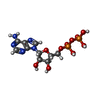
ChemComp-ADP:
ADENOSINE-5'-DIPHOSPHATE / ADP, energy-carrying molecule*YM

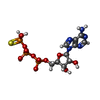
ChemComp-AGS:
PHOSPHOTHIOPHOSPHORIC ACID-ADENYLATE ESTER / ATP-gamma-S, energy-carrying molecule analogue*YM

ChemComp-MG:
Unknown entry

Source
  • Vibrio cholerae serotype O1 (strain ATCC 39315 / El Tor Inaba N16961) (bacteria)
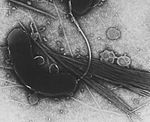
  • vibrio cholerae o1 biovar el tor str. n16961 (bacteria)
  • synthetic construct (others)
  • vibrio cholerae (bacteria)
KeywordsDNA BINDING PROTEIN/DNA / Helicase/UvrB N-terminal domain-containing protein / DNA BINDING PROTEIN-DNA complex / Helicase/UvrB N-terminal domain-containing protein DdmD

+
About Yorodumi Papers

-
News

-
Feb 9, 2022. New format data for meta-information of EMDB entries

New format data for meta-information of EMDB entries

  • Version 3 of the EMDB header file is now the official format.
  • The previous official version 1.9 will be removed from the archive.

Related info.:EMDB header

External links:wwPDB to switch to version 3 of the EMDB data model

-
Aug 12, 2020. Covid-19 info

Covid-19 info

URL: https://pdbj.org/emnavi/covid19.php

New page: Covid-19 featured information page in EM Navigator.

Related info.:Covid-19 info / Mar 5, 2020. Novel coronavirus structure data

+
Mar 5, 2020. Novel coronavirus structure data

Novel coronavirus structure data

Related info.:Yorodumi Speices / Aug 12, 2020. Covid-19 info

External links:COVID-19 featured content - PDBj / Molecule of the Month (242):Coronavirus Proteases

+
Jan 31, 2019. EMDB accession codes are about to change! (news from PDBe EMDB page)

EMDB accession codes are about to change! (news from PDBe EMDB page)

  • The allocation of 4 digits for EMDB accession codes will soon come to an end. Whilst these codes will remain in use, new EMDB accession codes will include an additional digit and will expand incrementally as the available range of codes is exhausted. The current 4-digit format prefixed with “EMD-” (i.e. EMD-XXXX) will advance to a 5-digit format (i.e. EMD-XXXXX), and so on. It is currently estimated that the 4-digit codes will be depleted around Spring 2019, at which point the 5-digit format will come into force.
  • The EM Navigator/Yorodumi systems omit the EMD- prefix.

Related info.:Q: What is EMD? / ID/Accession-code notation in Yorodumi/EM Navigator

External links:EMDB Accession Codes are Changing Soon! / Contact to PDBj

+
Jul 12, 2017. Major update of PDB

Major update of PDB

  • wwPDB released updated PDB data conforming to the new PDBx/mmCIF dictionary.
  • This is a major update changing the version number from 4 to 5, and with Remediation, in which all the entries are updated.
  • In this update, many items about electron microscopy experimental information are reorganized (e.g. em_software).
  • Now, EM Navigator and Yorodumi are based on the updated data.

External links:wwPDB Remediation / Enriched Model Files Conforming to OneDep Data Standards Now Available in the PDB FTP Archive

-
Yorodumi Papers

Database of articles cited by EMDB/PDB/SASBDB data

  • Database of articles cited by EMDB, PDB, and SASBDB entries
  • Using PubMed data

Related info.:EMDB / PDB / SASBDB / Yorodumi / EMN Papers / Changes in new EM Navigator and Yorodumi

Read more