 Movie
Movie Controller
 Structure viewers
 About Yorodumi Papers


+Search query
-Structure paper
| Title | Antibodies elicited by hepatitis E vaccination in humans confer cross-genus protection against rat hepatitis E virus. |
|---|---|
| Journal, issue, pages | J Hepatol, Vol. 83, Issue 5, Page 1046-1056, Year 2025 |
| Publish date | Jun 24, 2025 |
 Authors Authors | Zihao Chen / Liqin Liu / Jianwen Situ / Guanghui Li / Shaoqi Guo / Qi Lai / Shusheng Wu / Yanan Jiang / Jingyan Fan / Zimin Tang / Yu Li / Guiping Wen / Siling Wang / Dong Ying / Yonghao Liang / Stanley Siu-Fung Ho / Xiaodan Ma / James Yiu-Hung Tsoi / Estie Hon-Kiu Shun / Nicholas Foo-Siong Chew / Weihui Ma / Weiwei Mao / Tingting Li / Zhenqin Chen / Mujin Fang / Yingbin Wang / Hai Yu / Fa Zhang / Anna Jinxia Zhang / Shaowei Li / Ningshao Xia / Siddharth Sridhar / Qingbing Zheng / Zizheng Zheng /  |
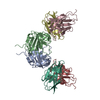
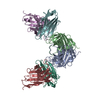
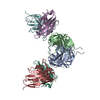
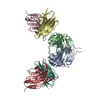
| PubMed Abstract | BACKGROUND & AIMS: Paslahepevirus balayani (bHEV), also known as hepatitis E virus (HEV), encompasses eight genotypes, five of which infect humans. Rats are natural reservoirs of Rocahepevirus ratti ...BACKGROUND & AIMS: Paslahepevirus balayani (bHEV), also known as hepatitis E virus (HEV), encompasses eight genotypes, five of which infect humans. Rats are natural reservoirs of Rocahepevirus ratti genotype 1 (HEV-r-1; rat HEV; rHEV), which has recently been implicated in viral hepatitis. Despite the antigenic divergence between bHEV and rHEV, studies on shared protective antibodies remain rare. METHODS: Polyclonal and monoclonal antibody responses against bHEV and rHEV were analyzed using antibody enzyme-linked immunosorbent assays. The efficacy of six potent bHEV-elicited cross-reactive antibodies in preventing rHEV infection was evaluated via challenge assays in rats. Cryo-electron microscopy was performed to assess the structural basis for the differential protective efficacy of the six antibodies. The viral lysis ability of these antibodies was assessed by separately reacting purified HEV-b-1 and HEV-r-1 virions with each antibody. RESULTS: We determined that antibody responses to bHEV infection and vaccination possess limited cross-reactivity to rHEV and identified two cross-reactive antigenic sites within the E2s domain. Structural analysis and animal challenge studies pinpointed potent cross-reactive antibodies targeting antigenic site 1, indicating its prophylactic efficacy against rHEV. Conversely, antibodies recognizing antigenic site 2 were found to facilitate viral lysis of bHEV but not rHEV. CONCLUSIONS: These findings underscore the importance of antigenic site 1 in the design of broad-spectrum vaccines and therapeutics to mitigate the impact of diverse HEV genotypes on human health. IMPACT AND IMPLICATIONS: Rat HEV (rHEV) spillover to humans represents an unprecedented threat. Significant antigenic differences between rHEV and bHEV (Paslahepevirus balayani) may exacerbate the impact of viral hepatitis. Our study reveals that cross-reactive human antibodies can offer protection against rHEV infection. Cross-protective antibodies targeting antigenic site 1 can be used to guide the development of practical strategies for preventing rHEV infection. |
 External links External links | J Hepatol / PubMed:40571163 |
| Methods | EM (single particle) |
| Resolution | 2.38 - 2.91 Å |
| Structure data | EMDB-61503, PDB-9jie: EMDB-61504, PDB-9jif: EMDB-61505, PDB-9jig: EMDB-61506, PDB-9jii: EMDB-61507, PDB-9jij: EMDB-61508, PDB-9jik: EMDB-61509, PDB-9jil: EMDB-61510, PDB-9jim: EMDB-61511, PDB-9jin: EMDB-61512, PDB-9jio: |
| Source |
|
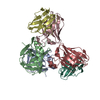
 Keywords Keywords | VIRAL PROTEIN/IMMUNE SYSTEM / Hepatitis E virus / Capsid protein / E2s domain / Immune complex / C6 antibody / VIRAL PROTEIN-IMMUNE SYSTEM complex / C158 antibody / C127 antibody / C131 antibody / C145 antibody / H4 antibody |











 rocahepevirus ratti
 homo sapiens (human)