[English] 日本語
Yorodumi Papers
- Database of articles cited by EMDB/PDB/SASBDB data -

+
Search query

Keywords
Structure methods
Author
Journal
IF

-
Structure paper

TitleThe Thermal-Stable LH1-RC Complex of a Hot Spring Purple Bacterium Powers Photosynthesis with Extremely Low-Energy Near-Infrared Light.
Journal, issue, pagesBiochemistry, Vol. 64, Issue 1, Page 170-179, Year 2025
Publish dateJan 7, 2025
AuthorsYukihiro Kimura / Ryo Kanno / Kaisei Mori / Yoshiki Matsuda / Ryuta Seto / Shinji Takenaka / Hiroyuki Mino / Tatsunari Ohkubo / Mai Honda / Yuji C Sasaki / Jun-Ichi Kishikawa / Kaoru Mitsuoka / Kazuhiro Mio / Malgorzata Hall / Endang R Purba / Toshiaki Mochizuki / Akira Mizoguchi / Bruno M Humbel / Michael T Madigan / Zheng-Yu Wang-Otomo / Kazutoshi Tani /
PubMed Abstract is a hot spring purple nonsulfur phototrophic bacterium that contains bacteriochlorophyll (BChl) . Here, we present a 2.21 Å cryo-EM structure of the thermostable light-harvesting 1-reaction center ... is a hot spring purple nonsulfur phototrophic bacterium that contains bacteriochlorophyll (BChl) . Here, we present a 2.21 Å cryo-EM structure of the thermostable light-harvesting 1-reaction center (LH1-RC) complex from . The LH1 ring comprises 16 circularly arranged αβγ-subunits plus one αβ-subunit that surround the RC complex composed of C-, H-, L-, and M-subunits. In a comparative study, the LH1-RC showed numerous electrostatic and hydrophobic interactions both within the LH1 complex itself and between the LH1 and the RC complexes that are absent from the LH1-RC complex of its mesophilic counterpart, . These additional interactions result in a tightly packed LH1-RC architecture with a reduced accessible surface area per volume that enhances the thermal stability of the complex and allows the light reactions of photosynthesis to proceed at hot spring temperatures. Moreover, based on high-resolution structural information combined with spectroscopic evidence, the unique photosynthetic property of the LH1-RC─absorption of energy-poor near-infrared light beyond 1000 nm─can be attributed to strong hydrogen-bonding interactions between the C3-acetyl C═O of the LH1 BChl and two LH1 α-Trp residues, structural rigidity of the LH1, and the enhanced exciton coupling of the LH1 BChls of this thermophile.
External linksBiochemistry / PubMed:39680849
MethodsEM (single particle)
Resolution2.2 Å
Structure data

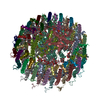
EMDB-61095, PDB-9j2f:
Structure of photosynthetic LH1-RC complex from the purple bacterium Blastochloris tepida
Method: EM (single particle) / Resolution: 2.2 Å

Chemicals

ChemComp-HEC:
HEME C

ChemComp-MG:
Unknown entry

ChemComp-UQ8:
Ubiquinone-8

ChemComp-DGA:
DIACYL GLYCEROL

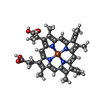
ChemComp-BCB:
BACTERIOCHLOROPHYLL B

ChemComp-BPB:
BACTERIOPHEOPHYTIN B

ChemComp-CDL:
CARDIOLIPIN / phospholipid*YM

ChemComp-FE:
Unknown entry

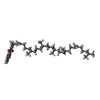
ChemComp-MQ7:
MENAQUINONE-7

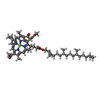
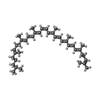
ChemComp-NS5:
15-cis-1,2-dihydroneurosporene

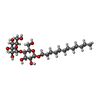
ChemComp-LMT:
DODECYL-BETA-D-MALTOSIDE / detergent*YM

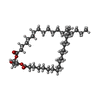
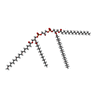
ChemComp-PGV:
(1R)-2-{[{[(2S)-2,3-DIHYDROXYPROPYL]OXY}(HYDROXY)PHOSPHORYL]OXY}-1-[(PALMITOYLOXY)METHYL]ETHYL (11E)-OCTADEC-11-ENOATE / phospholipid*YM

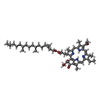
ChemComp-NS0:
all-trans-1,2-dihydroneurosporene

ChemComp-HOH:
WATER

Source
  • blastochloris tepida (bacteria)
KeywordsPHOTOSYNTHESIS / LH1-RC COMPLEX / PURPLE BACTERIA

+
About Yorodumi Papers

-
News

-
Feb 9, 2022. New format data for meta-information of EMDB entries

New format data for meta-information of EMDB entries

  • Version 3 of the EMDB header file is now the official format.
  • The previous official version 1.9 will be removed from the archive.

Related info.:EMDB header

External links:wwPDB to switch to version 3 of the EMDB data model

-
Aug 12, 2020. Covid-19 info

Covid-19 info

URL: https://pdbj.org/emnavi/covid19.php

New page: Covid-19 featured information page in EM Navigator.

Related info.:Covid-19 info / Mar 5, 2020. Novel coronavirus structure data

+
Mar 5, 2020. Novel coronavirus structure data

Novel coronavirus structure data

Related info.:Yorodumi Speices / Aug 12, 2020. Covid-19 info

External links:COVID-19 featured content - PDBj / Molecule of the Month (242):Coronavirus Proteases

+
Jan 31, 2019. EMDB accession codes are about to change! (news from PDBe EMDB page)

EMDB accession codes are about to change! (news from PDBe EMDB page)

  • The allocation of 4 digits for EMDB accession codes will soon come to an end. Whilst these codes will remain in use, new EMDB accession codes will include an additional digit and will expand incrementally as the available range of codes is exhausted. The current 4-digit format prefixed with “EMD-” (i.e. EMD-XXXX) will advance to a 5-digit format (i.e. EMD-XXXXX), and so on. It is currently estimated that the 4-digit codes will be depleted around Spring 2019, at which point the 5-digit format will come into force.
  • The EM Navigator/Yorodumi systems omit the EMD- prefix.

Related info.:Q: What is EMD? / ID/Accession-code notation in Yorodumi/EM Navigator

External links:EMDB Accession Codes are Changing Soon! / Contact to PDBj

+
Jul 12, 2017. Major update of PDB

Major update of PDB

  • wwPDB released updated PDB data conforming to the new PDBx/mmCIF dictionary.
  • This is a major update changing the version number from 4 to 5, and with Remediation, in which all the entries are updated.
  • In this update, many items about electron microscopy experimental information are reorganized (e.g. em_software).
  • Now, EM Navigator and Yorodumi are based on the updated data.

External links:wwPDB Remediation / Enriched Model Files Conforming to OneDep Data Standards Now Available in the PDB FTP Archive

-
Yorodumi Papers

Database of articles cited by EMDB/PDB/SASBDB data

  • Database of articles cited by EMDB, PDB, and SASBDB entries
  • Using PubMed data

Related info.:EMDB / PDB / SASBDB / Yorodumi / EMN Papers / Changes in new EM Navigator and Yorodumi

Read more