[English] 日本語
Yorodumi Papers
- Database of articles cited by EMDB/PDB/SASBDB data -

+
Search query

Keywords
Structure methods
Author
Journal
IF

-
Structure paper

TitleAncestral sequence reconstruction as a tool for structural analysis of modular polyketide synthases.
Journal, issue, pagesNat Commun, Vol. 16, Issue 1, Page 6847, Year 2025
Publish dateJul 25, 2025
AuthorsTaichi Chisuga / Shota Takinami / Zengwei Liao / Masayuki Karasawa / Naruhiko Adachi / Masato Kawasaki / Toshio Moriya / Toshiya Senda / Tohru Terada / Fumitaka Kudo / Tadashi Eguchi / Shogo Nakano / Sohei Ito / Akimasa Miyanaga /
PubMed AbstractModular polyketide synthases (PKSs) are large multi-domain enzymes critical for the biosynthesis of polyketide antibiotics. However, challenges with structural analysis limits our mechanistic ...Modular polyketide synthases (PKSs) are large multi-domain enzymes critical for the biosynthesis of polyketide antibiotics. However, challenges with structural analysis limits our mechanistic understanding of modular PKSs. In this report, we explore the potential of ancestral sequence reconstruction (ASR) for structure analysis of target proteins. As a model, we focus on the FD-891 PKS loading module composed of ketosynthase-like decarboxylase (KS), acyltransferase (AT) and acyl carrier protein (ACP) domains. We construct a KSAncAT chimeric didomain by replacing the native AT with an ancestral AT (AncAT) using ASR. After confirming that KSAncAT chimeric didomain retains similar enzymatic function to the native KSAT didomain, we successfully determine a high-resolution crystal structure of the KSAncAT chimeric didomain and cryo-EM structures of the KS-ACP complex. These cryo-EM structures, which could not be determined for the native protein, exemplify the utility of ASR to enable cryo-EM single-particle analysis. Our findings demonstrate that integrating ASR with structural analysis provides deeper mechanistic insight into modular PKSs. Furthermore, applying ASR to a partial region of the targeted multi-domain proteins could expand the potential of ASR and may serve as a valuable framework for investigating the structure and function of various multi-domain proteins.
External linksNat Commun / PubMed:40715098 / PubMed Central
MethodsEM (single particle) / X-ray diffraction
Resolution2 - 2.73 Å
Structure data

EMDB-60989: Class 2 state of the GfsA KSQ-ancestralAT chimeric didomain in complex with the GfsA ACP domain
Method: EM (single particle) / Resolution: 2.73 Å

EMDB-61520, PDB-9jj9:
Class 3 state of the GfsA KSQ-ancestralAT chimeric didomain in complex with the GfsA ACP domain
Method: EM (single particle) / Resolution: 2.71 Å

EMDB-61522, PDB-9jjb:
Class 1 state of the GfsA KSQ-ancestralAT chimeric didomain in complex with the GfsA ACP domain
Method: EM (single particle) / Resolution: 2.68 Å

PDB-9iyw:
Crystal structure of chimeric KSQ-AT didomain
Method: X-RAY DIFFRACTION / Resolution: 2 Å

Chemicals

ChemComp-NA:
Unknown entry

ChemComp-HOH:
WATER

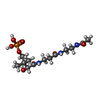
ChemComp-9EF:
N-[2-(acetylamino)ethyl]-N~3~-[(2R)-2-hydroxy-3,3-dimethyl-4-(phosphonooxy)butanoyl]-beta-alaninamide

Source
  • streptomyces graminofaciens (bacteria)
  • synthetic construt (others)
KeywordsTRANSFERASE / Polyketide biosynthesis / Decarboxylase / Acyltransferase / Thiolase fold / LYASE / polyketide synthase

+
About Yorodumi Papers

-
News

-
Feb 9, 2022. New format data for meta-information of EMDB entries

New format data for meta-information of EMDB entries

  • Version 3 of the EMDB header file is now the official format.
  • The previous official version 1.9 will be removed from the archive.

Related info.:EMDB header

External links:wwPDB to switch to version 3 of the EMDB data model

-
Aug 12, 2020. Covid-19 info

Covid-19 info

URL: https://pdbj.org/emnavi/covid19.php

New page: Covid-19 featured information page in EM Navigator.

Related info.:Covid-19 info / Mar 5, 2020. Novel coronavirus structure data

+
Mar 5, 2020. Novel coronavirus structure data

Novel coronavirus structure data

Related info.:Yorodumi Speices / Aug 12, 2020. Covid-19 info

External links:COVID-19 featured content - PDBj / Molecule of the Month (242):Coronavirus Proteases

+
Jan 31, 2019. EMDB accession codes are about to change! (news from PDBe EMDB page)

EMDB accession codes are about to change! (news from PDBe EMDB page)

  • The allocation of 4 digits for EMDB accession codes will soon come to an end. Whilst these codes will remain in use, new EMDB accession codes will include an additional digit and will expand incrementally as the available range of codes is exhausted. The current 4-digit format prefixed with “EMD-” (i.e. EMD-XXXX) will advance to a 5-digit format (i.e. EMD-XXXXX), and so on. It is currently estimated that the 4-digit codes will be depleted around Spring 2019, at which point the 5-digit format will come into force.
  • The EM Navigator/Yorodumi systems omit the EMD- prefix.

Related info.:Q: What is EMD? / ID/Accession-code notation in Yorodumi/EM Navigator

External links:EMDB Accession Codes are Changing Soon! / Contact to PDBj

+
Jul 12, 2017. Major update of PDB

Major update of PDB

  • wwPDB released updated PDB data conforming to the new PDBx/mmCIF dictionary.
  • This is a major update changing the version number from 4 to 5, and with Remediation, in which all the entries are updated.
  • In this update, many items about electron microscopy experimental information are reorganized (e.g. em_software).
  • Now, EM Navigator and Yorodumi are based on the updated data.

External links:wwPDB Remediation / Enriched Model Files Conforming to OneDep Data Standards Now Available in the PDB FTP Archive

-
Yorodumi Papers

Database of articles cited by EMDB/PDB/SASBDB data

  • Database of articles cited by EMDB, PDB, and SASBDB entries
  • Using PubMed data

Related info.:EMDB / PDB / SASBDB / Yorodumi / EMN Papers / Changes in new EM Navigator and Yorodumi

Read more