[English] 日本語
Yorodumi Papers
- Database of articles cited by EMDB/PDB/SASBDB data -

+
Search query

Keywords
Structure methods
Author
Journal
IF

-
Structure paper

TitleDiscovery and structural basis of endogenous and exogenous inhibitors of the proton-activated-chloride channel.
Journal, issue, pagesCell Rep, Vol. 44, Issue 7, Page 115998, Year 2025
Publish dateJul 22, 2025
AuthorsHeng Zhang / Zhijun Zhao / Xiaoying Chen / Qingxia Ma / Wenxuan Zhen / Qianqian Xu / Yaqi Wang / Bingyu He / Ying Huang / Pengfei Xu / Haoxing Xu / Zhimin Lu / Nannan Su / Fan Yang /
PubMed AbstractThe proton-activated chloride (PAC) channel is a broadly expressed chloride channel that senses extracellular acidification, regulates endosomal acidification, and participates in many processes, ...The proton-activated chloride (PAC) channel is a broadly expressed chloride channel that senses extracellular acidification, regulates endosomal acidification, and participates in many processes, including acid-induced cell death and cancer cell migration. However, the lack of specific modulators has limited our understanding of its function and therapeutic potential. Here, we discovered that endogenous cholesterol (CHL) partially inhibits PAC channel activation. Moreover, we identified a series of CHL analogs and structurally related dyes as full antagonists of the PAC channel, with deoxycholic acid (DCA) and Evans blue (EB) as their representative compounds. By combining cryo-electron microscopy (cryo-EM) and patch-clamp recordings, we revealed the distinct binding and inhibition mechanisms of DCA and EB on this channel. Moreover, in malignant osteosarcoma cells, where PAC channel expression is upregulated, EB inhibited the migration and invasion of these cells. Therefore, we identified DCA and EB as pharmacological tools for the PAC channel, which forms a basis for future drug discovery targeting this channel.
External linksCell Rep / PubMed:40664207
MethodsEM (single particle)
Resolution2.89 - 3.85 Å
Structure data

EMDB-60224, PDB-8zlb:
EB bound state of hPAC
Method: EM (single particle) / Resolution: 3.85 Å

EMDB-60228, PDB-8zll:
The apo state of hPAC with endogenous cholesterol
Method: EM (single particle) / Resolution: 2.89 Å

EMDB-63102, PDB-9lhm:
hPAC structure in the presence of MbCD
Method: EM (single particle) / Resolution: 3.43 Å

EMDB-63110, PDB-9li2:
DCA-bound state of hPAC structure
Method: EM (single particle) / Resolution: 3.72 Å

Chemicals

ChemComp-IZ8:
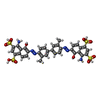
4-azanyl-6-[[4-[4-[(~{E})-(8-azanyl-1-oxidanyl-5,7-disulfo-naphthalen-2-yl)diazenyl]-3-methyl-phenyl]-2-methyl-phenyl]diazenyl]-5-oxidanyl-naphthalene-1,3-disulfonic acid

ChemComp-CLR:
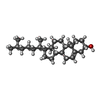
CHOLESTEROL

ChemComp-DXC:
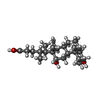
(3ALPHA,5BETA,12ALPHA)-3,12-DIHYDROXYCHOLAN-24-OIC ACID / detergent*YM

Source
  • homo sapiens (human)
KeywordsMEMBRANE PROTEIN / hPAC / EVANS BLUE / STRUCTUAL PROTEIN / PAC / DCA

+
About Yorodumi Papers

-
News

-
Feb 9, 2022. New format data for meta-information of EMDB entries

New format data for meta-information of EMDB entries

  • Version 3 of the EMDB header file is now the official format.
  • The previous official version 1.9 will be removed from the archive.

Related info.:EMDB header

External links:wwPDB to switch to version 3 of the EMDB data model

-
Aug 12, 2020. Covid-19 info

Covid-19 info

URL: https://pdbj.org/emnavi/covid19.php

New page: Covid-19 featured information page in EM Navigator.

Related info.:Covid-19 info / Mar 5, 2020. Novel coronavirus structure data

+
Mar 5, 2020. Novel coronavirus structure data

Novel coronavirus structure data

Related info.:Yorodumi Speices / Aug 12, 2020. Covid-19 info

External links:COVID-19 featured content - PDBj / Molecule of the Month (242):Coronavirus Proteases

+
Jan 31, 2019. EMDB accession codes are about to change! (news from PDBe EMDB page)

EMDB accession codes are about to change! (news from PDBe EMDB page)

  • The allocation of 4 digits for EMDB accession codes will soon come to an end. Whilst these codes will remain in use, new EMDB accession codes will include an additional digit and will expand incrementally as the available range of codes is exhausted. The current 4-digit format prefixed with “EMD-” (i.e. EMD-XXXX) will advance to a 5-digit format (i.e. EMD-XXXXX), and so on. It is currently estimated that the 4-digit codes will be depleted around Spring 2019, at which point the 5-digit format will come into force.
  • The EM Navigator/Yorodumi systems omit the EMD- prefix.

Related info.:Q: What is EMD? / ID/Accession-code notation in Yorodumi/EM Navigator

External links:EMDB Accession Codes are Changing Soon! / Contact to PDBj

+
Jul 12, 2017. Major update of PDB

Major update of PDB

  • wwPDB released updated PDB data conforming to the new PDBx/mmCIF dictionary.
  • This is a major update changing the version number from 4 to 5, and with Remediation, in which all the entries are updated.
  • In this update, many items about electron microscopy experimental information are reorganized (e.g. em_software).
  • Now, EM Navigator and Yorodumi are based on the updated data.

External links:wwPDB Remediation / Enriched Model Files Conforming to OneDep Data Standards Now Available in the PDB FTP Archive

-
Yorodumi Papers

Database of articles cited by EMDB/PDB/SASBDB data

  • Database of articles cited by EMDB, PDB, and SASBDB entries
  • Using PubMed data

Related info.:EMDB / PDB / SASBDB / Yorodumi / EMN Papers / Changes in new EM Navigator and Yorodumi

Read more