 Movie
Movie Controller
 Structure viewers
 About Yorodumi Papers


+Search query
-Structure paper
| Title | Equivalent gain-of-function variants in KCNK3 and KCNK9 and their contribution to distinct TASK K2P channelopathies. |
|---|---|
| Journal, issue, pages | J Gen Physiol, Vol. 158, Issue 5, Year 2026 |
| Publish date | Sep 7, 2026 |
 Authors Authors | Kate M Crowther / Thibault R H Jouen-Tachoire / Peter Proks / Peter Rory Hall / Emma L Veale / Janina Sörmann / Karin E J Rödström / Thomas Müller / Saskia B Wortmann / Nina Barisic / Natalie Hauser / Vincenzo Salpietro / RaeLynn Forsyth / Linford Williams / Nora Derrabi / Carlos A Bacino / Jill A Rosenfeld / Henry Houlden / Simon Newstead / Caroline F Wright / James Fasham / Alistair A Mathie / Reza Maroofian / Stephen J Tucker /      |
| PubMed Abstract | Gain-of-function (GoF) missense variants in the two-pore domain (K2P) K+ channel TASK-1 (KCNK3) result in developmental delay with sleep apnea (DDSA), a neurodevelopmental channelopathy, while loss- ...Gain-of-function (GoF) missense variants in the two-pore domain (K2P) K+ channel TASK-1 (KCNK3) result in developmental delay with sleep apnea (DDSA), a neurodevelopmental channelopathy, while loss-of-function (LoF) variants cause pulmonary arterial hypertension. However, for the related TASK-3 channel (KCNK9), both LoF and GoF variants underlie a distinct neurodevelopmental disorder, KCNK9 imprinting syndrome (KIS). The relationship between genotype and phenotype in these disorders is further complicated because TASK-1 and TASK-3 can co-assemble into heteromeric channels with distinct functional properties. Here, we report additional patients with missense variants in KCNK3 and KCNK9 and investigate the effect of four novel genetic variants on the functional properties of homomeric and heteromeric TASK channels. Interestingly, two of these new pathogenic GoF variants (R131H and L122V) are found in both TASK-1 and TASK-3 and have equivalent functional effects on heteromeric TASK-1/TASK-3 channel activity, yet result in different clinical phenotypes. We have also determined a cryo-EM structure for the pathogenic L122V mutant TASK-3 channel, which suggests that subtle changes in gating and permeation within the inner cavity are responsible for its activatory effect. Overall, these results highlight the dominant role that homomeric TASK channels likely play in defining their associated channelopathies as well as the complexity of interpreting K+ channel dysfunction in pathophysiology. |
 External links External links | J Gen Physiol / PubMed:42560358 / PubMed Central |
| Methods | EM (single particle) |
| Resolution | 2.83 Å |
| Structure data | EMDB-56538, PDB-28iz: |
| Chemicals |  ChemComp-K: 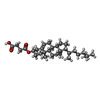 ChemComp-Y01: |
| Source |
|
 Keywords Keywords | MEMBRANE PROTEIN / K2P / potassium channel / ion channel |


 homo sapiens (human)