 Movie
Movie Controller

[English] 日本語
 Yorodumi
- PDB-28iz: Structure of the human two pore domain potassium ion channel TASK... -
+ Open data

- Basic information
| Entry | Database: PDB / ID: 28iz | ||||||||||||||||||||||||
|---|---|---|---|---|---|---|---|---|---|---|---|---|---|---|---|---|---|---|---|---|---|---|---|---|---|
| Title | Structure of the human two pore domain potassium ion channel TASK-3 L122V mutant (K2P9.1) | ||||||||||||||||||||||||
 Components Components | Potassium channel subfamily K member 9 | ||||||||||||||||||||||||
 Keywords Keywords | MEMBRANE PROTEIN / K2P / potassium channel / ion channel | ||||||||||||||||||||||||
| Function / homology |  Function and homology information Function and homology informationnegative regulation of aldosterone secretion / TWIK-releated acid-sensitive K+ channel (TASK) / regulation of action potential firing rate / Phase 4 - resting membrane potential / regulation of resting membrane potential / potassium ion leak channel activity / outward rectifier potassium channel activity / sodium channel activity / potassium ion import across plasma membrane / potassium ion transport ...negative regulation of aldosterone secretion / TWIK-releated acid-sensitive K+ channel (TASK) / regulation of action potential firing rate / Phase 4 - resting membrane potential / regulation of resting membrane potential / potassium ion leak channel activity / outward rectifier potassium channel activity / sodium channel activity / potassium ion import across plasma membrane / potassium ion transport / potassium channel activity / cellular response to acidic pH / visual perception / synaptic vesicle / mitochondrial inner membrane / protein heterodimerization activity / dendrite / metal ion binding / identical protein binding / plasma membrane Similarity search - Function | ||||||||||||||||||||||||
| Biological species |  Homo sapiens (human) Homo sapiens (human) | ||||||||||||||||||||||||
| Method | ELECTRON MICROSCOPY / single particle reconstruction / cryo EM / Resolution: 2.83 Å | ||||||||||||||||||||||||
 Authors Authors | Hall, P.R. / Rodstrom, K.E.J. / Tucker, S.J. | ||||||||||||||||||||||||
| Funding support |  United Kingdom, 3items United Kingdom, 3items
| ||||||||||||||||||||||||
 Citation Citation | Journal: J Gen Physiol / Year: 2026 Title: Equivalent gain-of-function variants in KCNK3 and KCNK9 and their contribution to distinct TASK K2P channelopathies. Authors: Kate M Crowther / Thibault R H Jouen-Tachoire / Peter Proks / Peter Rory Hall / Emma L Veale / Janina Sörmann / Karin E J Rödström / Thomas Müller / Saskia B Wortmann / Nina Barisic / ...Authors: Kate M Crowther / Thibault R H Jouen-Tachoire / Peter Proks / Peter Rory Hall / Emma L Veale / Janina Sörmann / Karin E J Rödström / Thomas Müller / Saskia B Wortmann / Nina Barisic / Natalie Hauser / Vincenzo Salpietro / RaeLynn Forsyth / Linford Williams / Nora Derrabi / Carlos A Bacino / Jill A Rosenfeld / Henry Houlden / Simon Newstead / Caroline F Wright / James Fasham / Alistair A Mathie / Reza Maroofian / Stephen J Tucker /     Abstract: Gain-of-function (GoF) missense variants in the two-pore domain (K2P) K+ channel TASK-1 (KCNK3) result in developmental delay with sleep apnea (DDSA), a neurodevelopmental channelopathy, while loss- ...Gain-of-function (GoF) missense variants in the two-pore domain (K2P) K+ channel TASK-1 (KCNK3) result in developmental delay with sleep apnea (DDSA), a neurodevelopmental channelopathy, while loss-of-function (LoF) variants cause pulmonary arterial hypertension. However, for the related TASK-3 channel (KCNK9), both LoF and GoF variants underlie a distinct neurodevelopmental disorder, KCNK9 imprinting syndrome (KIS). The relationship between genotype and phenotype in these disorders is further complicated because TASK-1 and TASK-3 can co-assemble into heteromeric channels with distinct functional properties. Here, we report additional patients with missense variants in KCNK3 and KCNK9 and investigate the effect of four novel genetic variants on the functional properties of homomeric and heteromeric TASK channels. Interestingly, two of these new pathogenic GoF variants (R131H and L122V) are found in both TASK-1 and TASK-3 and have equivalent functional effects on heteromeric TASK-1/TASK-3 channel activity, yet result in different clinical phenotypes. We have also determined a cryo-EM structure for the pathogenic L122V mutant TASK-3 channel, which suggests that subtle changes in gating and permeation within the inner cavity are responsible for its activatory effect. Overall, these results highlight the dominant role that homomeric TASK channels likely play in defining their associated channelopathies as well as the complexity of interpreting K+ channel dysfunction in pathophysiology. | ||||||||||||||||||||||||
| History |
|
- Structure visualization
| Structure viewer | Molecule: MolmilJmol/JSmol |
|---|
- Downloads & links
-Download
| PDBx/mmCIF format | 28iz.cif.gz | 117.5 KB | Display | PDBx/mmCIF format |
|---|---|---|---|---|
| PDB format | pdb28iz.ent.gz | 88.6 KB | Display | PDB format |
| PDBx/mmJSON format | 28iz.json.gz | Tree view | PDBx/mmJSON format | |
| Others |  Other downloads Other downloads |
-Validation report
| Arichive directory | https://data.pdbj.org/pub/pdb/validation_reports/8i/28izftp://data.pdbj.org/pub/pdb/validation_reports/8i/28iz | HTTPS FTP |
|---|
-Related structure data
| Related structure data |  56538MC M: map data used to model this data C: citing same article ( |
|---|---|
| Similar structure data |
-Links
 PDBj
PDBj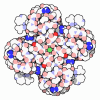
- Assembly
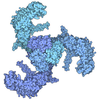
| Deposited unit | 
|
|---|---|
| 1 |
|
-Components
| #1: Protein | Mass: 30294.273 Da / Num. of mol.: 2 / Mutation: L122V Source method: isolated from a genetically manipulated source Details: M1 to D259 containing L122V mutation, with a HRV 3C protease site. Fused purification tags were cleaved prior to EM sample preparation. Source: (gene. exp.) Homo sapiens (human) / Gene: KCNK9, TASK3 / Plasmid: pFB-C3C10HF-LIC / Cell line (production host): Sf9 / Production host:   Spodoptera frugiperda (fall armyworm) / References: UniProt: Q9NPC2 Spodoptera frugiperda (fall armyworm) / References: UniProt: Q9NPC2#2: Chemical | ChemComp-K /   Mass: 39.098 Da / Num. of mol.: 4 / Source method: obtained synthetically / Formula: K Mass: 39.098 Da / Num. of mol.: 4 / Source method: obtained synthetically / Formula: K#3: Chemical | ChemComp-Y01 / 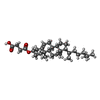 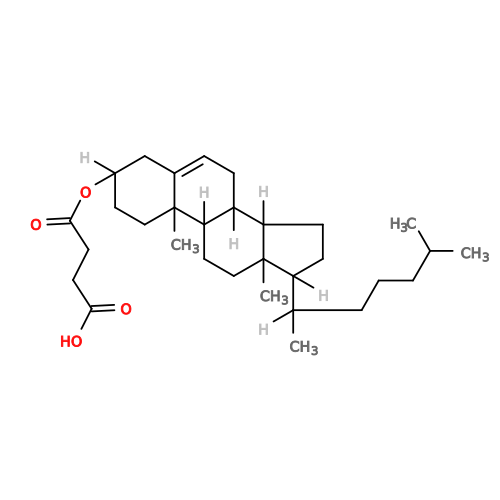 Mass: 486.726 Da / Num. of mol.: 6 / Source method: obtained synthetically / Formula: C31H50O4 Mass: 486.726 Da / Num. of mol.: 6 / Source method: obtained synthetically / Formula: C31H50O4Has ligand of interest | N | Has protein modification | N | |
|---|
-Experimental details
-Experiment
| Experiment | Method: ELECTRON MICROSCOPY |
|---|---|
| EM experiment | Aggregation state: PARTICLE / 3D reconstruction method: single particle reconstruction |
- Sample preparation
| Component | Name: K2P9.1 L122V homodimer / Type: COMPLEX Details: Protein generated by removal of the 10xHis and FLAG purification tags with 3C protease cleavage Entity ID: #1 / Source: RECOMBINANT |
|---|---|
| Molecular weight | Value: 0.06358 MDa / Experimental value: NO |
| Source (natural) | Organism: Homo sapiens (human) |
| Source (recombinant) | Organism: Spodoptera frugiperda (fall armyworm) / Strain: Sf9 |
| Buffer solution | pH: 7.5 Details: 20 mM HEPES pH 7.5, 200 mM KCl, 0.12% w/v DM, 0.012% w/v CHS |
| Specimen | Conc.: 4 mg/ml / Embedding applied: NO / Shadowing applied: NO / Staining applied: NO / Vitrification applied: YES / Details: Monodisperse sample |
| Specimen support | Grid material: GOLD / Grid mesh size: 300 divisions/in. / Grid type: Au-flat 1.2/1.3 |
| Vitrification | Instrument: FEI VITROBOT MARK IV / Cryogen name: ETHANE / Humidity: 100 % / Chamber temperature: 277 K / Details: Grid blotted for approximately 4 seconds |
- Electron microscopy imaging
| Experimental equipment |  Model: Titan Krios / Image courtesy: FEI Company |
|---|---|
| Microscopy | Model: TFS KRIOS |
| Electron gun | Electron source:  FIELD EMISSION GUN / Accelerating voltage: 300 kV / Illumination mode: FLOOD BEAM FIELD EMISSION GUN / Accelerating voltage: 300 kV / Illumination mode: FLOOD BEAM |
| Electron lens | Mode: BRIGHT FIELD / Nominal magnification: 105000 X / Nominal defocus max: 2700 nm / Nominal defocus min: 1200 nm / Alignment procedure: COMA FREE |
| Specimen holder | Cryogen: NITROGEN / Specimen holder model: FEI TITAN KRIOS AUTOGRID HOLDER |
| Image recording | Electron dose: 43.9 e/Å2 / Film or detector model: GATAN K3 BIOQUANTUM (6k x 4k) / Num. of grids imaged: 1 / Num. of real images: 13035 |
| EM imaging optics | Energyfilter name: GIF Bioquantum / Energyfilter slit width: 20 eV |
- Processing
| EM software |
| ||||||||||||||||||||||||||||||||||||||||
|---|---|---|---|---|---|---|---|---|---|---|---|---|---|---|---|---|---|---|---|---|---|---|---|---|---|---|---|---|---|---|---|---|---|---|---|---|---|---|---|---|---|
| CTF correction | Type: PHASE FLIPPING AND AMPLITUDE CORRECTION | ||||||||||||||||||||||||||||||||||||||||
| Particle selection | Num. of particles selected: 8381007 | ||||||||||||||||||||||||||||||||||||||||
| Symmetry | Point symmetry: C2 (2 fold cyclic) | ||||||||||||||||||||||||||||||||||||||||
| 3D reconstruction | Resolution: 2.83 Å / Resolution method: FSC 0.143 CUT-OFF / Num. of particles: 211355 / Symmetry type: POINT | ||||||||||||||||||||||||||||||||||||||||
| Atomic model building | B value: 60.32 / Protocol: FLEXIBLE FIT / Space: REAL Details: Initial fitting was done using Coot and refinement was conducted with PHENIX. | ||||||||||||||||||||||||||||||||||||||||
| Atomic model building | PDB-ID: 9G9V Accession code: 9G9V / Source name: PDB / Type: experimental model | ||||||||||||||||||||||||||||||||||||||||
| Refinement | Highest resolution: 2.83 Å Stereochemistry target values: REAL-SPACE (WEIGHTED MAP SUM AT ATOM CENTERS) |

