[English] 日本語
Yorodumi Papers
- Database of articles cited by EMDB/PDB/SASBDB data -

+
Search query

Keywords
Structure methods
Author
Journal
IF

-
Structure paper

TitleStructures and molecular mechanisms of RAD54B in modulating homologous recombination.
Journal, issue, pagesbioRxiv, Year 2026
Publish dateMar 24, 2026
PubMed AbstractGenome stability is essential for cellular viability yet constantly threatened by endogenous and exogenous DNA-damaging agents. Among these, DNA double-strand breaks (DSBs) are particularly harmful ...Genome stability is essential for cellular viability yet constantly threatened by endogenous and exogenous DNA-damaging agents. Among these, DNA double-strand breaks (DSBs) are particularly harmful and in S/G2 phases are faithfully repaired through homologous recombination (HR), a high-fidelity pathway utilising homologous sequences in sister chromatin. The RAD51 recombinase forms nucleoprotein filaments on single-stranded DNA (ssDNA) to mediate homology search, strand invasion and subsequent D-loop formation that leads to DNA synthesis and repair. The efficiency of HR depends on precise regulation of RAD51 filament dynamics by accessory factors, including RAD54 and RAD54B, which belong to the SWI2/SNF2-family DNA translocases. While RAD54 is well-characterized, RAD54B's molecular functions remain poorly understood. Here, we define RAD54B's role in HR using cryo-electron microscopy, mutagenesis, biochemical and cellular assays. We show that RAD54B stabilizes RAD51-DNA filaments, inhibits RAD51 ATPase activity, and promotes strand invasion, D-loop formation and strand exchange. The N-terminal domain (NTD) alone supports filament stabilization and strand exchange, while the C-terminal ATPase domain is required for D-loop formation. Structural and biochemical analyses reveal three RAD51-interacting sites within the NTD and a unique domain (β-domain) that bridges RAD51 protomers and contacts donor dsDNA. This β-domain also regulates RAD54B's ATPase activity and higher-order oligomer organization on dsDNA. Cellular assays reveal that the NTD RAD51-interacting sites as well as the β-domain are required for repairing camptothecin-induced DSBs by HR in human cells. Our findings uncover a modular architecture and mechanistic framework for RAD54B function in HR, highlighting its critical role in genome maintenance.
HIGHLIGHTS: cryoEM structure of RAD54B in complex with RAD51-DNA complexRAD54B uses three sites to interact with RAD51, including a previously unrecognised β-domain that bridges distal RAD51 protomers.The β-domain plays multiple crucial roles including regulating filament stability, RAD54B ATPase activity and RAD54B higher order assembly on DNA.RAD54B employs a modular mechanism, with the N-terminal region engaing and stabilising RAD51 filaments, capturing of the homologous strands, whereas the ATPase motor domainrequired for homology search and strand invasion.RAD54B N-terminus and β-domain are essential for HR-mediated repair of camptothecin-induced breaks in human cells.
External linksbioRxiv / PubMed:41929041 / PubMed Central
MethodsEM (single particle)
Resolution2.4 - 3.2 Å
Structure data

EMDB-55166, PDB-9srz:
RAD51-ssDNA filament in complex with calcium and ATP bound by the RAD54B N-terminus
Method: EM (single particle) / Resolution: 2.61 Å

EMDB-55189, PDB-9ssl:
RAD51-ssDNA filament in complex with magnesium and ATP bound by the RAD54B N-terminus (peptide)
Method: EM (single particle) / Resolution: 2.9 Å

EMDB-56178, PDB-9trl:
RAD51-ssDNA filament in complex with magnesium and ATP bound by the RAD54B N-terminus (beta-barrel)
Method: EM (single particle) / Resolution: 3.0 Å

EMDB-56179, PDB-9trm:
RAD51-dsDNA filament in complex with calcium and ATP bound by the RAD54B N-terminus
Method: EM (single particle) / Resolution: 2.4 Å

EMDB-56447, PDB-9tyy:
RAD51-ssDNA filament in complex with calcium and ATP bound by the RAD54 N-terminus
Method: EM (single particle) / Resolution: 3.2 Å

Chemicals

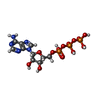
ChemComp-ATP:
ADENOSINE-5'-TRIPHOSPHATE / ATP, energy-carrying molecule*YM

ChemComp-CA:
Unknown entry

ChemComp-K:
Unknown entry

ChemComp-MG:
Unknown entry

Source
  • homo sapiens (human)
  • synthetic construct (others)
  • homo (humans)
KeywordsDNA BINDING PROTEIN / RAD51 recombinase / RAD54B / filament modulation / homologous recombination / RAD54

+
About Yorodumi Papers

-
News

-
Feb 9, 2022. New format data for meta-information of EMDB entries

New format data for meta-information of EMDB entries

  • Version 3 of the EMDB header file is now the official format.
  • The previous official version 1.9 will be removed from the archive.

Related info.:EMDB header

External links:wwPDB to switch to version 3 of the EMDB data model

-
Aug 12, 2020. Covid-19 info

Covid-19 info

URL: https://pdbj.org/emnavi/covid19.php

New page: Covid-19 featured information page in EM Navigator.

Related info.:Covid-19 info / Mar 5, 2020. Novel coronavirus structure data

+
Mar 5, 2020. Novel coronavirus structure data

Novel coronavirus structure data

Related info.:Yorodumi Speices / Aug 12, 2020. Covid-19 info

External links:COVID-19 featured content - PDBj / Molecule of the Month (242):Coronavirus Proteases

+
Jan 31, 2019. EMDB accession codes are about to change! (news from PDBe EMDB page)

EMDB accession codes are about to change! (news from PDBe EMDB page)

  • The allocation of 4 digits for EMDB accession codes will soon come to an end. Whilst these codes will remain in use, new EMDB accession codes will include an additional digit and will expand incrementally as the available range of codes is exhausted. The current 4-digit format prefixed with “EMD-” (i.e. EMD-XXXX) will advance to a 5-digit format (i.e. EMD-XXXXX), and so on. It is currently estimated that the 4-digit codes will be depleted around Spring 2019, at which point the 5-digit format will come into force.
  • The EM Navigator/Yorodumi systems omit the EMD- prefix.

Related info.:Q: What is EMD? / ID/Accession-code notation in Yorodumi/EM Navigator

External links:EMDB Accession Codes are Changing Soon! / Contact to PDBj

+
Jul 12, 2017. Major update of PDB

Major update of PDB

  • wwPDB released updated PDB data conforming to the new PDBx/mmCIF dictionary.
  • This is a major update changing the version number from 4 to 5, and with Remediation, in which all the entries are updated.
  • In this update, many items about electron microscopy experimental information are reorganized (e.g. em_software).
  • Now, EM Navigator and Yorodumi are based on the updated data.

External links:wwPDB Remediation / Enriched Model Files Conforming to OneDep Data Standards Now Available in the PDB FTP Archive

-
Yorodumi Papers

Database of articles cited by EMDB/PDB/SASBDB data

  • Database of articles cited by EMDB, PDB, and SASBDB entries
  • Using PubMed data

Related info.:EMDB / PDB / SASBDB / Yorodumi / EMN Papers / Changes in new EM Navigator and Yorodumi

Read more