 Movie
Movie Controller

[English] 日本語
 Yorodumi
- PDB-9trl: RAD51-ssDNA filament in complex with magnesium and ATP bound by t... -
+ Open data

- Basic information
| Entry | Database: PDB / ID: 9trl | ||||||||||||||||||||||||
|---|---|---|---|---|---|---|---|---|---|---|---|---|---|---|---|---|---|---|---|---|---|---|---|---|---|
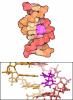
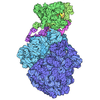
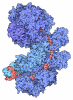
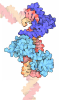
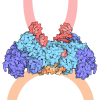
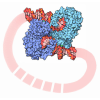
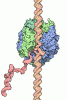
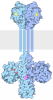
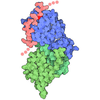
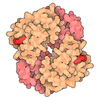
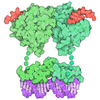
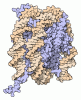
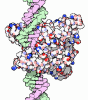
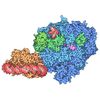
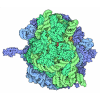
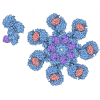
| Title | RAD51-ssDNA filament in complex with magnesium and ATP bound by the RAD54B N-terminus (beta-barrel) | ||||||||||||||||||||||||
 Components Components |
| ||||||||||||||||||||||||
 Keywords Keywords | DNA BINDING PROTEIN / RAD51 recombinase / RAD54B / filament modulation / homologous recombination | ||||||||||||||||||||||||
| Function / homology |  Function and homology information Function and homology informationpresynaptic intermediate filament cytoskeleton / response to glucoside / mitotic recombination-dependent replication fork processing / chromosome organization involved in meiotic cell cycle / cellular response to cisplatin / telomere maintenance via telomere lengthening / DNA recombinase assembly / double-strand break repair involved in meiotic recombination / DNA translocase activity / cellular response to camptothecin ...presynaptic intermediate filament cytoskeleton / response to glucoside / mitotic recombination-dependent replication fork processing / chromosome organization involved in meiotic cell cycle / cellular response to cisplatin / telomere maintenance via telomere lengthening / DNA recombinase assembly / double-strand break repair involved in meiotic recombination / DNA translocase activity / cellular response to camptothecin / DNA strand invasion / homologous recombination / mitotic recombination / lateral element / DNA strand exchange activity / Impaired BRCA2 binding to PALB2 / telomere maintenance via recombination / reciprocal meiotic recombination / single-stranded DNA helicase activity / response to X-ray / regulation of double-strand break repair via homologous recombination / ATP-dependent DNA damage sensor activity / HDR through Single Strand Annealing (SSA) / regulation of DNA damage checkpoint / Homologous DNA Pairing and Strand Exchange / Defective homologous recombination repair (HRR) due to BRCA1 loss of function / Defective HDR through Homologous Recombination Repair (HRR) due to PALB2 loss of BRCA1 binding function / Defective HDR through Homologous Recombination Repair (HRR) due to PALB2 loss of BRCA2/RAD51/RAD51C binding function / Resolution of D-loop Structures through Synthesis-Dependent Strand Annealing (SDSA) / nuclear chromosome / Resolution of D-loop Structures through Holliday Junction Intermediates / Transcriptional Regulation by E2F6 / negative regulation of signal transduction by p53 class mediator / Impaired BRCA2 binding to RAD51 / Presynaptic phase of homologous DNA pairing and strand exchange / ATP-dependent activity, acting on DNA / interstrand cross-link repair / condensed chromosome / DNA polymerase binding / replication fork processing / cellular response to ionizing radiation / condensed nuclear chromosome / cellular response to gamma radiation / meiotic cell cycle / protein-DNA complex / double-strand break repair via homologous recombination / PML body / response to toxic substance / Meiotic recombination / Hydrolases; Acting on acid anhydrides; Acting on acid anhydrides to facilitate cellular and subcellular movement / HDR through Homologous Recombination (HRR) / site of double-strand break / single-stranded DNA binding / double-stranded DNA binding / DNA recombination / protein-macromolecule adaptor activity / chromosome, telomeric region / response to xenobiotic stimulus / mitochondrial matrix / hydrolase activity / DNA repair / centrosome / chromatin binding / DNA damage response / nucleolus / chromatin / perinuclear region of cytoplasm / enzyme binding / ATP hydrolysis activity / protein-containing complex / mitochondrion / DNA binding / nucleoplasm / ATP binding / identical protein binding / nucleus / cytosol / cytoplasm Similarity search - Function | ||||||||||||||||||||||||
| Biological species |  Homo (humans) Homo (humans) Homo sapiens (human) Homo sapiens (human)synthetic construct (others) | ||||||||||||||||||||||||
| Method | ELECTRON MICROSCOPY / single particle reconstruction / cryo EM / Resolution: 3 Å | ||||||||||||||||||||||||
 Authors Authors | Liang, P. / Zhang, X. | ||||||||||||||||||||||||
| Funding support |  United Kingdom, 1items United Kingdom, 1items
| ||||||||||||||||||||||||
 Citation Citation | Journal: bioRxiv / Year: 2026 Title: Structures and molecular mechanisms of RAD54B in modulating homologous recombination. Authors: Pengtao Liang / Stephanie Tye / Johanna Ertl da Costa / Neelam Maharshi / Bilge Argunhan / Lucas Kuhlen / Megan Battley / Elizabeth A McCormack / Wolf-Dietrich Heyer / Markus Löbrich / Xiaodong Zhang /   Abstract: Genome stability is essential for cellular viability yet constantly threatened by endogenous and exogenous DNA-damaging agents. Among these, DNA double-strand breaks (DSBs) are particularly harmful ...Genome stability is essential for cellular viability yet constantly threatened by endogenous and exogenous DNA-damaging agents. Among these, DNA double-strand breaks (DSBs) are particularly harmful and in S/G2 phases are faithfully repaired through homologous recombination (HR), a high-fidelity pathway utilising homologous sequences in sister chromatin. The RAD51 recombinase forms nucleoprotein filaments on single-stranded DNA (ssDNA) to mediate homology search, strand invasion and subsequent D-loop formation that leads to DNA synthesis and repair. The efficiency of HR depends on precise regulation of RAD51 filament dynamics by accessory factors, including RAD54 and RAD54B, which belong to the SWI2/SNF2-family DNA translocases. While RAD54 is well-characterized, RAD54B's molecular functions remain poorly understood. Here, we define RAD54B's role in HR using cryo-electron microscopy, mutagenesis, biochemical and cellular assays. We show that RAD54B stabilizes RAD51-DNA filaments, inhibits RAD51 ATPase activity, and promotes strand invasion, D-loop formation and strand exchange. The N-terminal domain (NTD) alone supports filament stabilization and strand exchange, while the C-terminal ATPase domain is required for D-loop formation. Structural and biochemical analyses reveal three RAD51-interacting sites within the NTD and a unique domain (β-domain) that bridges RAD51 protomers and contacts donor dsDNA. This β-domain also regulates RAD54B's ATPase activity and higher-order oligomer organization on dsDNA. Cellular assays reveal that the NTD RAD51-interacting sites as well as the β-domain are required for repairing camptothecin-induced DSBs by HR in human cells. Our findings uncover a modular architecture and mechanistic framework for RAD54B function in HR, highlighting its critical role in genome maintenance. | ||||||||||||||||||||||||
| History |
|
- Structure visualization
| Structure viewer | Molecule: MolmilJmol/JSmol |
|---|
- Downloads & links
-Download
| PDBx/mmCIF format | 9trl.cif.gz | 419.3 KB | Display | PDBx/mmCIF format |
|---|---|---|---|---|
| PDB format | pdb9trl.ent.gz | 331.6 KB | Display | PDB format |
| PDBx/mmJSON format | 9trl.json.gz | Tree view | PDBx/mmJSON format | |
| Others |  Other downloads Other downloads |
-Validation report
| Arichive directory | https://data.pdbj.org/pub/pdb/validation_reports/tr/9trlftp://data.pdbj.org/pub/pdb/validation_reports/tr/9trl | HTTPS FTP |
|---|
-Related structure data
| Related structure data |  56178MC  9srzC  9sslC  9trmC  9tyyC M: map data used to model this data C: citing same article ( |
|---|---|
| Similar structure data |


-Links
 PDBj
PDBj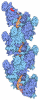



- Assembly
| Deposited unit | 
|
|---|---|
| 1 |
|
-Components
-DNA repair and recombination protein ... , 2 types, 5 molecules HIJKO
| #2: Protein | Mass: 32036.555 Da / Num. of mol.: 4 Source method: isolated from a genetically manipulated source Source: (gene. exp.) Homo sapiens (human) / Gene: RAD54B / Production host:  Trichoplusia ni (cabbage looper) Trichoplusia ni (cabbage looper)References: UniProt: Q9Y620, Hydrolases; Acting on acid anhydrides; Acting on acid anhydrides to facilitate cellular and subcellular movement #3: Protein | | Mass: 32052.555 Da / Num. of mol.: 1 Source method: isolated from a genetically manipulated source Source: (gene. exp.) Homo sapiens (human) / Gene: RAD54B / Production host: Trichoplusia ni (cabbage looper)References: UniProt: Q9Y620, Hydrolases; Acting on acid anhydrides; Acting on acid anhydrides to facilitate cellular and subcellular movement |
|---|
-Protein / DNA chain , 2 types, 7 molecules ABCDEFZ
| #1: Protein | Mass: 37009.125 Da / Num. of mol.: 6 Source method: isolated from a genetically manipulated source Source: (gene. exp.) Homo (humans) / Gene: RAD51, RAD51A, RECA / Production host:   Escherichia coli BL21(DE3) (bacteria) / References: UniProt: Q06609 Escherichia coli BL21(DE3) (bacteria) / References: UniProt: Q06609#4: DNA chain | | Mass: 6051.004 Da / Num. of mol.: 1 / Source method: obtained synthetically / Source: (synth.) synthetic construct (others) |
|---|
-Non-polymers , 3 types, 17 molecules 

| #5: Chemical | ChemComp-K /  Mass: 39.098 Da / Num. of mol.: 5 / Source method: obtained synthetically / Formula: K / Feature type: SUBJECT OF INVESTIGATION Mass: 39.098 Da / Num. of mol.: 5 / Source method: obtained synthetically / Formula: K / Feature type: SUBJECT OF INVESTIGATION#6: Chemical | ChemComp-ATP / 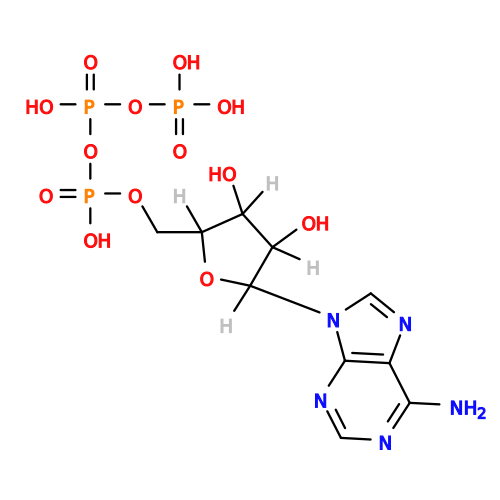 Mass: 507.181 Da / Num. of mol.: 7 / Source method: obtained synthetically / Formula: C10H16N5O13P3 / Feature type: SUBJECT OF INVESTIGATION / Comment: ATP, energy-carrying molecule*YM Mass: 507.181 Da / Num. of mol.: 7 / Source method: obtained synthetically / Formula: C10H16N5O13P3 / Feature type: SUBJECT OF INVESTIGATION / Comment: ATP, energy-carrying molecule*YM#7: Chemical | ChemComp-MG /  Mass: 24.305 Da / Num. of mol.: 5 / Source method: obtained synthetically / Formula: Mg / Feature type: SUBJECT OF INVESTIGATION Mass: 24.305 Da / Num. of mol.: 5 / Source method: obtained synthetically / Formula: Mg / Feature type: SUBJECT OF INVESTIGATION |
|---|
-Details
| Has ligand of interest | Y |
|---|---|
| Has protein modification | Y |
-Experimental details
-Experiment
| Experiment | Method: ELECTRON MICROSCOPY |
|---|---|
| EM experiment | Aggregation state: FILAMENT / 3D reconstruction method: single particle reconstruction |
- Sample preparation
| Component | Name: RAD51 filament in complex with magnesium and ATP bound by the RAD54B N-terminus (beta-barrel) Type: COMPLEX / Entity ID: #1-#2, #4 / Source: RECOMBINANT |
|---|---|
| Molecular weight | Experimental value: NO |
| Source (natural) | Organism: Homo sapiens (human) |
| Source (recombinant) | Organism: Escherichia coli BL21(DE3) (bacteria) |
| Buffer solution | pH: 7.5 |
| Specimen | Embedding applied: NO / Shadowing applied: NO / Staining applied: NO / Vitrification applied: YES |
| Vitrification | Cryogen name: ETHANE |
- Electron microscopy imaging
| Experimental equipment |  Model: Titan Krios / Image courtesy: FEI Company |
|---|---|
| Microscopy | Model: TFS KRIOS |
| Electron gun | Electron source:  FIELD EMISSION GUN / Accelerating voltage: 300 kV / Illumination mode: FLOOD BEAM FIELD EMISSION GUN / Accelerating voltage: 300 kV / Illumination mode: FLOOD BEAM |
| Electron lens | Mode: BRIGHT FIELD / Nominal defocus max: 3000 nm / Nominal defocus min: 900 nm |
| Image recording | Electron dose: 60 e/Å2 / Film or detector model: GATAN K3 (6k x 4k) |
- Processing
| EM software |
| ||||||||||||||||
|---|---|---|---|---|---|---|---|---|---|---|---|---|---|---|---|---|---|
| CTF correction | Type: PHASE FLIPPING AND AMPLITUDE CORRECTION | ||||||||||||||||
| 3D reconstruction | Resolution: 3 Å / Resolution method: FSC 0.143 CUT-OFF / Num. of particles: 148633 / Symmetry type: POINT |
