 Movie
Movie Controller
 Structure viewers
 About Yorodumi Papers


+Search query
-Structure paper
| Title | Quality control of glycogen through direct ubiquitylation by RNF213. |
|---|---|
| Journal, issue, pages | Nature, Year 2026 |
| Publish date | Sep 15, 2026 |
 Authors Authors | Matthew C J Yip / Katerina Naydenova / Elsje G Otten / Alexander Heatley / Agnes Moe / Leonie Anton / Lucía de Los Reyes-Ramírez / Helen E Jolin / Frederic Langevin / Michal Wiacek / Catarina Franco / Anne Bertolotti / Wanda Kukulski / Andrew N J McKenzie / Felix Randow /    |
| PubMed Abstract | Quality control of biomolecules is vital for organismal health. While DNA repair and protein quality control are well understood, how cells monitor other important biomolecules such as glycogen ...Quality control of biomolecules is vital for organismal health. While DNA repair and protein quality control are well understood, how cells monitor other important biomolecules such as glycogen remains ill-defined. The accumulation of aberrant, poorly branched glycogen into insoluble polyglucosan bodies causes severe disease. Here, we discover autophagy of ubiquitylated aberrant glycogen as a previously unrecognized quality control mechanism safeguarding the brain from polyglucosan buildup. This mechanism depends on the E3 ubiquitin ligase RNF213. Mice lacking ligase activity in RNF213 accumulate polyglucosan in cerebellum, pons, and hippocampus. Using cells engineered to produce polyglucosan, we show that RNF213 selectively ubiquitylates abnormal glycogen. Cryo-EM analysis of RNF213 bound to glycogen-derived maltoheptaose revealed its CBM20 domain binds linear oligosaccharides. Disrupting carbohydrate binding results in gain of E3 ligase activity towards physiological glycogen, indicating the CBM20 domain limits RNF213 activity towards physiological glycogen. Epistasis analysis places RNF213 upstream of LUBAC, suggesting a hierarchical network of multiple E3 ligases surveying glycogen quality. Ubiquitylated polyglucosan recruits the autophagy receptors SQSTM1, TAX1BP1, and optineurin, thereby triggering uptake into autophagosomes. These findings identify RNF213 as a quality control factor preventing polyglucosan accumulation in astrocytes through direct ubiquitylation of polyglucosan, revealing an essential role for non-protein ubiquitylation in glycogen quality control. |
 External links External links | Nature / PubMed:42744304 |
| Methods | EM (single particle) / EM (tomography) |
| Resolution | 2.7 - 3.1 Å |
| Structure data | EMDB-55686, PDB-9t8h:  EMDB-55687: Murine RNF213 bound to maltoheptaose (Consensus refinement)  EMDB-55688: Murine RNF213 bound to maltoheptaose (Focused refinement of ATPase domain)  EMDB-55689: Murine RNF213 bound to maltoheptaose (Focused refinement of stalk)  EMDB-55690: Murine RNF213 bound to maltoheptaose (Focused refinement of top of stalk)  EMDB-55691: Murine RNF213 bound to maltoheptaose (Focused refinement of CBM20 domain)  EMDB-55692: Murine RNF213 bound to maltoheptaose (Focused refinement of E3 module)  EMDB-55693: Murine RNF213 bound to maltoheptaose (Focused refinement of E3 shell) EMDB-55694, PDB-9t8i:  EMDB-55695: Murine RNF213 (Consensus refinement)  EMDB-55696: Murine RNF213 (Focused refinement of ATPase domain)  EMDB-55697: Murine RNF213 (Focused refinement of stalk)  EMDB-55698: Murine RNF213 (Focused refinement of top of stalk)  EMDB-55699: Murine RNF213 (Focused refinement of CBM20 domain)  EMDB-55700: Murine RNF213 (Focused refinement of E3 module)  EMDB-55701: Murine RNF213 (Focused refinement of E3 shell)  EMDB-59437: Murine RNF213 (Y434A) (Focused refinement of ATPase domain)  EMDB-59438: Murine RNF213 (Y434A) (focused refinement of stalk)  EMDB-59439: murine RNF213 (Y434A) (focused refinement of top of stalk)  EMDB-59440: murine RNF213 (Y434A) (focused refinement of CBM20 domain)  EMDB-59441: murine RNF213 (Y434A) (focused refinement of E3)  EMDB-59442: murine RNF213 (Y434A) (focused refinement of E3 shell)  EMDB-59443: murine RNF213 (Y434A) (consensus refinement) EMDB-59444, PDB-33hm:  EMDB-59854: Cryo-electron tomogram of MEF cell containing polyglucosan |
| Chemicals | 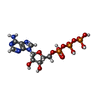 ChemComp-ATP:  ChemComp-ZN: |
| Source |
|
 Keywords Keywords | SUGAR BINDING PROTEIN / E3 ubiquitin ligase / AAA+ ATPase / CBM20 |


 mus musculus (house mouse)