 Movie
Movie Controller
 Structure viewers
 About Yorodumi Papers


+Search query
-Structure paper
| Title | ACLY inhibition promotes tumour immunity and suppresses liver cancer. |
|---|---|
| Journal, issue, pages | Nature, Vol. 645, Issue 8080, Page 507-517, Year 2025 |
| Publish date | Jul 30, 2025 |
 Authors Authors | Jaya Gautam / Jianhan Wu / James S V Lally / Jamie D McNicol / Russta Fayyazi / Elham Ahmadi / Daniela Carmen Oniciu / Spencer Heaton / Roger S Newton / Sonia Rehal / Dipankar Bhattacharya / Fiorella Di Pastena / Binh Nguyen / Celina M Valvano / Logan K Townsend / Suhrid Banskota / Battsetseg Batchuluun / Maria Joy Therese Jabile / Alice Payne / Junfeng Lu / Eric M Desjardins / Naoto Kubota / Evangelia E Tsakiridis / Bejal Mistry / Alex Aganostopoulos / Vanessa Houde / Ann Dansercoer / Koen H G Verschueren / Savvas N Savvides / Joanne A Hammill / Ksenia Bezverbnaya / Paola Muti / Theodoros Tsakiridis / Wenting Dai / Lei Jiang / Yujin Hoshida / Mark Larché / Jonathan L Bramson / Scott L Friedman / Kenneth Verstraete / Dongdong Wang / Gregory R Steinberg /    |
| PubMed Abstract | Immunosuppressive tumour microenvironments are common in cancers such as metabolic dysfunction-associated steatohepatitis (MASH)-driven hepatocellular carcinoma (HCC) (MASH-HCC). Although immune ...Immunosuppressive tumour microenvironments are common in cancers such as metabolic dysfunction-associated steatohepatitis (MASH)-driven hepatocellular carcinoma (HCC) (MASH-HCC). Although immune cell metabolism influences effector function, the effect of tumour metabolism on immunogenicity is less understood. ATP citrate lyase (ACLY) links substrate availability and mitochondrial metabolism with lipid biosynthesis and gene regulation. Although ACLY inhibition shows antiproliferative effects in various tumours, clinical translation has been limited by challenges in inhibitor development and compensatory metabolic pathways. Here, using a mouse model of MASH-HCC that mirrors human disease, genetic inhibition of ACLY in hepatocytes and tumours reduced neoplastic lesions by over 70%. To evaluate the therapeutic potential of this pathway, a novel small-molecule ACLY inhibitor, EVT0185 (6-[4-(5-carboxy-5-methyl-hexyl)-phenyl]-2,2-dimethylhexanoic acid), was identified via phenotypic screening. EVT0185 is converted to a CoA thioester in the liver by SLC27A2 and structural analysis by cryo-electron microscopy reveals that EVT0185-CoA directly interacts with the CoA-binding site of ACLY. Oral delivery of EVT0185 in three mouse models of MASH-HCC dramatically reduces tumour burden as monotherapy and enhances efficacy of current standards of care including tyrosine kinase inhibitors and immunotherapies. Transcriptomic and spatial profiling in mice and humans linked reduced tumour ACLY with increases in the chemokine CXCL13, tumour-infiltrating B cells and tertiary lymphoid structures. The depletion of B cells blocked the antitumour effects of ACLY inhibition. Together, these findings illustrate how targeting tumour metabolism can rewire immune function and suppress cancer progression in MASH-HCC. |
 External links External links | Nature / PubMed:40739358 / PubMed Central |
| Methods | EM (single particle) |
| Resolution | 3.25 Å |
| Structure data | EMDB-53847, PDB-9r90: |
| Chemicals | 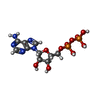 ChemComp-ADP: 
ChemComp-W1K: |
| Source |
|
 Keywords Keywords | LYASE / ATP citrate lyase / ACL / ACLY / de novo lipogenesis / acetyl-CoA / citrate / oxaloacetate / cancer |


 homo sapiens (human)