[English] 日本語
Yorodumi Papers
- Database of articles cited by EMDB/PDB/SASBDB data -

+
Search query

Keywords
Structure methods
Author
Journal
IF

-
Structure paper

TitlePseudouridine increases ribosome stability in a thermophilic eukaryote.
Journal, issue, pagesNucleic Acids Res, Vol. 53, Issue 22, Year 2025
Publish dateNov 26, 2025
AuthorsKlemens Wild / Marius Klein / Alicia Burkard / Virginie Marchand / Nikola Kellner / Antonio Paez / Stefan Pastore / Tamer Butto / Yuri Motorin / Mark Helm / Irmgard Sinning /
PubMed AbstractRNA modifications alter stability, folding space, and interaction network of RNA molecules. Ribosomal RNA (rRNA) modifications stabilize the structure of ribosomes and cluster around functionally ...RNA modifications alter stability, folding space, and interaction network of RNA molecules. Ribosomal RNA (rRNA) modifications stabilize the structure of ribosomes and cluster around functionally important sites such as the peptidyl transferase center, ribosomal subunit bridges, and the polypeptide tunnel. Here, we investigate the rRNA modifications of the thermophilic fungus Chaetomium thermophilum (ct), a model organism for eukaryotic thermophily and structural stability. Using LC-MS/MS, orthogonal second and third generation RNA-sequencing and high-resolution cryo-electron microscopy, we describe a cross-correlating method to assign and quantify all ct rRNA modifications. Overall, a doubling of rRNA modifications to 4% explains ribosomal thermostability with an extended distribution towards peripheral functional sites. The 2.4 Å structure of the idle ct60S ribosome, retaining nascent chains and including metal ions, polyamines, and water molecules, allows for a comprehensive structure-function analysis. Comparison with mesophilic ribosomes from Chaetomium globosum, yeast, and human highlights the significant increase of pseudouridines (Ψs). The number of Ψs linearly correlates with growth temperature, suggesting statistical modification. A ct-specific Ψ substitution forming a 'Ψ-turn' at the polypeptide tunnel exit close to the third constriction exemplifies mechanistic adaptations of the ribosome at elevated temperatures.
External linksNucleic Acids Res / PubMed:41432034 / PubMed Central
MethodsEM (single particle)
Resolution2.38 Å
Structure data

EMDB-52576, PDB-9i1w:
High resolution structure of the thermophilic 60S ribosomal subunit of Chaetomium thermophilum
Method: EM (single particle) / Resolution: 2.38 Å

Chemicals

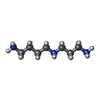
ChemComp-SPD:
SPERMIDINE

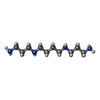
ChemComp-SPM:
SPERMINE

ChemComp-MG:
Unknown entry

ChemComp-K:
Unknown entry

ChemComp-ZN:
Unknown entry

ChemComp-HOH:
WATER

Source
  • Thermochaetoides thermophila (fungus)
  • thermochaetoides thermophila dsm 1495 (fungus)
KeywordsRIBOSOME / 60S ribosomal subunit thermophilic eukaryote RNA modification pseudouridine

+
About Yorodumi Papers

-
News

-
Feb 9, 2022. New format data for meta-information of EMDB entries

New format data for meta-information of EMDB entries

  • Version 3 of the EMDB header file is now the official format.
  • The previous official version 1.9 will be removed from the archive.

Related info.:EMDB header

External links:wwPDB to switch to version 3 of the EMDB data model

-
Aug 12, 2020. Covid-19 info

Covid-19 info

URL: https://pdbj.org/emnavi/covid19.php

New page: Covid-19 featured information page in EM Navigator.

Related info.:Covid-19 info / Mar 5, 2020. Novel coronavirus structure data

+
Mar 5, 2020. Novel coronavirus structure data

Novel coronavirus structure data

Related info.:Yorodumi Speices / Aug 12, 2020. Covid-19 info

External links:COVID-19 featured content - PDBj / Molecule of the Month (242):Coronavirus Proteases

+
Jan 31, 2019. EMDB accession codes are about to change! (news from PDBe EMDB page)

EMDB accession codes are about to change! (news from PDBe EMDB page)

  • The allocation of 4 digits for EMDB accession codes will soon come to an end. Whilst these codes will remain in use, new EMDB accession codes will include an additional digit and will expand incrementally as the available range of codes is exhausted. The current 4-digit format prefixed with “EMD-” (i.e. EMD-XXXX) will advance to a 5-digit format (i.e. EMD-XXXXX), and so on. It is currently estimated that the 4-digit codes will be depleted around Spring 2019, at which point the 5-digit format will come into force.
  • The EM Navigator/Yorodumi systems omit the EMD- prefix.

Related info.:Q: What is EMD? / ID/Accession-code notation in Yorodumi/EM Navigator

External links:EMDB Accession Codes are Changing Soon! / Contact to PDBj

+
Jul 12, 2017. Major update of PDB

Major update of PDB

  • wwPDB released updated PDB data conforming to the new PDBx/mmCIF dictionary.
  • This is a major update changing the version number from 4 to 5, and with Remediation, in which all the entries are updated.
  • In this update, many items about electron microscopy experimental information are reorganized (e.g. em_software).
  • Now, EM Navigator and Yorodumi are based on the updated data.

External links:wwPDB Remediation / Enriched Model Files Conforming to OneDep Data Standards Now Available in the PDB FTP Archive

-
Yorodumi Papers

Database of articles cited by EMDB/PDB/SASBDB data

  • Database of articles cited by EMDB, PDB, and SASBDB entries
  • Using PubMed data

Related info.:EMDB / PDB / SASBDB / Yorodumi / EMN Papers / Changes in new EM Navigator and Yorodumi

Read more