[English] 日本語
Yorodumi Papers
- Database of articles cited by EMDB/PDB/SASBDB data -

+
Search query

Keywords
Structure methods
Author
Journal
IF

-
Structure paper

TitleCryo-EM structure of photosystem II supercomplex from a green microalga with extreme phototolerance.
Journal, issue, pagesNat Commun, Vol. 17, Issue 1, Page 341, Year 2026
Publish dateJan 9, 2026
AuthorsRameez Arshad / Ioannis Skalidis / David Kopečný / Sylva Brabencová / Monika Opatíková / Petr Ilík / Pavel Pospíšil / Farzad Hamdi / Sanja Ćavar Zeljković / Martina Kopečná / Pavel Roudnický / Dušan Lazár / Eduard Elias / Roberta Croce / Panagiotis L Kastritis / Roman Kouřil /
PubMed AbstractPhotosystem II (PSII) is essential for energy conversion during oxygenic photosynthesis in plants and algae. Chlorella ohadii, one of the fastest multiplying green algae, thrives under the harsh ...Photosystem II (PSII) is essential for energy conversion during oxygenic photosynthesis in plants and algae. Chlorella ohadii, one of the fastest multiplying green algae, thrives under the harsh desert sun but lacks the standard PSII photoprotective mechanisms involving LhcSR/PsbS proteins or protein phosphorylation. Here, we present the cryo-EM structure of the PSII supercomplex from C. ohadii at 2.9 Å resolution, which is used to determine whether the exceptional resistance to desert conditions has a structural basis in PSII. The structure reveals a distinct PsbO isoform and additional subunits, PsbR and PsbY, which enhance core complex stability through extensive interactions. Furthermore, the trimeric light-harvesting complexes (LHCII) are bound to the PSII core by specific light-harvesting proteins whose down-regulation in response to high-light conditions implies a reduction in the number of bound LHCII trimers. These structural modifications, together with the high accumulation of specific polyamines in the thylakoid membrane, play a key role in maintaining PSII stability and photoprotection, allowing C. ohadii to survive in extreme conditions.
External linksNat Commun / PubMed:41513636 / PubMed Central
MethodsEM (single particle)
Resolution2.95 Å
Structure data

EMDB-52056, PDB-9hd7:
Cryo-EM structure of photosystem II C2S2M2L2 supercomplex from the green alga Chlorella ohadii
Method: EM (single particle) / Resolution: 2.95 Å

Chemicals

ChemComp-CHL:
CHLOROPHYLL B

ChemComp-CLA:
CHLOROPHYLL A

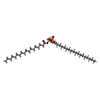
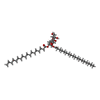
ChemComp-LHG:
1,2-DIPALMITOYL-PHOSPHATIDYL-GLYCEROLE / phospholipid*YM

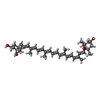
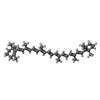
ChemComp-LUT:
(3R,3'R,6S)-4,5-DIDEHYDRO-5,6-DIHYDRO-BETA,BETA-CAROTENE-3,3'-DIOL

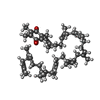
ChemComp-NEX:
(1R,3R)-6-{(3E,5E,7E,9E,11E,13E,15E,17E)-18-[(1S,4R,6R)-4-HYDROXY-2,2,6-TRIMETHYL-7-OXABICYCLO[4.1.0]HEPT-1-YL]-3,7,12,16-TETRAMETHYLOCTADECA-1,3,5,7,9,11,13,15,17-NONAENYLIDENE}-1,5,5-TRIMETHYLCYCLOHEXANE-1,3-DIOL

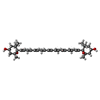
ChemComp-XAT:
(3S,5R,6S,3'S,5'R,6'S)-5,6,5',6'-DIEPOXY-5,6,5',6'- TETRAHYDRO-BETA,BETA-CAROTENE-3,3'-DIOL

ChemComp-3PH:
1,2-DIACYL-GLYCEROL-3-SN-PHOSPHATE

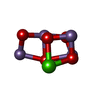
ChemComp-OEX:
CA-MN4-O5 CLUSTER

ChemComp-PHO:
PHEOPHYTIN A

ChemComp-BCR:
BETA-CAROTENE

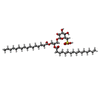
ChemComp-SQD:
1,2-DI-O-ACYL-3-O-[6-DEOXY-6-SULFO-ALPHA-D-GLUCOPYRANOSYL]-SN-GLYCEROL

ChemComp-LMG:
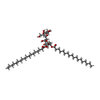
1,2-DISTEAROYL-MONOGALACTOSYL-DIGLYCERIDE

ChemComp-PL9:
2,3-DIMETHYL-5-(3,7,11,15,19,23,27,31,35-NONAMETHYL-2,6,10,14,18,22,26,30,34-HEXATRIACONTANONAENYL-2,5-CYCLOHEXADIENE-1,4-DIONE-2,3-DIMETHYL-5-SOLANESYL-1,4-BENZOQUINONE

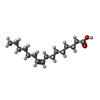
ChemComp-LNL:
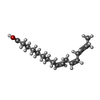
ALPHA-LINOLENIC ACID

ChemComp-STE:
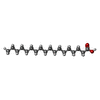
STEARIC ACID

ChemComp-CL:
Unknown entry

ChemComp-DGD:
DIGALACTOSYL DIACYL GLYCEROL (DGDG)

ChemComp-FE2:
Unknown entry

ChemComp-BCT:
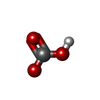
BICARBONATE ION / pH buffer*YM

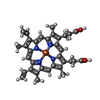
ChemComp-HEM:
PROTOPORPHYRIN IX CONTAINING FE

ChemComp-PAM:
PALMITOLEIC ACID

Source
  • chlorella ohadii (plant)
KeywordsMEMBRANE PROTEIN / supercomplex / photosynthesis / chlorophyll / algae

+
About Yorodumi Papers

-
News

-
Feb 9, 2022. New format data for meta-information of EMDB entries

New format data for meta-information of EMDB entries

  • Version 3 of the EMDB header file is now the official format.
  • The previous official version 1.9 will be removed from the archive.

Related info.:EMDB header

External links:wwPDB to switch to version 3 of the EMDB data model

-
Aug 12, 2020. Covid-19 info

Covid-19 info

URL: https://pdbj.org/emnavi/covid19.php

New page: Covid-19 featured information page in EM Navigator.

Related info.:Covid-19 info / Mar 5, 2020. Novel coronavirus structure data

+
Mar 5, 2020. Novel coronavirus structure data

Novel coronavirus structure data

Related info.:Yorodumi Speices / Aug 12, 2020. Covid-19 info

External links:COVID-19 featured content - PDBj / Molecule of the Month (242):Coronavirus Proteases

+
Jan 31, 2019. EMDB accession codes are about to change! (news from PDBe EMDB page)

EMDB accession codes are about to change! (news from PDBe EMDB page)

  • The allocation of 4 digits for EMDB accession codes will soon come to an end. Whilst these codes will remain in use, new EMDB accession codes will include an additional digit and will expand incrementally as the available range of codes is exhausted. The current 4-digit format prefixed with “EMD-” (i.e. EMD-XXXX) will advance to a 5-digit format (i.e. EMD-XXXXX), and so on. It is currently estimated that the 4-digit codes will be depleted around Spring 2019, at which point the 5-digit format will come into force.
  • The EM Navigator/Yorodumi systems omit the EMD- prefix.

Related info.:Q: What is EMD? / ID/Accession-code notation in Yorodumi/EM Navigator

External links:EMDB Accession Codes are Changing Soon! / Contact to PDBj

+
Jul 12, 2017. Major update of PDB

Major update of PDB

  • wwPDB released updated PDB data conforming to the new PDBx/mmCIF dictionary.
  • This is a major update changing the version number from 4 to 5, and with Remediation, in which all the entries are updated.
  • In this update, many items about electron microscopy experimental information are reorganized (e.g. em_software).
  • Now, EM Navigator and Yorodumi are based on the updated data.

External links:wwPDB Remediation / Enriched Model Files Conforming to OneDep Data Standards Now Available in the PDB FTP Archive

-
Yorodumi Papers

Database of articles cited by EMDB/PDB/SASBDB data

  • Database of articles cited by EMDB, PDB, and SASBDB entries
  • Using PubMed data

Related info.:EMDB / PDB / SASBDB / Yorodumi / EMN Papers / Changes in new EM Navigator and Yorodumi

Read more