 Movie
Movie Controller
 Structure viewers
 About Yorodumi Papers


+Search query
-Structure paper
| Title | The assembly rules guiding hetero-oligomeric bacterioferritin organization and their evolutionary signature. |
|---|---|
| Journal, issue, pages | Proc Natl Acad Sci U S A, Vol. 123, Issue 5, Page e2504561123, Year 2026 |
| Publish date | Feb 3, 2026 |
 Authors Authors | Daniel Stein / Bruno Jartoux / Shiran Dror / René Uebe / Tracy Chih-Ting Koubková-Yu / Ran Zalk / Anat Shahar / Raz Zarivach / Gabriel A Frank /   |
| PubMed Abstract | Homomeric and heteromeric protein complexes are ubiquitous across all domains of life. The evolutionary transition from homo- to hetero-oligomers by gene duplication and chain specialization is ...Homomeric and heteromeric protein complexes are ubiquitous across all domains of life. The evolutionary transition from homo- to hetero-oligomers by gene duplication and chain specialization is widespread, yet it entails challenging requirements for maintaining oligomerization and functionality. Chain specialization in ferritins, which occurs in bacteria, vertebrates, and plants, is a salient example of this phenomenon. In heteroferritins, the two essential functions, ferroxidase activity and electron transfer, are split between two specialized chain types. Many heteroferritins assemble into complexes with variable subunit ratios, implying the existence of assembly rules that balance compositional flexibility with structural constraints. Here, we identify the assembly rules governing the organization of the heterobacterioferritin from (MSR-1 Bfr) by analyzing its cryo-EM reconstructions. These rules consist of structural constraints that limit the number of possible arrangements and promote juxtaposition of the two, now separated functions. These constraints support compositional flexibility while preserving function, thereby providing resilience to stochastic variation in oligomer stoichiometry. Bioinformatic analysis revealed that the assembly rules identified in MSR-1 Bfr are widespread across the Bfr family and coevolved with chain specialization. Together, these findings support leading models of hetero-oligomer evolution and reveal the emergence of order-exerting mutations that shape the organization of multimeric protein complexes while conserving function. |
 External links External links | Proc Natl Acad Sci U S A / PubMed:41609675 / PubMed Central |
| Methods | EM (single particle) |
| Resolution | 2.86 Å |
| Structure data | EMDB-51772, PDB-9h1u: |
| Chemicals | 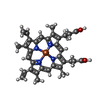 ChemComp-HEM:  ChemComp-FE: |
| Source |
|
 Keywords Keywords | METAL BINDING PROTEIN / Heterooligomer / Iron-storage protein / Heme binding / Octahedral |


 magnetospirillum gryphiswaldense msr-1 (magnetotactic)