[English] 日本語
Yorodumi Papers
- Database of articles cited by EMDB/PDB/SASBDB data -

+
Search query

Keywords
Structure methods
Author
Journal
IF

-
Structure paper

TitleTransport of herbicides by PIN-FORMED auxin transporters.
Journal, issue, pagesbioRxiv, Year 2024
Publish dateAug 31, 2024
AuthorsLukas Schulz / Kien Lam Ung / Sarah Koutnik-Abele / David L Stokes / Bjørn Panyella Pedersen / Ulrich Z Hammes /
PubMed AbstractAuxins are a group of phytohormones that control plant growth and development . Their crucial role in plant physiology has inspired development of potent synthetic auxins that can be used as ...Auxins are a group of phytohormones that control plant growth and development . Their crucial role in plant physiology has inspired development of potent synthetic auxins that can be used as herbicides . Phenoxyacetic acid derivatives are a widely used group of auxin herbicides in agriculture and research. Despite their prevalence, the identity of the transporters required for distribution of these herbicides in plants is both poorly understood and the subject of controversial debate . Here we show that PIN-FORMED auxin transporters transport a range of phenoxyacetic acid herbicides across the membrane and we characterize the molecular determinants of this process using a variety of different substrates as well as protein mutagenesis to control substrate specificity. Finally, we present Cryo-EM structures of PIN8 with 2,4-dichlorophenoxyacetic acid (2,4-D) or 4-chlorophenoxyacetic acid (4-CPA) bound. These structures represent five key states from the transport cycle, allowing us to describe conformational changes associated with substrate binding and transport across the membrane. Overall, our results reveal that phenoxyacetic acid herbicides use the same export machinery as endogenous auxins and exemplify how transporter binding sites undergo transformations that dictate substrate specificity. These results enable development of novel synthetic auxins and for guiding precision breeding of herbicide resistant crop plants.
External linksbioRxiv / PubMed:39257797 / PubMed Central
MethodsEM (single particle)
Resolution3.31 - 3.54 Å
Structure data

EMDB-50950, PDB-9g0w:
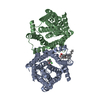
auxin transporter PIN8 as asymmetric dimer (inward/outward) with 2,4-D bound in the inward vestibule prebinding state
Method: EM (single particle) / Resolution: 3.54 Å

EMDB-50951, PDB-9g0x:
auxin transporter PIN8 as asymmetric dimer (inward/outward) with 4-CPA bound in the inward vestibule prebinding state
Method: EM (single particle) / Resolution: 3.38 Å

EMDB-50952, PDB-9g0z:
auxin transporter PIN8 as symmetric dimer (outward/outward) with 4-CPA bound in the outward binding state
Method: EM (single particle) / Resolution: 3.31 Å

EMDB-50953, PDB-9g10:
auxin transporter PIN8 as asymmetric dimer (outward/inward) with 4-CPA bound in the outward partly released state
Method: EM (single particle) / Resolution: 3.43 Å

Chemicals

ChemComp-CFA:
(2,4-DICHLOROPHENOXY)ACETIC ACID

ChemComp-DMS:
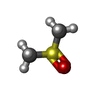
DIMETHYL SULFOXIDE / DMSO, precipitant*YM

ChemComp-DLP:
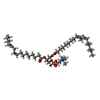
1,2-DILINOLEOYL-SN-GLYCERO-3-PHOSPHOCHOLINE / phospholipid*YM

ChemComp-HOH:
WATER

PDB-1ihp:
STRUCTURE OF PHOSPHOMONOESTERASE

Source
  • arabidopsis thaliana (thale cress)
KeywordsMEMBRANE PROTEIN / Auxin transport / AEC family / BART superfamily / TRANSPORT PROTEIN

+
About Yorodumi Papers

-
News

-
Feb 9, 2022. New format data for meta-information of EMDB entries

New format data for meta-information of EMDB entries

  • Version 3 of the EMDB header file is now the official format.
  • The previous official version 1.9 will be removed from the archive.

Related info.:EMDB header

External links:wwPDB to switch to version 3 of the EMDB data model

-
Aug 12, 2020. Covid-19 info

Covid-19 info

URL: https://pdbj.org/emnavi/covid19.php

New page: Covid-19 featured information page in EM Navigator.

Related info.:Covid-19 info / Mar 5, 2020. Novel coronavirus structure data

+
Mar 5, 2020. Novel coronavirus structure data

Novel coronavirus structure data

Related info.:Yorodumi Speices / Aug 12, 2020. Covid-19 info

External links:COVID-19 featured content - PDBj / Molecule of the Month (242):Coronavirus Proteases

+
Jan 31, 2019. EMDB accession codes are about to change! (news from PDBe EMDB page)

EMDB accession codes are about to change! (news from PDBe EMDB page)

  • The allocation of 4 digits for EMDB accession codes will soon come to an end. Whilst these codes will remain in use, new EMDB accession codes will include an additional digit and will expand incrementally as the available range of codes is exhausted. The current 4-digit format prefixed with “EMD-” (i.e. EMD-XXXX) will advance to a 5-digit format (i.e. EMD-XXXXX), and so on. It is currently estimated that the 4-digit codes will be depleted around Spring 2019, at which point the 5-digit format will come into force.
  • The EM Navigator/Yorodumi systems omit the EMD- prefix.

Related info.:Q: What is EMD? / ID/Accession-code notation in Yorodumi/EM Navigator

External links:EMDB Accession Codes are Changing Soon! / Contact to PDBj

+
Jul 12, 2017. Major update of PDB

Major update of PDB

  • wwPDB released updated PDB data conforming to the new PDBx/mmCIF dictionary.
  • This is a major update changing the version number from 4 to 5, and with Remediation, in which all the entries are updated.
  • In this update, many items about electron microscopy experimental information are reorganized (e.g. em_software).
  • Now, EM Navigator and Yorodumi are based on the updated data.

External links:wwPDB Remediation / Enriched Model Files Conforming to OneDep Data Standards Now Available in the PDB FTP Archive

-
Yorodumi Papers

Database of articles cited by EMDB/PDB/SASBDB data

  • Database of articles cited by EMDB, PDB, and SASBDB entries
  • Using PubMed data

Related info.:EMDB / PDB / SASBDB / Yorodumi / EMN Papers / Changes in new EM Navigator and Yorodumi

Read more