[English] 日本語
Yorodumi Papers
- Database of articles cited by EMDB/PDB/SASBDB data -

+
Search query

Keywords
Structure methods
Author
Journal
IF

-
Structure paper

TitleAPC/C-mediated ubiquitylation of extranucleosomal histone complexes lacking canonical degrons.
Journal, issue, pagesNat Commun, Vol. 16, Issue 1, Page 2561, Year 2025
Publish dateMar 15, 2025
AuthorsAleksandra Skrajna / Tatyana Bodrug / Raquel C Martinez-Chacin / Caleb B Fisher / Kaeli A Welsh / Holly C Simmons / Eyla C Arteaga / Jake M Simmons / Mohamed A Nasr / Kyle M LaPak / Anh Nguyen / Mai T Huynh / Isabel Fargo / Joshua G Welfare / Yani Zhao / David S Lawrence / Dennis Goldfarb / Nicholas G Brown / Robert K McGinty /
PubMed AbstractNon-degradative histone ubiquitylation plays a myriad of well-defined roles in the regulation of gene expression and choreographing DNA damage repair pathways. In contrast, the contributions of ...Non-degradative histone ubiquitylation plays a myriad of well-defined roles in the regulation of gene expression and choreographing DNA damage repair pathways. In contrast, the contributions of degradative histone ubiquitylation on genomic processes has remained elusive. Recently, the APC/C has been shown to ubiquitylate histones to regulate gene expression in pluripotent cells, but the molecular mechanism is unclear. Here we show that despite directly binding to the nucleosome through subunit APC3, the APC/C is unable to ubiquitylate nucleosomal histones. In contrast, extranucleosomal H2A/H2B and H3/H4 complexes are broadly ubiquitylated by the APC/C in an unexpected manner. Using a combination of cryo-electron microscopy (cryo-EM) and biophysical and enzymatic assays, we demonstrate that APC8 and histone tails direct APC/C-mediated polyubiquitylation of core histones in the absence of traditional APC/C substrate degron sequences. Taken together, our work implicates APC/C-nucleosome tethering in the degradation of diverse chromatin-associated proteins and extranucleosomal histones for the regulation of transcription and the cell cycle and for preventing toxicity due to excess histone levels.
External linksNat Commun / PubMed:40089476 / PubMed Central
MethodsEM (single particle)
Resolution3.9 Å
Structure data

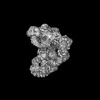
EMDB-48928: Cryo-EM map of APC/C-CDC20-UBE2C-H2A/H2B crosslinked complex
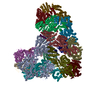
PDB-9n9r: Model of APC/C-CDC20-UBE2C from H2A/H2B-bound complex
Method: EM (single particle) / Resolution: 3.9 Å

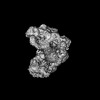
EMDB-48984: Cryo-EM map of APC/C-CDC20-UBE2C-H3/H4 crosslinked complex
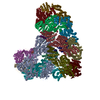
PDB-9n9s: Model of APC/C-CDC20-UBE2C from H3/H4-bound complex
Method: EM (single particle) / Resolution: 3.9 Å

Chemicals

ChemComp-ZN:
Unknown entry

Source
  • homo sapiens (human)
KeywordsCELL CYCLE / ubiquitin ligase / histone / chromatin / ubiquitin / complex

+
About Yorodumi Papers

-
News

-
Feb 9, 2022. New format data for meta-information of EMDB entries

New format data for meta-information of EMDB entries

  • Version 3 of the EMDB header file is now the official format.
  • The previous official version 1.9 will be removed from the archive.

Related info.:EMDB header

External links:wwPDB to switch to version 3 of the EMDB data model

-
Aug 12, 2020. Covid-19 info

Covid-19 info

URL: https://pdbj.org/emnavi/covid19.php

New page: Covid-19 featured information page in EM Navigator.

Related info.:Covid-19 info / Mar 5, 2020. Novel coronavirus structure data

+
Mar 5, 2020. Novel coronavirus structure data

Novel coronavirus structure data

Related info.:Yorodumi Speices / Aug 12, 2020. Covid-19 info

External links:COVID-19 featured content - PDBj / Molecule of the Month (242):Coronavirus Proteases

+
Jan 31, 2019. EMDB accession codes are about to change! (news from PDBe EMDB page)

EMDB accession codes are about to change! (news from PDBe EMDB page)

  • The allocation of 4 digits for EMDB accession codes will soon come to an end. Whilst these codes will remain in use, new EMDB accession codes will include an additional digit and will expand incrementally as the available range of codes is exhausted. The current 4-digit format prefixed with “EMD-” (i.e. EMD-XXXX) will advance to a 5-digit format (i.e. EMD-XXXXX), and so on. It is currently estimated that the 4-digit codes will be depleted around Spring 2019, at which point the 5-digit format will come into force.
  • The EM Navigator/Yorodumi systems omit the EMD- prefix.

Related info.:Q: What is EMD? / ID/Accession-code notation in Yorodumi/EM Navigator

External links:EMDB Accession Codes are Changing Soon! / Contact to PDBj

+
Jul 12, 2017. Major update of PDB

Major update of PDB

  • wwPDB released updated PDB data conforming to the new PDBx/mmCIF dictionary.
  • This is a major update changing the version number from 4 to 5, and with Remediation, in which all the entries are updated.
  • In this update, many items about electron microscopy experimental information are reorganized (e.g. em_software).
  • Now, EM Navigator and Yorodumi are based on the updated data.

External links:wwPDB Remediation / Enriched Model Files Conforming to OneDep Data Standards Now Available in the PDB FTP Archive

-
Yorodumi Papers

Database of articles cited by EMDB/PDB/SASBDB data

  • Database of articles cited by EMDB, PDB, and SASBDB entries
  • Using PubMed data

Related info.:EMDB / PDB / SASBDB / Yorodumi / EMN Papers / Changes in new EM Navigator and Yorodumi

Read more