[English] 日本語
Yorodumi Papers
- Database of articles cited by EMDB/PDB/SASBDB data -

+
Search query

Keywords
Structure methods
Author
Journal
IF

-
Structure paper

TitleAn IMPDH2 variant associated with neurodevelopmental disorder disrupts purine biosynthesis and somite organization.
Journal, issue, pagesProc Natl Acad Sci U S A, Vol. 122, Issue 49, Page e2511727122, Year 2025
Publish dateDec 9, 2025
AuthorsAudrey G O'Neill / Morgan E McCartney / Gavin M Wheeler / Jeet H Patel / Gardenia Sanchez-Ramirez / Justin M Kollman / Andrea E Wills /
PubMed AbstractIMP dehydrogenase (IMPDH) controls a key regulatory node in purine biosynthesis. Gain-of-function mutations in human IMPDH2 are associated with neurodevelopmental disorders and neuromuscular symptoms ...IMP dehydrogenase (IMPDH) controls a key regulatory node in purine biosynthesis. Gain-of-function mutations in human IMPDH2 are associated with neurodevelopmental disorders and neuromuscular symptoms including dystonia, but the developmental mechanisms underlying these defects are unknown. We previously showed that these mutants are insensitive to GTP inhibition and hypothesized that their hyperactivity would affect nucleotide metabolism in vivo. Here, we characterize the metabolic and developmental consequences of the neurodevelopmental disorder-associated IMPDH2 mutant, S160del, in . We show that expressing S160del but not WT human IMPDH2 disrupts purine pools and somite organization in the developing tadpole. We also show that S160del disrupts in vivo IMPDH filament assembly, a well-described IMPDH regulatory mechanism. Cryo-EM structures show that S160del disrupts filament assembly by destabilizing the dimerization of regulatory Bateman domains. Dimerization of Bateman domains and subsequent filament formation can be restored with a high affinity ligand, but this does not restore sensitivity to GTP inhibition, suggesting S160del also disrupts allostery of IMPDH2 filaments. This work demonstrates that the structural effects of patient IMPDH2 variants can cause disruptions both to nucleotide levels and to the normal development of sensorimotor structures, helping us better understand the physiological basis of disease in these patients.
External linksProc Natl Acad Sci U S A / PubMed:41343675 / PubMed Central
MethodsEM (single particle)
Resolution2.1 - 2.5 Å
Structure data

EMDB-48627, PDB-9mub:
Human IMPDH2 mutant - S160del, treated with GTP, ATP, IMP, and NAD+; tetramer reconstruction
Method: EM (single particle) / Resolution: 2.5 Å

EMDB-48628, PDB-9muc:
Human IMPDH2 mutant - S160del, treated with GTP, ATP, IMP, and NAD+; interfacial octamer reconstruction
Method: EM (single particle) / Resolution: 2.1 Å

Chemicals

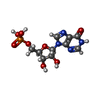
ChemComp-IMP:
INOSINIC ACID

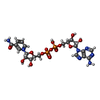
ChemComp-NAD:
NICOTINAMIDE-ADENINE-DINUCLEOTIDE / NAD*YM

Source
  • homo sapiens (human)
KeywordsOXIDOREDUCTASE / Dehydrogenase / purine biosynthesis

+
About Yorodumi Papers

-
News

-
Feb 9, 2022. New format data for meta-information of EMDB entries

New format data for meta-information of EMDB entries

  • Version 3 of the EMDB header file is now the official format.
  • The previous official version 1.9 will be removed from the archive.

Related info.:EMDB header

External links:wwPDB to switch to version 3 of the EMDB data model

-
Aug 12, 2020. Covid-19 info

Covid-19 info

URL: https://pdbj.org/emnavi/covid19.php

New page: Covid-19 featured information page in EM Navigator.

Related info.:Covid-19 info / Mar 5, 2020. Novel coronavirus structure data

+
Mar 5, 2020. Novel coronavirus structure data

Novel coronavirus structure data

Related info.:Yorodumi Speices / Aug 12, 2020. Covid-19 info

External links:COVID-19 featured content - PDBj / Molecule of the Month (242):Coronavirus Proteases

+
Jan 31, 2019. EMDB accession codes are about to change! (news from PDBe EMDB page)

EMDB accession codes are about to change! (news from PDBe EMDB page)

  • The allocation of 4 digits for EMDB accession codes will soon come to an end. Whilst these codes will remain in use, new EMDB accession codes will include an additional digit and will expand incrementally as the available range of codes is exhausted. The current 4-digit format prefixed with “EMD-” (i.e. EMD-XXXX) will advance to a 5-digit format (i.e. EMD-XXXXX), and so on. It is currently estimated that the 4-digit codes will be depleted around Spring 2019, at which point the 5-digit format will come into force.
  • The EM Navigator/Yorodumi systems omit the EMD- prefix.

Related info.:Q: What is EMD? / ID/Accession-code notation in Yorodumi/EM Navigator

External links:EMDB Accession Codes are Changing Soon! / Contact to PDBj

+
Jul 12, 2017. Major update of PDB

Major update of PDB

  • wwPDB released updated PDB data conforming to the new PDBx/mmCIF dictionary.
  • This is a major update changing the version number from 4 to 5, and with Remediation, in which all the entries are updated.
  • In this update, many items about electron microscopy experimental information are reorganized (e.g. em_software).
  • Now, EM Navigator and Yorodumi are based on the updated data.

External links:wwPDB Remediation / Enriched Model Files Conforming to OneDep Data Standards Now Available in the PDB FTP Archive

-
Yorodumi Papers

Database of articles cited by EMDB/PDB/SASBDB data

  • Database of articles cited by EMDB, PDB, and SASBDB entries
  • Using PubMed data

Related info.:EMDB / PDB / SASBDB / Yorodumi / EMN Papers / Changes in new EM Navigator and Yorodumi

Read more