[English] 日本語
Yorodumi Papers
- Database of articles cited by EMDB/PDB/SASBDB data -

+
Search query

Keywords
Structure methods
Author
Journal
IF

-
Structure paper

TitleEvaluating TcAs for Use in Biotechnology Applications.
Journal, issue, pagesBioTech (Basel), Vol. 14, Issue 1, Year 2025
Publish dateJan 25, 2025
AuthorsCole L Martin / John H Hill / Brian D Wright / Solana R Fernandez / Aubrey L Miller / Karina J Yoon / Suzanne E Lapi / Stephen G Aller /
PubMed AbstractABC toxin complexes (Tcs) are tripartite complexes that come together to form nano-syringe-like translocation systems. ABC Tcs are often compared with (Bt) toxins, and as such, they have been highly ...ABC toxin complexes (Tcs) are tripartite complexes that come together to form nano-syringe-like translocation systems. ABC Tcs are often compared with (Bt) toxins, and as such, they have been highly studied as a potential novel pesticide to combat growing insect resistance. Moreover, it is possible to substitute the cytotoxic hypervariable region with alternative peptides, which promise potential use as a novel peptide delivery system. These toxins possess the unique ability to form active chimeric holotoxins across species and display the capability to translocate a variety of payloads across membrane bilayers. Additionally, mutagenesis on the linker region and the receptor binding domains (RBDs) show that mutations do not inherently cause a loss of functionality for translocation. For these reasons, Tcs have emerged as an ideal candidate for targeted protein engineering. However, elucidation of the specific function of each RBD in relation to target receptor recognition currently limits the use of a rational design approach with any ABC Tc. Additionally, there is a distinct lack of targeting and biodistribution data for many Tcs among mammals and mammalian cell lines. Here, we outline two separate strategies for modifying the targeting capabilities of the A subunit (TcA) from , Xn-XptA2. We identify novel structural differences that make Xn-XptA2 different than other characterized TcAs and display the modular capabilities of substituting RBDs from alternative TcAs into the Xn-XptA2 scaffold. Finally, we show the first, to our knowledge, biodistribution data of any TcA in mice.
External linksBioTech (Basel) / PubMed:39982272 / PubMed Central
MethodsEM (single particle)
Resolution3.4 - 4.3 Å
Structure data

EMDB-48371, PDB-9mlg:
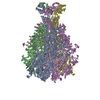
Xenorhabdus nematophilus XptA2 State 2, 1181insYWK1183, D1182T mutant
Method: EM (single particle) / Resolution: 4.3 Å

EMDB-48372, PDB-9mlh:
Xenorhabdus nematophilus XptA2, wild type State 2
Method: EM (single particle) / Resolution: 3.9 Å

EMDB-48373, PDB-9mli:
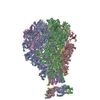
Xenorhabdus nematophilus XptA2 RBD C Chimera
Method: EM (single particle) / Resolution: 3.4 Å

Source
  • xenorhabdus nematophila (bacteria)
KeywordsTOXIN / TcA / Pore Forming Toxin

+
About Yorodumi Papers

-
News

-
Feb 9, 2022. New format data for meta-information of EMDB entries

New format data for meta-information of EMDB entries

  • Version 3 of the EMDB header file is now the official format.
  • The previous official version 1.9 will be removed from the archive.

Related info.:EMDB header

External links:wwPDB to switch to version 3 of the EMDB data model

-
Aug 12, 2020. Covid-19 info

Covid-19 info

URL: https://pdbj.org/emnavi/covid19.php

New page: Covid-19 featured information page in EM Navigator.

Related info.:Covid-19 info / Mar 5, 2020. Novel coronavirus structure data

+
Mar 5, 2020. Novel coronavirus structure data

Novel coronavirus structure data

Related info.:Yorodumi Speices / Aug 12, 2020. Covid-19 info

External links:COVID-19 featured content - PDBj / Molecule of the Month (242):Coronavirus Proteases

+
Jan 31, 2019. EMDB accession codes are about to change! (news from PDBe EMDB page)

EMDB accession codes are about to change! (news from PDBe EMDB page)

  • The allocation of 4 digits for EMDB accession codes will soon come to an end. Whilst these codes will remain in use, new EMDB accession codes will include an additional digit and will expand incrementally as the available range of codes is exhausted. The current 4-digit format prefixed with “EMD-” (i.e. EMD-XXXX) will advance to a 5-digit format (i.e. EMD-XXXXX), and so on. It is currently estimated that the 4-digit codes will be depleted around Spring 2019, at which point the 5-digit format will come into force.
  • The EM Navigator/Yorodumi systems omit the EMD- prefix.

Related info.:Q: What is EMD? / ID/Accession-code notation in Yorodumi/EM Navigator

External links:EMDB Accession Codes are Changing Soon! / Contact to PDBj

+
Jul 12, 2017. Major update of PDB

Major update of PDB

  • wwPDB released updated PDB data conforming to the new PDBx/mmCIF dictionary.
  • This is a major update changing the version number from 4 to 5, and with Remediation, in which all the entries are updated.
  • In this update, many items about electron microscopy experimental information are reorganized (e.g. em_software).
  • Now, EM Navigator and Yorodumi are based on the updated data.

External links:wwPDB Remediation / Enriched Model Files Conforming to OneDep Data Standards Now Available in the PDB FTP Archive

-
Yorodumi Papers

Database of articles cited by EMDB/PDB/SASBDB data

  • Database of articles cited by EMDB, PDB, and SASBDB entries
  • Using PubMed data

Related info.:EMDB / PDB / SASBDB / Yorodumi / EMN Papers / Changes in new EM Navigator and Yorodumi

Read more