[English] 日本語
Yorodumi Papers
- Database of articles cited by EMDB/PDB/SASBDB data -

+
Search query

Keywords
Structure methods
Author
Journal
IF

-
Structure paper

TitleMolecular basis for shifted receptor recognition by an encephalitic arbovirus.
Journal, issue, pagesCell, Vol. 188, Issue 11, Page 2957-2973.e28, Year 2025
Publish dateMay 29, 2025
AuthorsXiaoyi Fan / Wanyu Li / Jessica Oros / Jessica A Plante / Brooke M Mitchell / Jesse S Plung / Himanish Basu / Sivapratha Nagappan-Chettiar / Joshua M Boeckers / Laurentia V Tjang / Colin J Mann / Vesna Brusic / Tierra K Buck / Haley Varnum / Pan Yang / Linzy M Malcolm / So Yoen Choi / William M de Souza / Isaac M Chiu / Hisashi Umemori / Scott C Weaver / Kenneth S Plante / Jonathan Abraham /
PubMed AbstractWestern equine encephalitis virus (WEEV) is an arbovirus that historically caused large outbreaks of encephalitis throughout the Americas. WEEV binds protocadherin 10 (PCDH10) as a receptor, and ...Western equine encephalitis virus (WEEV) is an arbovirus that historically caused large outbreaks of encephalitis throughout the Americas. WEEV binds protocadherin 10 (PCDH10) as a receptor, and highly virulent ancestral WEEV strains also bind low-density lipoprotein receptor (LDLR)-related proteins. As WEEV declined as a human pathogen in North America over the past century, isolates have lost the ability to bind mammalian receptors while still recognizing avian receptors. To explain shifts in receptor dependencies and assess the risk of WEEV re-emergence, we determined cryoelectron microscopy structures of WEEV bound to human PCDH10, avian PCDH10, and human very-low-density lipoprotein receptor (VLDLR). We show that one to three E2 glycoprotein substitutions are sufficient for a nonpathogenic strain to regain the ability to bind mammalian receptors. A soluble VLDLR fragment protects mice from lethal challenge by a virulent ancestral WEEV strain. Because WEEV recently re-emerged in South America after decades of inactivity, our findings have important implications for outbreak preparedness.
External linksCell / PubMed:40187345 / PubMed Central
MethodsEM (single particle)
Resolution2.8 - 3.4 Å
Structure data

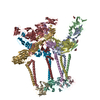
EMDB-47116, PDB-9dqv:
Structure of western equine encephalitis virus CBA87 VLP in complex with human PCDH10 EC1
Method: EM (single particle) / Resolution: 3.3 Å

EMDB-47117, PDB-9dqx:
Structure of western equine encephalitis virus CBA87 VLP
Method: EM (single particle) / Resolution: 3.4 Å

EMDB-47118, PDB-9dqy:
Structure of western equine encephalitis virus Imperial 181 VLP in complex with house sparrow PCDH10 EC1
Method: EM (single particle) / Resolution: 2.8 Å

EMDB-47119, PDB-9dqz:
Structure of western equine encephalitis virus McMillan VLP in complex with human VLDLR
Method: EM (single particle) / Resolution: 2.9 Å

Chemicals

ChemComp-NAG:
2-acetamido-2-deoxy-beta-D-glucopyranose

ChemComp-CA:
Unknown entry

Source
  • western equine encephalitis virus
  • homo sapiens (human)
  • passer domesticus (house sparrow)
KeywordsVIRUS LIKE PARTICLE / western equine encephalitis virus / WEEV / receptor binding / PCDH10 / virus like particles / VLDLR

+
About Yorodumi Papers

-
News

-
Feb 9, 2022. New format data for meta-information of EMDB entries

New format data for meta-information of EMDB entries

  • Version 3 of the EMDB header file is now the official format.
  • The previous official version 1.9 will be removed from the archive.

Related info.:EMDB header

External links:wwPDB to switch to version 3 of the EMDB data model

-
Aug 12, 2020. Covid-19 info

Covid-19 info

URL: https://pdbj.org/emnavi/covid19.php

New page: Covid-19 featured information page in EM Navigator.

Related info.:Covid-19 info / Mar 5, 2020. Novel coronavirus structure data

+
Mar 5, 2020. Novel coronavirus structure data

Novel coronavirus structure data

Related info.:Yorodumi Speices / Aug 12, 2020. Covid-19 info

External links:COVID-19 featured content - PDBj / Molecule of the Month (242):Coronavirus Proteases

+
Jan 31, 2019. EMDB accession codes are about to change! (news from PDBe EMDB page)

EMDB accession codes are about to change! (news from PDBe EMDB page)

  • The allocation of 4 digits for EMDB accession codes will soon come to an end. Whilst these codes will remain in use, new EMDB accession codes will include an additional digit and will expand incrementally as the available range of codes is exhausted. The current 4-digit format prefixed with “EMD-” (i.e. EMD-XXXX) will advance to a 5-digit format (i.e. EMD-XXXXX), and so on. It is currently estimated that the 4-digit codes will be depleted around Spring 2019, at which point the 5-digit format will come into force.
  • The EM Navigator/Yorodumi systems omit the EMD- prefix.

Related info.:Q: What is EMD? / ID/Accession-code notation in Yorodumi/EM Navigator

External links:EMDB Accession Codes are Changing Soon! / Contact to PDBj

+
Jul 12, 2017. Major update of PDB

Major update of PDB

  • wwPDB released updated PDB data conforming to the new PDBx/mmCIF dictionary.
  • This is a major update changing the version number from 4 to 5, and with Remediation, in which all the entries are updated.
  • In this update, many items about electron microscopy experimental information are reorganized (e.g. em_software).
  • Now, EM Navigator and Yorodumi are based on the updated data.

External links:wwPDB Remediation / Enriched Model Files Conforming to OneDep Data Standards Now Available in the PDB FTP Archive

-
Yorodumi Papers

Database of articles cited by EMDB/PDB/SASBDB data

  • Database of articles cited by EMDB, PDB, and SASBDB entries
  • Using PubMed data

Related info.:EMDB / PDB / SASBDB / Yorodumi / EMN Papers / Changes in new EM Navigator and Yorodumi

Read more