[English] 日本語
Yorodumi Papers
- Database of articles cited by EMDB/PDB/SASBDB data -

+
Search query

Keywords
Structure methods
Author
Journal
IF

-
Structure paper

TitleAutoimmune mechanisms elucidated through muscle acetylcholine receptor structures.
Journal, issue, pagesCell, Vol. 188, Issue 9, Page 2390-2406.e20, Year 2025
Publish dateMay 1, 2025
AuthorsHuanhuan Li / Minh C Pham / Jinfeng Teng / Kevin C O'Connor / Colleen M Noviello / Ryan E Hibbs /
PubMed AbstractSkeletal muscle contraction is triggered by acetylcholine (ACh) binding to its ionotropic receptors (AChRs) at neuromuscular junctions. In myasthenia gravis (MG), autoantibodies target AChRs, ...Skeletal muscle contraction is triggered by acetylcholine (ACh) binding to its ionotropic receptors (AChRs) at neuromuscular junctions. In myasthenia gravis (MG), autoantibodies target AChRs, disrupting neurotransmission and causing muscle weakness. While treatments exist, variable patient responses suggest pathogenic heterogeneity. Progress in understanding the molecular basis of MG has been limited by the absence of structures of intact human muscle AChRs. Here, we present high-resolution cryoelectron microscopy (cryo-EM) structures of the human adult AChR in different functional states. Using six MG patient-derived monoclonal antibodies, we mapped distinct epitopes involved in diverse pathogenic mechanisms, including receptor blockade, internalization, and complement activation. Electrophysiological and binding assays revealed how these autoantibodies directly inhibit AChR channel activation. These findings provide critical insights into MG immunopathogenesis, uncovering unrecognized antibody epitope diversity and modes of receptor inhibition, and provide a framework for developing personalized therapies targeting antibody-mediated autoimmune disorders.
External linksCell / PubMed:40203823 / PubMed Central
MethodsEM (single particle)
Resolution1.92 - 2.46 Å
Structure data

EMDB-47003, PDB-9dmg:
Human muscle nAChR apo state
Method: EM (single particle) / Resolution: 2.05 Å

EMDB-47005, PDB-9dmh:
Human muscle nAChR ACh-bound state
Method: EM (single particle) / Resolution: 2.06 Å

EMDB-47007, PDB-9dmj:
Human muscle nAChR with two fab1b-bound
Method: EM (single particle) / Resolution: 2.19 Å

EMDB-47008, PDB-9dmk:
Human muscle nAChR with one fab1b-bound
Method: EM (single particle) / Resolution: 2.46 Å

EMDB-47009, PDB-9dml:
Human muscle nAChR with fab2-bound
Method: EM (single particle) / Resolution: 2.24 Å

EMDB-47013, PDB-9dmq:
Human muscle nAChR with fab3-bound
Method: EM (single particle) / Resolution: 2.06 Å

EMDB-47014, PDB-9dms:
Human muscle nAChR with fab6-bound
Method: EM (single particle) / Resolution: 1.92 Å

EMDB-47015, PDB-9dmt:
Human muscle nAChR with fab7-bound
Method: EM (single particle) / Resolution: 2.18 Å

Chemicals

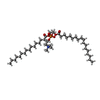
ChemComp-POV:
(2S)-3-(hexadecanoyloxy)-2-[(9Z)-octadec-9-enoyloxy]propyl 2-(trimethylammonio)ethyl phosphate / phospholipid*YM

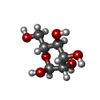
ChemComp-MAN:
alpha-D-mannopyranose

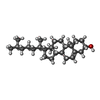
ChemComp-CLR:
CHOLESTEROL

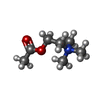
ChemComp-ACH:
ACETYLCHOLINE / neurotransmitter*YM

ChemComp-HOH:
WATER

ChemComp-NAG:
2-acetamido-2-deoxy-beta-D-glucopyranose

Source
  • homo sapiens (human)
KeywordsMEMBRANE PROTEIN / human muscle / nicotinic acetylcholine receptor

+
About Yorodumi Papers

-
News

-
Feb 9, 2022. New format data for meta-information of EMDB entries

New format data for meta-information of EMDB entries

  • Version 3 of the EMDB header file is now the official format.
  • The previous official version 1.9 will be removed from the archive.

Related info.:EMDB header

External links:wwPDB to switch to version 3 of the EMDB data model

-
Aug 12, 2020. Covid-19 info

Covid-19 info

URL: https://pdbj.org/emnavi/covid19.php

New page: Covid-19 featured information page in EM Navigator.

Related info.:Covid-19 info / Mar 5, 2020. Novel coronavirus structure data

+
Mar 5, 2020. Novel coronavirus structure data

Novel coronavirus structure data

Related info.:Yorodumi Speices / Aug 12, 2020. Covid-19 info

External links:COVID-19 featured content - PDBj / Molecule of the Month (242):Coronavirus Proteases

+
Jan 31, 2019. EMDB accession codes are about to change! (news from PDBe EMDB page)

EMDB accession codes are about to change! (news from PDBe EMDB page)

  • The allocation of 4 digits for EMDB accession codes will soon come to an end. Whilst these codes will remain in use, new EMDB accession codes will include an additional digit and will expand incrementally as the available range of codes is exhausted. The current 4-digit format prefixed with “EMD-” (i.e. EMD-XXXX) will advance to a 5-digit format (i.e. EMD-XXXXX), and so on. It is currently estimated that the 4-digit codes will be depleted around Spring 2019, at which point the 5-digit format will come into force.
  • The EM Navigator/Yorodumi systems omit the EMD- prefix.

Related info.:Q: What is EMD? / ID/Accession-code notation in Yorodumi/EM Navigator

External links:EMDB Accession Codes are Changing Soon! / Contact to PDBj

+
Jul 12, 2017. Major update of PDB

Major update of PDB

  • wwPDB released updated PDB data conforming to the new PDBx/mmCIF dictionary.
  • This is a major update changing the version number from 4 to 5, and with Remediation, in which all the entries are updated.
  • In this update, many items about electron microscopy experimental information are reorganized (e.g. em_software).
  • Now, EM Navigator and Yorodumi are based on the updated data.

External links:wwPDB Remediation / Enriched Model Files Conforming to OneDep Data Standards Now Available in the PDB FTP Archive

-
Yorodumi Papers

Database of articles cited by EMDB/PDB/SASBDB data

  • Database of articles cited by EMDB, PDB, and SASBDB entries
  • Using PubMed data

Related info.:EMDB / PDB / SASBDB / Yorodumi / EMN Papers / Changes in new EM Navigator and Yorodumi

Read more