[English] 日本語
Yorodumi Papers
- Database of articles cited by EMDB/PDB/SASBDB data -

+
Search query

Keywords
Structure methods
Author
Journal
IF

-
Structure paper

TitleStructurally convergent antibodies derived from different vaccine strategies target the influenza virus HA anchor epitope with a subset of V3 and V3 genes.
Journal, issue, pagesNat Commun, Vol. 16, Issue 1, Page 1268, Year 2025
Publish dateFeb 2, 2025
AuthorsTing-Hui Lin / Chang-Chun David Lee / Monica L Fernández-Quintero / James A Ferguson / Julianna Han / Xueyong Zhu / Wenli Yu / Jenna J Guthmiller / Florian Krammer / Patrick C Wilson / Andrew B Ward / Ian A Wilson /
PubMed AbstractH1N1 influenza viruses are responsible for both seasonal and pandemic influenza. The continual antigenic shift and drift of these viruses highlight the urgent need for a universal influenza vaccine ...H1N1 influenza viruses are responsible for both seasonal and pandemic influenza. The continual antigenic shift and drift of these viruses highlight the urgent need for a universal influenza vaccine to elicit broadly neutralizing antibodies (bnAbs). Identification and characterization of bnAbs elicited in natural infection and immunization to influenza virus hemagglutinin (HA) can provide insights for development of a universal influenza vaccine. Here, we structurally and biophysically characterize four antibodies that bind to a conserved region on the HA membrane-proximal region known as the anchor epitope. Despite some diversity in their V and V genes, the antibodies interact with the HA through germline-encoded residues in HCDR2 and LCDR3. Somatic mutations on HCDR3 also contribute hydrophobic interactions with the conserved HA epitope. This convergent binding mode provides extensive neutralization breadth against H1N1 viruses and suggests possible countermeasures against H1N1 viruses.
External linksNat Commun / PubMed:39894881 / PubMed Central
MethodsEM (single particle) / X-ray diffraction
Resolution2.01 - 3.29 Å
Structure data

EMDB-46994, PDB-9dm0:
Cryo-EM structure of the SFV009 3G01 Fab in complex with A/California/04/2009
Method: EM (single particle) / Resolution: 2.9 Å

PDB-9dru:
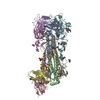
Crystal structure of 04709_4F04 Fab in complex with H1 HA from A/California/04/2009(H1N1)
Method: X-RAY DIFFRACTION / Resolution: 2.75 Å

PDB-9ds1:
Crystal structure of 241_2F04 Fab in complex with H1 HA from A/California/04/2009(H1N1)
Method: X-RAY DIFFRACTION / Resolution: 2.4 Å

PDB-9ds2:
Crystal structure of 346-54 Fab in complex with H1 HA from A/California/04/2009(H1N1)
Method: X-RAY DIFFRACTION / Resolution: 3.29 Å

PDB-9dsc:
Crystal structure of Apo-241_2F04-A95a mutant Fab
Method: X-RAY DIFFRACTION / Resolution: 2.01 Å

Chemicals

ChemComp-NAG:
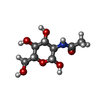
2-acetamido-2-deoxy-beta-D-glucopyranose

ChemComp-HOH:
WATER

Source
  • homo sapiens (human)
  • influenza a virus (a/california/04/2009(h1n1))
  • influenza a virus
KeywordsIMMUNE SYSTEM / hemagglutinin / HA / antibody / anchor epitope / influenza virus / VIRAL PROTEIN/IMMUNE SYSTEM / H1N1 / VIRAL PROTEIN-IMMUNE SYSTEM complex / VIRAL PROTEIN

+
About Yorodumi Papers

-
News

-
Feb 9, 2022. New format data for meta-information of EMDB entries

New format data for meta-information of EMDB entries

  • Version 3 of the EMDB header file is now the official format.
  • The previous official version 1.9 will be removed from the archive.

Related info.:EMDB header

External links:wwPDB to switch to version 3 of the EMDB data model

-
Aug 12, 2020. Covid-19 info

Covid-19 info

URL: https://pdbj.org/emnavi/covid19.php

New page: Covid-19 featured information page in EM Navigator.

Related info.:Covid-19 info / Mar 5, 2020. Novel coronavirus structure data

+
Mar 5, 2020. Novel coronavirus structure data

Novel coronavirus structure data

Related info.:Yorodumi Speices / Aug 12, 2020. Covid-19 info

External links:COVID-19 featured content - PDBj / Molecule of the Month (242):Coronavirus Proteases

+
Jan 31, 2019. EMDB accession codes are about to change! (news from PDBe EMDB page)

EMDB accession codes are about to change! (news from PDBe EMDB page)

  • The allocation of 4 digits for EMDB accession codes will soon come to an end. Whilst these codes will remain in use, new EMDB accession codes will include an additional digit and will expand incrementally as the available range of codes is exhausted. The current 4-digit format prefixed with “EMD-” (i.e. EMD-XXXX) will advance to a 5-digit format (i.e. EMD-XXXXX), and so on. It is currently estimated that the 4-digit codes will be depleted around Spring 2019, at which point the 5-digit format will come into force.
  • The EM Navigator/Yorodumi systems omit the EMD- prefix.

Related info.:Q: What is EMD? / ID/Accession-code notation in Yorodumi/EM Navigator

External links:EMDB Accession Codes are Changing Soon! / Contact to PDBj

+
Jul 12, 2017. Major update of PDB

Major update of PDB

  • wwPDB released updated PDB data conforming to the new PDBx/mmCIF dictionary.
  • This is a major update changing the version number from 4 to 5, and with Remediation, in which all the entries are updated.
  • In this update, many items about electron microscopy experimental information are reorganized (e.g. em_software).
  • Now, EM Navigator and Yorodumi are based on the updated data.

External links:wwPDB Remediation / Enriched Model Files Conforming to OneDep Data Standards Now Available in the PDB FTP Archive

-
Yorodumi Papers

Database of articles cited by EMDB/PDB/SASBDB data

  • Database of articles cited by EMDB, PDB, and SASBDB entries
  • Using PubMed data

Related info.:EMDB / PDB / SASBDB / Yorodumi / EMN Papers / Changes in new EM Navigator and Yorodumi

Read more