 Movie
Movie Controller
 Structure viewers
 About Yorodumi Papers


+Search query
-Structure paper
| Title | 14-3-3 binding maintains the Parkinson's associated kinase LRRK2 in an inactive state. |
|---|---|
| Journal, issue, pages | Nat Commun, Vol. 16, Issue 1, Page 7226, Year 2025 |
| Publish date | Aug 5, 2025 |
 Authors Authors | Juliana A Martinez Fiesco / Alexandra Beilina / Astrid Alvarez de la Cruz / Ning Li / Riley D Metcalfe / Mark R Cookson / Ping Zhang /  |
| PubMed Abstract | Leucine-rich repeat kinase 2 (LRRK2) is an essential regulator in cellular signaling and a major contributor to Parkinson's disease (PD) pathogenesis. 14-3-3 proteins are critical modulators of LRRK2 ...Leucine-rich repeat kinase 2 (LRRK2) is an essential regulator in cellular signaling and a major contributor to Parkinson's disease (PD) pathogenesis. 14-3-3 proteins are critical modulators of LRRK2 activity, yet the structural basis of their interaction has remained unclear. Here, we present the cryo-electron microscopy structure of the LRRK2:14-3-3 autoinhibitory complex, revealing how a 14-3-3 dimer stabilizes an autoinhibited LRRK2 monomer through dual-site anchoring. The dimer engages both phosphorylated S910/S935 sites and the COR-A/B subdomains within the Roc-COR GTPase region. This spatial configuration constrains LRR domain mobility, reinforces the inactive conformation, and likely impedes LRRK2 dimerization and oligomer formation. Structure-guided mutagenesis studies show that PD-associated mutations at the COR:14-3-3 interface and within the GTPase domain weaken 14-3-3 binding and impair its inhibitory effect on LRRK2 kinase activity. Furthermore, we demonstrate that type I LRRK2 kinase inhibitor, which stabilizes the kinase domain in its active conformation, reduces 14-3-3 binding and promotes dephosphorylation at pS910 and pS935. Together, these findings provide a structural basis for understanding how LRRK2 is maintained in an inactive state, elucidate the mechanistic role of 14-3-3 in LRRK2 regulation, inform the interpretation of PD biomarkers, and suggest therapeutic strategies aimed at enhancing LRRK2-14-3-3 interactions to treat PD and related disorders. |
 External links External links | Nat Commun / PubMed:40764514 / PubMed Central |
| Methods | EM (single particle) |
| Resolution | 3.96 Å |
| Structure data | EMDB-45609, PDB-9ci3: |
| Chemicals | 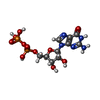 ChemComp-GDP: |
| Source |
|
 Keywords Keywords | TRANSFERASE/SIGNALING PROTEIN / LRRK2 / LRRK2 complex / LRRK2 14-3-3 complex / LRRK2 autoinhibited / TRANSFERASE / TRANSFERASE-SIGNALING PROTEIN complex |


 homo sapiens (human)