[English] 日本語
Yorodumi Papers
- Database of articles cited by EMDB/PDB/SASBDB data -

+
Search query

Keywords
Structure methods
Author
Journal
IF

-
Structure paper

TitleStructure of an LGR dimer, an evolutionary predecessor of glycoprotein hormone receptors.
Journal, issue, pagesNat Commun, Vol. 16, Issue 1, Page 11716, Year 2025
Publish dateNov 28, 2025
AuthorsZhen Gong / Shuobing Chen / Ziao Fu / Brian Kloss / Chi Wang / Jonathan Kim / Oliver B Clarke / Qing R Fan / Wayne A Hendrickson /
PubMed AbstractGlycoprotein hormones (GpHs) produced in the human pituitary act through receptors (GpHRs) in the gonads to support reproduction and in the thyroid for metabolism. GpHs are heterodimeric cystine-knot ...Glycoprotein hormones (GpHs) produced in the human pituitary act through receptors (GpHRs) in the gonads to support reproduction and in the thyroid for metabolism. GpHs are heterodimeric cystine-knot proteins; their receptors bind cognate hormones at an extracellular domain and signal through a transmembrane domain to heterotrimeric G proteins. GpHs and GpHRs have co-evolved from invertebrate counterparts. Structures of the human receptors as isolated for cryogenic electron microscopy (cryo-EM) are all monomeric despite compelling evidence for their functioning as dimers. Here we characterize the homologous receptor from Caenorhabditis elegans. Its biochemical properties are notably similar to those of the thyroid stimulating hormone receptor (TSHR) of humans. Structurally, it is an asymmetric dimer (protomers screw-transformed by 142°/4.1 Å), composed such that only one hormone could bind. This is compatible with the 1:2 asymmetry of negatively cooperative TSH:TSHR complexes and for the transactivation evident from functional complementation of binding-deficient and signaling-deficient GpHRs. By modeling, a symmetrized dimer can bind two hormones as in the 2:2 complexes that support TSHR switches in G-protein usage.
External linksNat Commun / PubMed:41315418 / PubMed Central
MethodsEM (single particle)
Resolution3.79 Å
Structure data

EMDB-43735, PDB-8w1z:
Structure of a LGR dimer from Caenorhabditis elegans in apo state
Method: EM (single particle) / Resolution: 3.79 Å

Chemicals

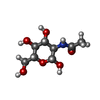
ChemComp-NAG:
2-acetamido-2-deoxy-beta-D-glucopyranose

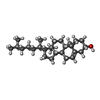
ChemComp-CLR:
CHOLESTEROL

Source
  • caenorhabditis elegans (invertebrata)
KeywordsMEMBRANE PROTEIN / glycoprotein hormones / glycoprotein hormone receptors / leucine-rich-repeat-containing GPCRs (LGRs) / Caenorhabditis elegans / dimer / cryo-EM.

+
About Yorodumi Papers

-
News

-
Feb 9, 2022. New format data for meta-information of EMDB entries

New format data for meta-information of EMDB entries

  • Version 3 of the EMDB header file is now the official format.
  • The previous official version 1.9 will be removed from the archive.

Related info.:EMDB header

External links:wwPDB to switch to version 3 of the EMDB data model

-
Aug 12, 2020. Covid-19 info

Covid-19 info

URL: https://pdbj.org/emnavi/covid19.php

New page: Covid-19 featured information page in EM Navigator.

Related info.:Covid-19 info / Mar 5, 2020. Novel coronavirus structure data

+
Mar 5, 2020. Novel coronavirus structure data

Novel coronavirus structure data

Related info.:Yorodumi Speices / Aug 12, 2020. Covid-19 info

External links:COVID-19 featured content - PDBj / Molecule of the Month (242):Coronavirus Proteases

+
Jan 31, 2019. EMDB accession codes are about to change! (news from PDBe EMDB page)

EMDB accession codes are about to change! (news from PDBe EMDB page)

  • The allocation of 4 digits for EMDB accession codes will soon come to an end. Whilst these codes will remain in use, new EMDB accession codes will include an additional digit and will expand incrementally as the available range of codes is exhausted. The current 4-digit format prefixed with “EMD-” (i.e. EMD-XXXX) will advance to a 5-digit format (i.e. EMD-XXXXX), and so on. It is currently estimated that the 4-digit codes will be depleted around Spring 2019, at which point the 5-digit format will come into force.
  • The EM Navigator/Yorodumi systems omit the EMD- prefix.

Related info.:Q: What is EMD? / ID/Accession-code notation in Yorodumi/EM Navigator

External links:EMDB Accession Codes are Changing Soon! / Contact to PDBj

+
Jul 12, 2017. Major update of PDB

Major update of PDB

  • wwPDB released updated PDB data conforming to the new PDBx/mmCIF dictionary.
  • This is a major update changing the version number from 4 to 5, and with Remediation, in which all the entries are updated.
  • In this update, many items about electron microscopy experimental information are reorganized (e.g. em_software).
  • Now, EM Navigator and Yorodumi are based on the updated data.

External links:wwPDB Remediation / Enriched Model Files Conforming to OneDep Data Standards Now Available in the PDB FTP Archive

-
Yorodumi Papers

Database of articles cited by EMDB/PDB/SASBDB data

  • Database of articles cited by EMDB, PDB, and SASBDB entries
  • Using PubMed data

Related info.:EMDB / PDB / SASBDB / Yorodumi / EMN Papers / Changes in new EM Navigator and Yorodumi

Read more